

Commercial Air Source Heat Pump Installation London: The 2026 Business Guide
- 1 day ago
- 12 min read
What if your London office could slash its operational carbon footprint while actually reclaiming 100% of the installation costs through your tax return? With the 2026 energy standards now in full effect, commercial air source heat pump installation London has moved from a green luxury to a strategic necessity for businesses facing rising energy levies.
It's understandable if you're feeling the pressure of these new requirements. You likely recognise the importance of sustainability, yet the labyrinth of London borough planning permissions and the strict MCS 020a noise standards requiring levels below 37 dB(A) can make the technical hurdles feel overwhelming. You need a solution that guarantees reliable, year-round climate control without compromising your property's integrity or your neighbours' peace.
This 2026 guide simplifies the transition for you. We'll explore how to navigate local regulations, leverage permanent full expensing capital allowances, and ensure your system is perfectly sized for your specific London building stock. By the end, you'll have a clear roadmap to lower operational costs and total compliance with UK Net Zero targets.
Table of Contents
Decarbonising London’s Business Landscape with Heat Pumps
How can your business move away from the volatility of fossil fuels without disrupting daily operations? Investing in a commercial air source heat pump installation London offers a dependable, low-carbon alternative to traditional gas boilers. These systems extract thermal energy from the external air and upgrade it to provide consistent heating and hot water. Because they move heat rather than generating it through combustion, they significantly reduce your carbon footprint. It’s a logical step for meeting ambitious Corporate Social Responsibility (CSR) goals whilst ensuring long-term energy security. In a market where gas prices remain unpredictable, switching to an electric-based system provides stability that traditional heating simply cannot match.
Reduced Carbon Footprint: Direct transition from fossil fuels to renewable-ready electricity.
Price Stability: Decoupling your heating costs from the volatile global gas market.
Regulatory Compliance: Meeting the 2026 standards before penalties are introduced.
Why 2026 is the Turning Point for London Commercial Heating
This year marks a definitive shift in how London’s commercial properties are heated and managed. The Future Buildings Standard now places rigorous demands on energy performance, effectively phasing out fossil fuel heating in new developments and setting a clear trajectory for retrofitting existing stock. Alongside this, the Clean Heat Market Mechanism has influenced the market by requiring manufacturers to meet specific heat pump sales quotas. Adopting this technology is now a strategic necessity for maintaining property value. Compliance is key; a commercial air source heat pump installation London is essential for ensuring your building remains an attractive, high-value asset in a decarbonising economy.
Energy Efficiency and the Commercial Bottom Line
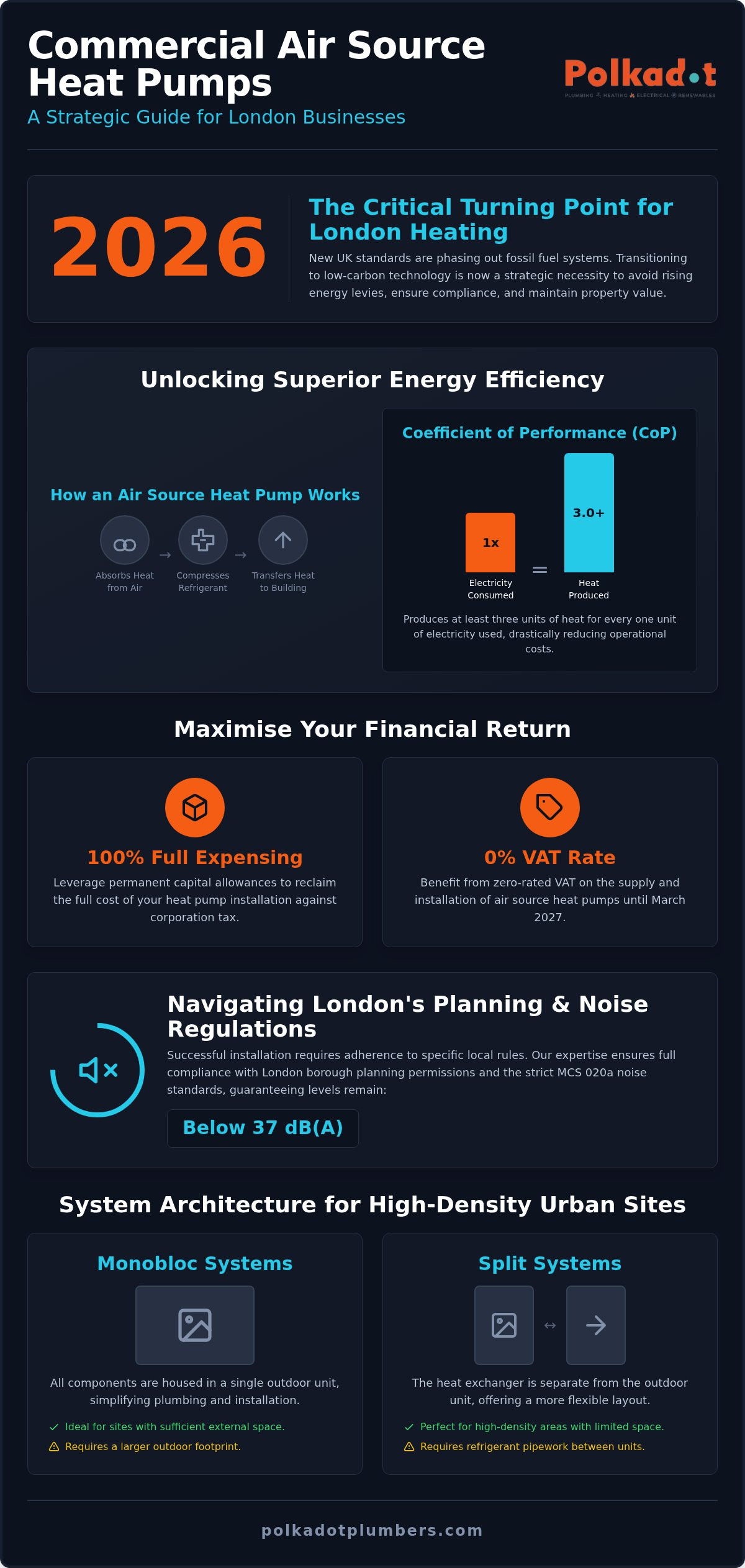
The primary financial driver for this transition is the Coefficient of Performance (CoP). A well-designed system typically delivers a CoP of 3.0 or higher, meaning it produces three units of heat for every unit of electricity consumed. This high level of efficiency reduces your overall reliance on the grid and lowers your exposure to rising carbon levies. From a landlord’s perspective, the impact on Energy Performance Certificates (EPC) is equally critical. As minimum energy efficiency standards become more stringent, a higher EPC rating is vital for lease viability. Secure your building's future by understanding the Technical Architecture of a Commercial ASHP System and optimising these efficiency gains to suit the London rental market.
Technical Architecture of a Commercial ASHP System
How does a commercial air source heat pump installation London actually function within a busy urban environment? At its core, the system relies on a highly efficient refrigeration cycle. Four primary components work in unison: the evaporator absorbs heat from the external air; the compressor increases the pressure and temperature of the refrigerant; the condenser transfers this heat to your building's water circuit; and the expansion valve resets the process. It's a closed-loop system that provides a steady, reliable flow of thermal energy. For larger sites such as hotels or multi-storey offices, we often recommend cascade systems. These involve linking multiple units together, allowing them to work in sequence to meet high demand whilst maintaining peak efficiency during quieter periods.
Space is a premium in the capital, so choosing between monobloc and split systems is a critical decision. Monobloc units house all components in a single outdoor casing, which simplifies the plumbing but requires more external footprint. Split systems separate the heat exchanger, allowing for a more flexible layout in high-density areas. Regardless of the configuration, these systems integrate seamlessly with existing emitters. Whilst underfloor heating is the most efficient partner, modern heat pumps can effectively serve traditional radiators, provided they are correctly sized for lower flow temperatures. If you're unsure which setup fits your plant room, our team provides expert project management to guide you through the options.
Sizing and Design for London’s Unique Building Stock
You can't rely on guesswork when transitioning away from gas. A room-by-room heat loss survey is the only way to avoid the common pitfall of undersizing. Victorian conversions, with their solid brick walls, require a different approach compared to modern glass-fronted offices that may deal with significant solar gain. We also consider how your heating works alongside London air conditioning systems to create a unified climate control strategy. Precise modelling ensures your system remains quiet and compliant, especially when Navigating London’s Planning and Noise Regulations for units placed near neighbouring properties.
Integrating ASHP with Solar and Battery Storage
To truly minimise operational costs, many businesses are now pairing their heat pumps with London solar panels. By using self-generated electricity to power the compressor, you can achieve near-zero running costs during daylight hours. Thermal stores also play a vital role here; they act as a "battery" for hot water, storing energy during off-peak times to meet the heavy demands of commercial kitchens or gym facilities. When integrated with a Smart Building Management System (BMS), the entire architecture becomes a self-optimising asset that reacts to occupancy levels and external weather patterns in real time.
Navigating London’s Planning and Noise Regulations
Does your business need full planning permission for a heat pump? In many cases, a commercial air source heat pump installation London falls under Permitted Development (PD) rights, meaning you can avoid a lengthy application process. However, these rights come with strict limitations regarding the size of the unit and its distance from property boundaries. If your building is listed or situated within one of London’s many Conservation Areas, such as those in Westminster or Camden, the rules change significantly. You'll likely need to demonstrate that the unit doesn't negatively impact the historic character of the streetscape. For those managing heritage assets, following the official guidance for installations in historic buildings is essential for a successful outcome.
Managing the visual impact on London’s iconic skyline is a priority for local councils. We often utilise existing architectural features, such as parapet walls or recessed roof sections, to shield equipment from view. This methodical approach ensures your transition to sustainable heating respects the aesthetic value of your property whilst meeting all local authority requirements. Our team handles the technical documentation, ensuring that every detail of the proposed site plan is transparent and compliant with borough-specific mandates.
The Noise Factor: Meeting Borough-Specific Standards
Noise compliance is the primary hurdle for London commercial installations because of the extreme proximity between business premises and residential windows. To qualify for permitted development, the sound level at the assessment position of the nearest noise-sensitive property must be 37 dB(A) or lower, as dictated by the MCS 020a standard. We conduct rigorous acoustic assessments to model how sound will travel across your site. If the initial readings are too high, we implement mitigation strategies such as:
Acoustic Enclosures: Bespoke weather-proof housings that dampen sound without restricting airflow.
Anti-Vibration Mounts: Specialised footings that prevent noise from travelling through the building’s structure.
Strategic Orientation: Turning the fan discharge away from neighbouring balconies or bedrooms.
Space Constraints: Rooftop and Courtyard Solutions
Finding a footprint for a commercial-grade unit in the City or the West End requires creative engineering. Rooftops are often the only viable location, but placing heavy machinery on older London roofing requires a careful structural survey to confirm the deck can support the load. We also design bespoke mounting frames for narrow internal courtyards or alleyways. The key is ensuring the unit has enough "breathing room" to draw in air; without proper clearance, the system's efficiency drops, and operational costs rise. Our designs prioritise both mechanical performance and building integrity, ensuring a stress-free installation even in the tightest urban spaces.
Calculating ROI and Accessing Government Funding in 2026
What does the financial return on a commercial air source heat pump installation London look like over a fifteen-year period? Whilst the initial capital expenditure is higher than a traditional gas system, the long-term savings are significant. As carbon taxes on fossil fuels continue to rise, the operational cost of gas-based heating becomes increasingly difficult to justify. When you factor in the high efficiency of a heat pump, which can deliver three to four units of heat for every unit of electricity, the lifecycle costs often tip in favour of renewables within the first six to eight years. It's a strategic move that protects your business from the volatility of the global energy market.
The tax landscape in 2026 offers powerful incentives for businesses to make the switch. Under the permanent "Full Expensing" capital allowance, companies subject to UK corporation tax can claim a 100% first-year deduction on the cost of new qualifying plant and machinery. This includes heat pump systems. There's also the benefit of 0% VAT on energy-saving materials, which is currently set to remain in place until March 2027. These mechanisms effectively reduce the net cost of your project, allowing you to reinvest that capital back into your core business operations.
The 2026 Grant Landscape for London Businesses
For small and medium-sized commercial properties, the Boiler Upgrade Scheme (BUS) remains a vital source of funding. As of late 2026, eligible businesses can access a grant of £7,500 toward their installation. If your property is off the gas grid, a temporary increased grant of £9,000 is available for installations completed before 31st March 2027. Larger public sector organisations or those in specific London boroughs may also qualify for the Public Sector Decarbonisation Scheme (PSDS) or local "Green Business" incentives. To ensure you don't miss out on these opportunities, you should contact our specialist team for a detailed funding assessment.
Maintenance and Longevity: Protecting Your Investment
A well-maintained commercial heat pump typically has an operational lifespan of 15 to 20 years. This longevity outperforms many traditional boiler installations in London, which often require major overhauls much sooner. Annual servicing is essential to keep your system running at peak efficiency and to maintain manufacturer warranties. Because these systems have fewer moving parts than combustion-based boilers, the long-term maintenance schedule is often simpler and more predictable. Regular checks on refrigerant levels and evaporator cleanliness ensure your Coefficient of Performance (CoP) remains high, safeguarding your return on investment for decades to come.
Choosing Polkadot for Your London Commercial Installation
Why should your business trust Polkadot with such a critical infrastructure upgrade? We understand that a commercial air source heat pump installation London is never just a "plug-and-play" exercise. It requires a deep appreciation for the capital's unique architectural fabric, from the heritage constraints of Mayfair to the modern logistical demands of the City. We position ourselves as the trustworthy guardians of your property. Our team doesn't just install equipment; we protect the structural and aesthetic integrity of your building whilst ensuring it meets the highest contemporary energy standards. This methodical approach is designed to alleviate the typical stress associated with complex mechanical and electrical transitions.
Our end-to-end service is built on professional integrity and technical precision. We manage every stage of the journey, starting with a comprehensive site survey and moving through to system design, DNO (Distribution Network Operator) notification, and final commissioning. You won't have to juggle multiple contractors or worry about missing regulatory deadlines. We handle the paperwork and the technical hurdles, providing a stabilizing force that allows you to focus on your core business operations. Our aftercare packages ensure your system remains a high-performing asset long after the initial installation is complete.
Our Seamless Diagnostic and Installation Process
How do we ensure your business continues to run smoothly during the transition? We utilise a multi-trade team that combines expertise in electrical installations, plumbing, and renewable technology. This integrated approach allows us to work efficiently and minimise downtime. We follow a logical, diagnostic rhythm: identifying your specific heat load requirements, explaining the best technical path, and executing the plan with minimal disruption. You'll receive transparent communication at every step. We believe that professional standards are best demonstrated through a clean, organised site and a commitment to delivering on our promises without unexpected delays or hidden costs.
Integrated Expertise: Seamless coordination between our electrical and plumbing specialists.
Business Continuity: Phased installation schedules to keep your premises operational.
Transparent Reporting: Clear updates on project milestones and regulatory compliance.
Ready to Future-Proof Your London Commercial Property?
The transition to sustainable heating is a significant step, but it doesn't have to be a daunting one. By choosing a dependable London team, you gain the peace of mind that comes from working with seasoned innovators who value your comfort and convenience. We invite you to take the first step toward energy security and lower operational costs by arranging a professional feasibility survey. Our experts will assess your building's unique requirements and provide a clear, honest roadmap for your commercial air source heat pump installation London. Contact Polkadot for a professional commercial heat pump consultation today and secure your property’s place in a low-carbon future.
Secure Your Business’s Energy Future in London
Transitioning your property to sustainable heating is no longer just an environmental choice; it’s a strategic move to safeguard your business against volatile energy markets and strict carbon levies. By integrating a commercial air source heat pump installation London, you ensure long-term compliance with 2026 standards whilst reclaiming significant capital through 100% full expensing tax allowances. Navigating the capital’s complex planning and noise regulations requires a methodical approach, but the result is a high-performing, quiet system that enhances your building’s lease viability and operational efficiency.
As MCS Certified Installers and London Regulatory Specialists, Polkadot provides the professional integrity and technical precision your project deserves. We manage the entire process, from initial feasibility modelling to DNO notifications, and we provide comprehensive 2-year aftercare support for total peace of mind. Are you ready to future-proof your commercial site? Book a Commercial ASHP Site Survey with Polkadot today. Our team is here to ensure your transition to renewable energy is dependable, transparent, and entirely stress-free.
Frequently Asked Questions
Do I need planning permission for a commercial air source heat pump in London?
Planning permission is typically not required if the installation meets specific Permitted Development criteria. These rules limit the unit's size and its distance from the property boundary. However, London's high density of Conservation Areas and Listed buildings means many sites require a formal application. Our team handles the technical drawings and planning statements to ensure your project complies with local borough mandates, providing a clear path through the approval process.
How much space does a commercial ASHP unit require on my London premises?
Space requirements vary based on your building's specific heat load. A small office might only need a single unit taking up roughly one square metre of floor space. Larger hotels or warehouses often require a cascade of units, which we strategically place on flat roofs or in recessed courtyards. It's vital to maintain adequate breathing room for airflow. Our design process identifies the most compact configuration that doesn't compromise system efficiency.
Can a heat pump provide enough hot water for a busy London office or restaurant?
A correctly sized system provides consistent, high-volume hot water for demanding commercial environments. For restaurants or gyms with peak usage periods, we integrate large-scale thermal stores that act as energy batteries. These cylinders hold hot water ready for immediate use, ensuring your business never experiences a drop in service. By matching the system's capacity to your specific occupancy levels, we guarantee reliable, year-round performance for your business operations.
What is the typical ROI for a commercial heat pump installation in 2026?
Most businesses see a return on investment within six to eight years. This timeframe is driven by the high Coefficient of Performance and the reduction in carbon levies associated with fossil fuels. When you include the permanent 100% full expensing capital allowance available in 2026, the net cost of a commercial air source heat pump installation London drops significantly. It’s a strategic long-term asset that lowers your operational overheads almost immediately.
How noisy are commercial air source heat pumps for neighbouring properties?
Modern commercial units are engineered for quiet operation, typically producing a low hum rather than a loud drone. To meet strict London noise standards, we conduct detailed acoustic modelling before any work begins. If a unit is situated near residential windows, we can install bespoke acoustic enclosures or anti-vibration mounts to dampen sound further. Our goal is to ensure your heating upgrade doesn't cause any friction with your neighbours.
Can I install a heat pump in a Listed building or Conservation Area in London?
You can install heat pumps in historic properties, provided the design respects the building's heritage. We specialise in discreet placements that hide units from public view, such as behind parapets or within internal lightwells. Working closely with local conservation officers, we follow official guidance to secure the necessary consents. Our experience with London's older building stock ensures your sustainable upgrade doesn't compromise the architectural integrity or the value of your property.
What happens to my existing gas boiler during the ASHP installation?
Decommissioning your existing boiler is a common choice for businesses looking to maximise carbon savings and free up plant room space. Alternatively, you might opt for a bivalent setup, where the gas boiler remains as a secondary backup for extreme peak demands. We assess your current plumbing and electrical infrastructure to recommend the most dependable path. Our goal is to ensure a seamless transition that maintains your building’s long-term heating integrity.
Are there specific grants for London businesses installing heat pumps in 2026?
Small and medium enterprises can access the £7,500 Boiler Upgrade Scheme grant. Beyond direct grants, the most significant financial support comes through the tax system, including the 0% VAT rate on energy-saving materials and full expensing capital allowances. Some London boroughs also offer local Green Business incentives or low-interest loans for decarbonisation projects. We help you navigate these funding streams to ensure you're accessing every available financial benefit for your installation.


Comments