

How Does a Combi Boiler Work? A Complete Guide to Modern Heating (2026)
- 2 days ago
- 13 min read
Why does a device the size of a kitchen cupboard manage to outperform the massive, clunky water tanks gathering dust in many London lofts? It's understandable if you feel a bit skeptical about how such a compact unit provides enough heat for your entire home whilst delivering hot water to your taps instantly. When you're faced with technical terms like heat exchangers and diverter valves, it's easy to feel overwhelmed by the jargon. You simply want to know how does a combi boiler work without needing an engineering degree to decipher the answer.
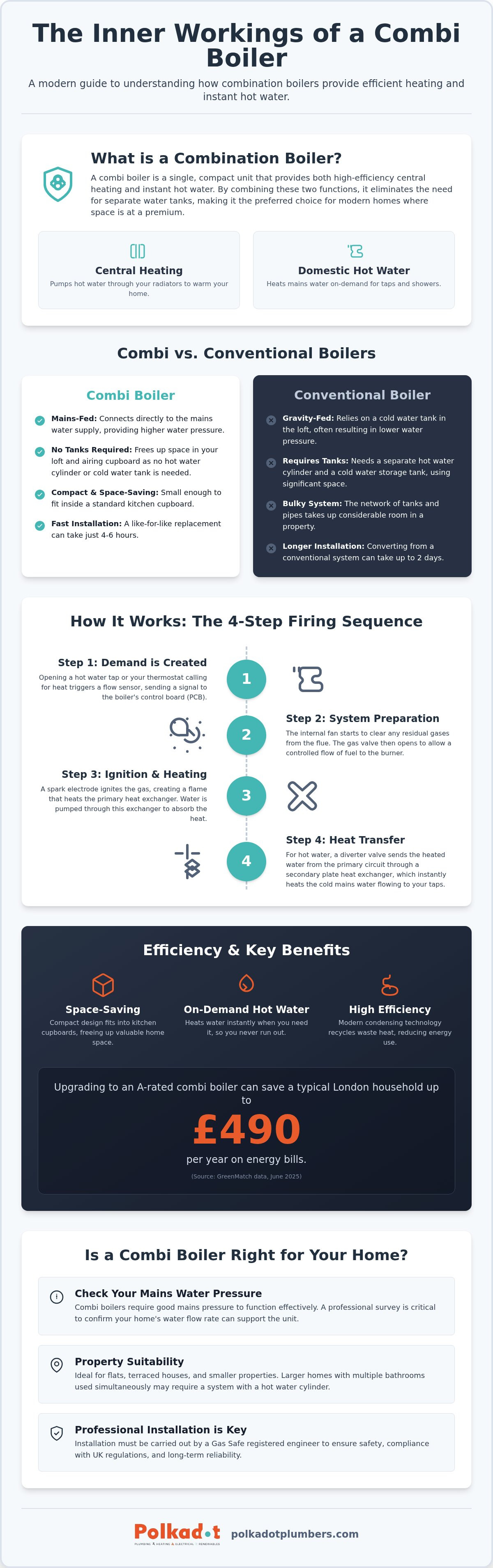
This guide strips away the complexity to reveal the internal mechanics of modern combination boilers, addressing your concerns about water pressure and installation costs. We'll explore the precision engineering inside the box, help you decide if it's the right fit for your property, and show you how to maintain the system for long-term reliability. According to GreenMatch data from June 2025, upgrading to an A-rated model can save a typical London household up to £490 per year, providing both efficiency and professional peace of mind.
Table of Contents
Understanding the Basics: What is a Combi Boiler?
A combination boiler, or "combi" as it's commonly known, is a high-efficiency water heater and central heating unit combined into a single, compact chassis. For many homeowners, it represents the gold standard of modern heating because it simplifies the entire plumbing layout of a property. Instead of relying on a network of tanks, cylinders, and pipes, the combi handles everything internally. It takes cold water directly from the mains and heats it only when you turn on a tap or your thermostat calls for warmth.
This "on-demand" approach has made combi boilers the most popular choice for property refurbishments across the UK. They offer a streamlined solution that fits neatly into a kitchen cupboard, making them ideal for urban living where every square foot of space is valuable. To truly understand how does a combi boiler work, you have to look at its ability to switch between functions seamlessly, ensuring your home stays warm whilst providing hot water the moment you need it.
The "Combination" Concept Explained
The name "combination" refers to the boiler's dual-purpose nature. It manages two distinct circuits within one box: the central heating circuit, which pumps hot water through your radiators, and the domestic hot water circuit, which feeds your taps and showers. Traditional systems keep these functions separate, often requiring a large copper cylinder to store pre-heated water. The combi replaces this "stored" energy model with tankless water heating technology, producing energy instantaneously.
This shift is particularly beneficial for London flats and smaller terraced houses. By removing the need for a hot water cylinder, you can reclaim your airing cupboard for storage. Because the system is sealed and pressurised, it eliminates the risk of frozen pipes in the loft or stagnant water in old storage tanks. It's a cleaner, more efficient way to manage your home's climate.
Combi vs Conventional: Key Differences
The most significant difference between a combi and a conventional boiler is how they receive water. Conventional systems are gravity-fed, meaning they rely on the weight of water from a tank in the loft to create pressure. In contrast, a combi is mains-fed. This usually results in much stronger water pressure at the tap, which is why many people prefer them for a more invigorating shower experience. Understanding how does a combi boiler work is the first step in modernising your home's efficiency.
When you're organising a renovation, a combi is typically faster to install. A like-for-like replacement often takes between 4 and 6 hours, whereas converting from an older system may take up to 2 days. If you are considering a boiler installation in London, the primary check is whether your local mains pressure can support the unit's requirements. Once that's confirmed, the transition to a combi often feels like a major upgrade in both performance and property value.
The Mechanics of Heat: How a Combi Boiler Works Internally
To understand how does a combi boiler work, you have to look past the casing and into a world of precision timing. The process is entirely reactive. It stays in a standby state until a sensor detects a drop in temperature from your thermostat or the movement of water when you turn on a tap. Once triggered, the gas burner ignites, creating a controlled flame within the primary heat exchanger. A pump then circulates water through this exchanger to absorb the thermal energy.
Modern units are significantly more efficient than older models because they use condensing technology. This captures latent heat from the flue gases that would otherwise be wasted. By the time the air leaves the flue, it has been cooled so much that the water vapour turns back into liquid, recycling every possible bit of warmth. This process ensures that 2026 models maintain the high efficiency standards required by UK regulations.
The Firing Sequence: From Tap to Flame
The internal "brain" of the boiler follows a strict protocol to ensure safety and efficiency. If you've ever wondered about the technical definition of what a combination boiler is, it's best defined by this four-step firing sequence:
Step 1: Opening a hot tap triggers a flow sensor, sending a signal to the printed circuit board (PCB).
Step 2: The internal fan starts up to clear the flue of any residual gases, and the gas valve opens.
Step 3: A spark electrode ignites the burner, which begins heating the primary water circuit.
Step 4: This heat is transferred through a secondary plate heat exchanger to the fresh mains water heading to your tap.
The Diverter Valve: The Traffic Warden of Your Boiler
The diverter valve is perhaps the most critical moving part inside the unit. It acts as a traffic warden, directing the flow of heated water to either your radiators or your hot water taps. In a combi system, hot water always takes priority. If you're running a bath whilst the heating is on, the diverter valve will temporarily close the circuit to the radiators to ensure your bath water stays hot.
Because this valve moves every time you use a tap, it's a common point of mechanical wear. If you find your radiators getting hot whilst you're trying to run a cold tap, or if your shower is only lukewarm when the heating is active, the valve might be sticking. If you notice these symptoms, a professional Heating expert can help diagnose the issue before it leads to a total breakdown.
The Role of the Heat Exchanger
Most modern combis use two heat exchangers. The primary exchanger heats the water for your central heating. The secondary exchanger, often called the "plate" exchanger, is where the magic happens for your taps. It allows heat to pass from the primary circuit to the fresh mains water without the two ever mixing. These components are usually made from high-grade stainless steel or aluminium to resist corrosion. However, they can still be affected by limescale or sludge. This is why we always recommend a magnetic filter to catch debris before it can clog these narrow plates.
Is a Combi Right for Your London Home?
Whilst combi boilers are the most popular choice in the UK, they aren't a universal solution for every London property. Their compact design makes them perfect for homes with one or two bathrooms where space is at a premium. However, because you've learned how does a combi boiler work by heating water directly from the mains, you'll realise that the performance of your shower is entirely dependent on the strength of the water coming into your building. If your property is a large Victorian house with multiple bathrooms, you need to consider if a single unit can meet your peak demand.
Choosing the right boiler involves more than just picking a high-energy rating. It's about matching the unit's output to your lifestyle and your property's physical constraints. In many London refurbishments, the goal is to reclaim space, but this shouldn't come at the cost of a weak shower or lukewarm taps. We always suggest looking at your household's daily routine before deciding which system to install.
Mains Pressure and the London Context
Thames Water pressure can vary significantly between boroughs, and even between different floors in a converted Victorian terrace. If your mains pressure is low, a combi boiler will struggle to provide a powerful flow to your taps. We always recommend a professional Plumbing Survey to test your flow rate before you commit to a purchase. In many older London homes, the internal pipework consists of narrow copper or even lead pipes that aren't compatible with high-flow modern units. Checking these details early prevents the frustration of a weak shower after a significant investment.
Combi vs System Boilers: A Comparison
If you're debating between a combi and a system boiler, the decision usually rests on three main factors:
Hot Water Delivery: A combi provides unlimited hot water on demand, whilst a system boiler relies on a stored volume in a cylinder. If the cylinder runs dry, you have to wait for it to reheat.
Simultaneous Use: If your home has three or more bathrooms, a system boiler allows multiple people to shower at once without a drop in pressure. A combi typically prioritises one outlet at a time.
Installation and Space: A combi is faster to organise and frees up your airing cupboard. A system boiler requires more complex pipework and dedicated space for a hot water tank, which isn't always available in London flats.
Understanding how does a combi boiler work helps you see that whilst it's incredibly efficient, it relies on a strong "feed" from the street. If your home has the right infrastructure, it's an unbeatable solution for modern living.
Maximising Performance: Efficiency and Common Operational Issues
A modern A-rated combi boiler is designed to operate at peak efficiency, often reaching levels of 94% or higher. This high performance is achieved through condensing technology, which recycles the heat from exhaust gases that would otherwise escape through the flue. When you understand how does a combi boiler work in this "recycling" mode, it's clear why they are so much cheaper to run than older, G-rated models. To maintain these savings, annual servicing is essential. It isn't just about safety; it's a legal requirement to keep your manufacturer's warranty valid and ensure the internal components remain free from debris.
Modulation and Smart Controls
One of the most impressive features of a modern heating system is its ability to modulate. In the past, boilers operated like a simple light switch: they were either fully on or completely off. Modern units act more like a dimmer switch. They can "dim" their flame to a lower output once your home reaches the desired temperature. This prevents the system from "cycling" on and off, which wastes gas and puts unnecessary strain on the components. Understanding how does a combi boiler work alongside these smart controls helps you get the most out of your investment.
Smart thermostats like Nest or Tado take this further by using Load Compensation. They communicate with the boiler to tell it exactly how much heat is needed to reach the target temperature. Some systems even use Weather Compensation, adjusting the internal firing sequence based on the temperature outside. These small adjustments significantly reduce your carbon footprint and keep your monthly energy bills manageable.
Troubleshooting "Working" Issues
Even the best systems can encounter minor operational hurdles. The most common query we receive from London homeowners is why their boiler losing pressure. For a combi to function correctly, the internal water circuit must be pressurised. You can check this on the pressure gauge, usually located on the front of the unit. The "sweet spot" is typically between 1.0 and 1.5 bar when the system is cold. If the needle drops below 0.5 bar, the boiler will "lock out" as a safety precaution to prevent damage.
Living in London also means dealing with hard water. Over time, limescale can build up inside the primary heat exchanger, leading to a phenomenon known as "kettling." This sounds like a whistling kettle and occurs when water flow is restricted, causing it to overheat and bubble. If you hear these noises or notice your pressure fluctuating, it's time to speak with a professional about a system flush. Our team specialises in Heating maintenance to ensure your system remains as quiet and efficient as the day it was installed.
Professional Installation and Care with Polkadot
Investing in a new heating system is a major decision for any homeowner. In London, this process is often complicated by the architectural diversity of our properties, from draughty Victorian terraces to compact modern apartments. A successful boiler installation in London requires an expert who doesn't just see a box on a wall, but understands the intricate relationship between the unit and the property's historical pipework. At Polkadot, we prioritise professional integrity and transparent communication, ensuring you feel confident throughout the entire transition.
Our team specialises in minimising the stress typically associated with home maintenance. We organise every stage of the process to fit around your daily routine, from the initial diagnostic visit to the final Gas Safe certification. By choosing a local, dependable team, you gain the peace of mind that comes from knowing your property is in the hands of seasoned professionals who value your comfort as much as you do.
The Importance of a Professional Survey
We don't believe in "one-size-fits-all" solutions. Every project begins with a comprehensive survey to assess your home's unique requirements. Whilst you now understand how does a combi boiler work in principle, our role is to ensure it works perfectly in practice. This involves testing your mains water pressure and flow rate to guarantee the unit can deliver the performance you expect. We also examine your gas supply pipes; modern, high-power combis often require larger pipe diameters than the old systems they replace.
Location is another critical factor we consider. We identify the most efficient position for your new boiler to maximise your living space whilst ensuring strict adherence to current 2026 flue safety regulations. This methodical approach prevents technical failures and ensures your system operates at its peak efficiency from day one. Our experts can explain exactly how does a combi boiler work in the context of your specific floor plan during our visit.
Long-term Reliability and Maintenance
Our commitment to your home doesn't end once the tools are packed away. To protect your investment and maintain the manufacturer's warranty, we help you set up a regular annual service schedule. This proactive care is the best way to catch minor wear and tear before it becomes a costly repair. It also ensures your boiler continues to run as safely and efficiently as possible, keeping your energy bills low and your carbon footprint small.
We pride ourselves on being a stabilising force for London homeowners, offering clear directions and reliable solutions for all your property maintenance needs. If you're ready to upgrade to a more efficient, dependable heating system, we're here to guide you through every step. Contact Polkadot for a dependable boiler survey today.
Secure Your Home’s Comfort for the Future
Transitioning to a combination boiler is one of the most effective ways to streamline your property’s plumbing whilst reducing your annual energy expenditure. By eliminating bulky tanks and heating water only when it’s needed, you reclaim valuable space and enjoy consistent pressure at every tap. Understanding how does a combi boiler work is the first step toward a more efficient, modern household; however, the success of the system depends on a professional assessment of your London property’s specific water pressure and infrastructure.
Our team of Gas Safe Registered Engineers and London Emergency Plumbing Specialists is here to ensure your installation is seamless and stress-free. We provide a comprehensive 12-month workmanship guarantee on every project, giving you the peace of mind that your heating is in expert hands. If you’re ready to upgrade your home’s performance and reliability, Book a Dependable Boiler Survey with Polkadot London today. We look forward to helping you create a warmer, more manageable home environment.
Frequently Asked Questions
Do I need a cold water tank with a combi boiler?
No, you don't need a cold water storage tank in your loft or a hot water cylinder in the airing cupboard. A combi boiler takes its water supply directly from the mains. This specific setup frees up significant space in your home, which is why they are a favourite for London refurbishments. Because the system is sealed and pressurised, it also removes the risk of a tank overflowing or freezing during a cold winter.
Why does my combi boiler take a long time to get hot water to the tap?
The delay is usually caused by the physical distance between the boiler and your tap. When you turn on the water, the boiler must first ignite and heat the internal heat exchanger. It then has to push the cold water already sitting in the pipes out before the hot water reaches you. If your tap is far away, such as on a different floor, this process naturally takes longer.
Can I have a power shower with a combi boiler?
No, power showers aren't compatible with combi boilers. Power showers require a pump to draw water from a storage tank, but a combi is fed directly by the mains. However, because combi boilers deliver water at mains pressure, you usually won't need a power shower anyway. A high-quality thermostatic mixer shower will typically provide a powerful and consistent flow, provided your local London mains pressure is strong enough.
What happens if my combi boiler loses pressure?
If your boiler loses pressure, it will likely display a fault code and stop working as a safety precaution. This lock out prevents the unit from operating without enough water, which could damage the internal components. You can usually resolve this by using the filling loop to top up the system to the recommended 1.0 to 1.5 bar. If the pressure continues to drop, it might indicate a small leak or a faulty expansion vessel.
How long should a modern combi boiler last?
A well-maintained modern combi boiler should typically last between 10 and 15 years. Longevity depends heavily on the quality of the initial installation and whether you keep up with annual servicing. In hard water areas like London, fitting a scale reducer and a magnetic filter is essential. These additions protect the heat exchanger from debris and limescale, ensuring the unit remains efficient throughout its entire working life.
Can a combi boiler run two showers at the same time?
Most standard combi boilers struggle to run two showers simultaneously. Because the boiler must divide its hot water output between two outlets, you'll likely notice a significant drop in flow. Whilst some high-output models can handle two showers, success depends entirely on your mains water pressure. For larger households with high demand, a system boiler is often a more dependable choice.
Is a combi boiler more expensive to run than a regular boiler?
No, a combi is typically cheaper to run because it only heats the water you actually use. Regular boilers waste energy by keeping a large cylinder of water hot, even when you don't need it. By understanding how does a combi boiler work on an instantaneous basis, you can see why they are more efficient. Modern A-rated models achieve over 90% efficiency, which can lead to substantial savings on your annual gas bills.
What size combi boiler do I need for a three-bedroom house?
For a typical three-bedroom house with one bathroom and an ensuite, a boiler with an output of 28kW to 34kW is usually sufficient. The size in this context refers to the hot water delivery rate rather than the physical dimensions of the box. When researching how does a combi boiler work for your specific property, it's vital to choose a unit that meets your peak demand without being oversized for your heating needs.


Comments