
Radiator Cold at the Bottom: Restore Heating Efficiency
What if that stubborn chill in your living room has nothing to do with your boiler's power and everything to do with what is hiding inside your pipes? It's incredibly frustrating to watch your heating bills climb whilst your radiators remain stone cold at the base, leaving you searching for a radiator cold at bottom fix that actually works. You have likely tried turning up the thermostat, only to find the house stays drafty and your anxiety about potential boiler damage grows. We understand that you just want a warm home and don't need the stress of unexpected technical failures.
The good news is that restoring your comfort is often more manageable than you might fear. This guide will help you discover why these cold spots occur and provide the step-by-step methods needed to clear out sludge build-up and improve your heating efficiency. We will walk you through the diagnostic process, explain the importance of British Standard maintenance, and clarify exactly when you should call a London heating engineer to ensure your system remains reliable throughout the winter months.
Table of Contents
Understanding Why Radiators Stay Cold at the Bottom
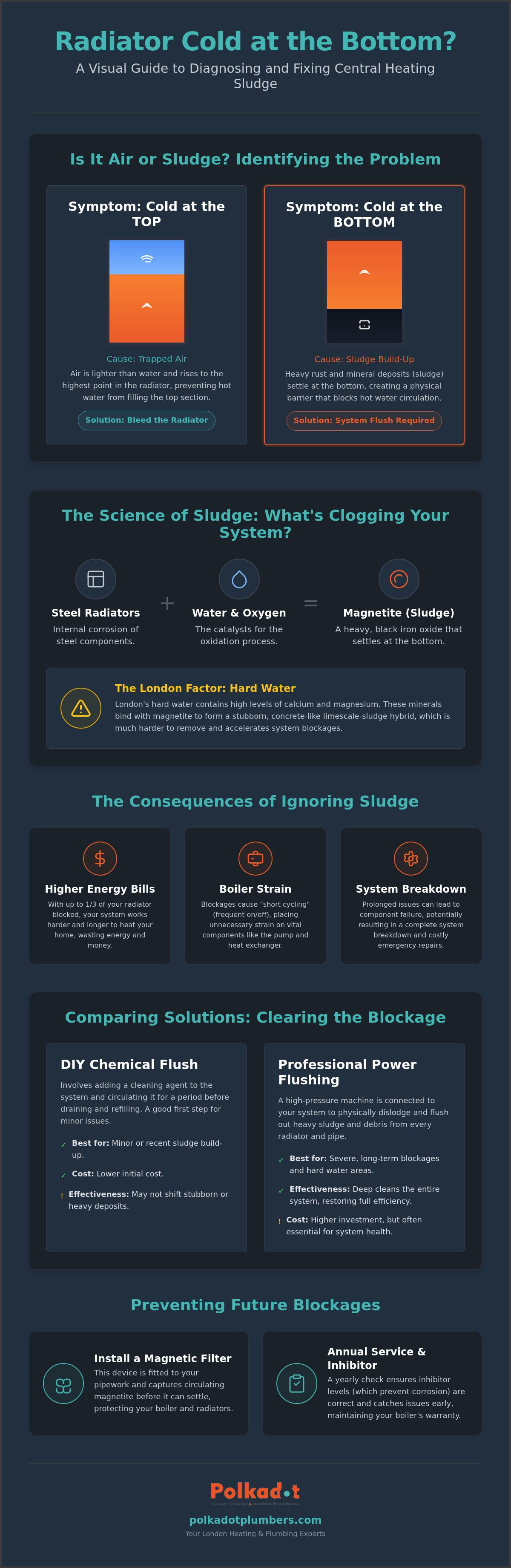
Why is the top of your radiator scorching whilst the bottom feels like a block of ice? This is the classic symptom of a system that needs a radiator cold at bottom fix. A healthy radiator should emit heat evenly across its entire surface; when it doesn't, it usually means something is physically blocking the flow of hot water. Central heating sludge is a mixture of rust and minerals. This heavy, black substance is primarily composed of magnetite, which is a byproduct of internal corrosion within your central heating system. Because these particles are denser than water, gravity causes them to settle in the lowest parts of the system, eventually forming a thick, mud-like barrier that prevents hot water from circulating through the bottom of the panel.
The Difference Between Air and Sludge Blockages
It's a common mistake to assume that every cold radiator just needs bleeding. If your radiator is cold at the top but warm at the bottom, air is trapped and a simple bleed will likely solve the problem. However, if the base is cold, bleeding won't help because air naturally rises to the highest point. You can perform a quick diagnostic check by feeling the bottom of multiple radiators throughout your home. If several units share the same cold base, you're likely dealing with a system-wide sludge issue rather than an isolated air pocket. This blockage often causes the boiler to "short cycle," which means it switches off prematurely because the water returns to the boiler still hot, even though your rooms remain chilly. This constant on-and-off behaviour wastes significant energy and places unnecessary strain on internal components.
How Uneven Heating Affects Your Energy Bills
The physics of heat transfer is simple; if the bottom third of your radiator is blocked by sludge, you've effectively lost a third of your heating capacity. To compensate for the lack of warmth, many homeowners turn their thermostats up higher or leave the heating on for longer periods. This doesn't fix the underlying blockage; it just forces your pump to work harder to push water through restricted pipes. This inefficiency shows up directly on your monthly energy bills. Over time, the abrasive nature of magnetite can damage the heat exchanger and the pump. Ignoring these early warning signs often leads to a total system breakdown, potentially forcing an expensive boiler installation London years earlier than expected. Addressing the sludge now is a proactive way to protect your investment and keep your home comfortable.
The Science of Sludge: Why London Hard Water Matters
Inside your heating system, a silent chemical reaction occurs every day. When water and oxygen meet the steel of your radiators, oxidation begins. This process creates iron oxide, commonly known as rust. In older systems, this was a slow decay, but modern high-efficiency boilers are much more sensitive. These boilers use compact heat exchangers with narrow waterways designed to maximise heat transfer. Even a small amount of debris can cause a total blockage, making a professional radiator cold at bottom fix essential to prevent a complete boiler shutdown. Many homeowners are surprised to find their system is failing even when the water looks clear. This is because the heaviest particles don't float; they remain trapped at the lowest points of your radiators.
What is Magnetite and How Does it Form?
Magnetite is the technical name for the black iron oxide sludge that settles in your pipes. It's magnetic, which means it clings to metallic surfaces and tends to congregate in areas with lower flow rates. As it accumulates, it forms a thick "blanket" across the bottom of the radiator. This layer acts as an insulator, preventing the hot water from reaching the metal surface and radiating heat into your room. You might see relatively clear water when you bleed a radiator, but this is deceptive. The heavy sludge stays at the bottom, undisturbed by the minor flow of a bleed valve. Without intervention, this "blanket" grows thicker every winter, slowly choking the system's ability to warm your home.
The London Factor: Hard Water and Heating Efficiency
Living in London presents a unique challenge for your central heating. The capital is a notorious hard water area, meaning the water contains high levels of calcium and magnesium. When heated, these minerals precipitate out as limescale. In your heating system, this limescale doesn't just sit alone; it binds with the magnetite rust to create a particularly stubborn, concrete-like substance. This hybrid blockage is much harder to shift than standard sludge found in other parts of the country. Residents across the South East often find their systems lose efficiency faster than those in soft water regions. Using high-quality chemical inhibitors is vital here to keep these minerals in suspension and prevent them from bonding to your pipework. If your system is already struggling, a professional London heating survey can help identify the extent of the build-up before it causes permanent damage.
Comparing Solutions: DIY Chemical Flushes vs. Professional Power Flushing
Deciding on the right radiator cold at bottom fix depends entirely on the severity of the blockage and the age of your system. There isn't a one-size-fits-all approach to heating maintenance; a minor circulation issue requires a very different strategy than a system choked by years of magnetite build-up. Comprehensive London property maintenance typically includes a diagnostic check of these symptoms to ensure the most cost-effective method is chosen. For homeowners, the choice usually falls between a DIY-friendly chemical flush or a professional power flush.
When is a DIY Chemical Flush Enough?
A chemical flush is essentially a "soft clean" for your central heating. It's most effective for systems less than five years old that are only just beginning to show minor cold spots. The process involves adding a bottle of chemical cleaner into the system, letting it circulate for several days, and then draining and refilling the water. Whilst the cost of the chemical bottles is relatively low, you must factor in the time required to organise the drainage and the risk of not fully clearing the debris. Chemicals are excellent at loosening light sludge; however, they lack the physical force to remove heavy, compacted deposits at the bottom of a radiator panel. If the base of your radiator feels stone cold after a chemical treatment, the blockage is likely too dense for liquid cleaners alone.
The Benefits of a Professional Power Flush
A professional power flush is a high-pressure deep clean that uses a specialised pumping machine. This device connects to your system and scours the internal pipework with high-velocity water and advanced chemicals. It's a mandatory step before any new boiler or air conditioning installation London project to ensure the new components aren't immediately contaminated by old debris. The results are often transformative. Beyond restoring heat to those cold spots, a power flush can lead to fuel savings of up to 15% because the boiler doesn't have to work as hard to reach the desired temperature. It also extends the life of your pump and heat exchanger, providing a long-term return on investment that far outweighs the initial cost. For systems older than ten years, or those with significant cold spots, this is the only reliable way to restore full heating efficiency.
How to Fix a Cold Radiator Bottom: A Homeowner’s Guide
Before you begin any technical work, you must identify whether the issue is isolated or widespread. Turn your heating system on and wait for about 20 minutes to allow the temperature to stabilise. Methodically check every radiator in your home. If only one unit is affected, it's possible that the system is simply "unbalanced," meaning the hot water is taking the path of least resistance and bypassing that specific room. You can often achieve a radiator cold at bottom fix by adjusting the lockshield valve to restrict flow to the hottest radiators, forcing water into the colder ones. If balancing doesn't restore the heat, you're likely facing a physical blockage that requires a more direct intervention.
Step-by-Step: Adding Chemical Cleaner to Your System
A chemical "restorer" or "sludge remover" is the least invasive way to break down internal debris. If you have an open-vented system with a small expansion tank in the loft, you can pour the chemical directly into the tank after draining some water. For sealed systems or combi boilers, you will need to add the cleaner through a radiator. Close both valves, drain a small amount of water from the bleed valve, and use a funnel or a specialised injector tool to introduce the chemical. Once added, turn the heating on and let the cleaner circulate. Most manufacturers recommend leaving these chemicals in for at least 48 hours, but no longer than a week, to ensure they have enough time to loosen the magnetite. After this period, you must drain the entire system and refill it with fresh water and a protective inhibitor to prevent the problem from returning.
Manual Radiator Flushing: What You Need to Know
If chemical cleaners fail to shift the blockage, you might consider a manual flush. This involves physically removing the radiator from the wall to wash it out. You will need adjustable spanners, a radiator key, and plenty of old towels. Be extremely careful; the "black water" inside is highly concentrated magnetite and will permanently stain carpets, floorboards, and furniture. Once the radiator is disconnected, take it outside and attach a garden hose to one end. Flush water through the unit until it runs completely clear. If the water remains murky or the flow seems restricted even after several minutes of hosing, the blockage is likely too solidified for a DIY approach. In these cases, it is safer to stop and contact a professional London heating engineer to prevent further damage to your pipework or boiler pump.
Preventing Future Blockages with Advanced System Protection
Once you have successfully implemented a radiator cold at bottom fix, your priority should shift to ensuring the sludge never returns. Maintaining a clean system is far more cost-effective than repeatedly flushing it. The most vital component in this defensive strategy is the chemical inhibitor. This liquid acts as a protective shield, coating the internal metal surfaces of your radiators and pipes to passivate them against oxidation. However, inhibitors can only do so much if your system is constantly being topped up with fresh, oxygenated water. If you find yourself frequently using the filling loop due to pressure loss, you must find the leak. If the dampness is entering your home from the outside, it may be worth reviewing London roofing services to ensure your property's integrity isn't compromised, as external leaks can often disguise internal plumbing issues.
Why Every London Home Needs a Magnetic Filter
How do you stop metallic debris that has already formed from reaching your boiler? The answer lies in a magnetic system filter. These devices are installed on the return pipework and use a powerful internal magnet to "grab" magnetite particles as they circulate. Instead of settling at the base of your radiators, the sludge is trapped safely inside the filter canister. These devices are now a requirement under the BS 7593:2019 standard for new installations. Beyond protection, they offer a clear diagnostic window into your system's health. During an annual service, an engineer can simply unscrew the canister and remove the captured debris, preventing it from ever causing a blockage. Most major boiler manufacturers now make their warranties conditional on having a filter installed, as it significantly reduces the risk of heat exchanger failure.
The Importance of Annual Central Heating Maintenance
A proactive approach to maintenance is the only way to guarantee long-term efficiency. During a professional service, our engineers don't just check for gas leaks; we also test the concentration of inhibitor levels in your system water. Over time, these chemicals degrade and lose their effectiveness, leaving your radiators vulnerable to rust once again. We look for early warning signs, such as slight temperature variations or noisy pumps, before they escalate into emergency repairs. Polkadot’s heating engineers specialise in keeping London properties efficient by adhering to strict maintenance codes. This includes an annual on-site water test to check for cleanliness, ensuring your home stays warm and your energy consumption remains as low as possible throughout the winter months.
Secure Your Home’s Warmth and Efficiency
Restoring your home’s comfort starts with identifying that a cold radiator base isn't just a minor annoyance; it's a symptom of system-wide inefficiency. By understanding how London’s hard water accelerates magnetite build-up, you can choose the most effective radiator cold at bottom fix, whether that's a simple balancing exercise or a professional deep clean. Implementing advanced protection like magnetic filters and high-quality inhibitors ensures your boiler stays healthy and your energy bills remain manageable.
If your radiators are still struggling or you want the peace of mind that comes with a professional diagnosis, our team is ready to assist. Restore your heating efficiency with Polkadot’s professional London heating services. Our Gas Safe Registered engineers provide London-wide coverage and transparent pricing for power flushing and essential repairs. Don't let a chilly room dampen your winter; taking action now protects your boiler and ensures a cosy, reliable home for years to come.
Frequently Asked Questions
Can I fix a radiator cold at the bottom without removing it?
Yes, you can often resolve this issue using chemical cleaners or a professional power flush. These methods work by circulating specialised fluids through the entire system to break down and mobilise the sludge without needing to disconnect individual units. This is a common radiator cold at bottom fix for minor to moderate blockages. However, if the debris has completely solidified, a professional might suggest more intensive measures to ensure your system's long-term health.
How much does a professional power flush cost in London?
While costs vary based on the size of your property and the total number of radiators, prices in London typically reflect the complexity of the work and regional labour rates. Instead of searching for a fixed price, you should request a transparent quote that covers your specific system requirements. Professional services usually include the necessary chemicals, specialised equipment, and the expertise of a Gas Safe Registered engineer to ensure the work meets British Standards.
Is black radiator sludge dangerous or toxic?
Magnetite sludge isn't typically classified as toxic to touch, but it is extremely messy and can cause permanent staining to carpets, floorboards, and furniture. It consists of iron oxide particles that have rusted away from the internal surfaces of your radiators. You should always handle it with care and use protective gloves. If you are attempting a DIY task, ensure you have plenty of old towels and buckets ready to catch any spills immediately.
Will bleeding my radiator fix the cold spots at the bottom?
No, bleeding a radiator only removes trapped air, which is the primary cause of cold spots at the top of the unit. If the base of the radiator is cold, the issue is almost certainly heavy sludge that has settled due to gravity. Bleeding the system won't move this heavy, metallic debris. You will require a different radiator cold at bottom fix, such as a chemical restorer or a professional power flush, to restore full circulation.
How often should I add central heating inhibitor to my system?
You should ideally check your inhibitor levels every year during your annual boiler service to ensure your system remains protected. Most manufacturers recommend a full re-dose every five years to maintain the protective coating on your internal pipework. However, if you have recently drained the system for a repair or moved a radiator, you must add fresh inhibitor immediately. This prevents the chemical reaction between oxygen and metal that creates efficiency-killing sludge.
Can sludge in my radiators cause my boiler to make banging noises?
Yes, this is a common symptom known as kettling. When sludge or limescale builds up inside the boiler's heat exchanger, it restricts the water flow and causes the water to overheat and turn to steam. This creates the loud banging or whistling sounds you hear coming from the unit. Ignoring these noises can lead to a cracked heat exchanger, which often requires a full boiler replacement rather than a simple, cost-effective repair.
What happens if I ignore a radiator that is cold at the bottom?
Ignoring the problem will lead to significantly higher energy bills and the risk of total system failure. As the blockage grows, your boiler has to work harder and run for longer to heat your home, which increases the wear on the pump and other internal components. Over time, the sludge can travel through the system and cause a complete breakdown. Early intervention is always more reliable than dealing with a heating emergency in mid-winter.
Should I replace my radiators if they are full of sludge?
Replacement is usually a last resort because most radiators can be successfully restored using a professional power flush. This process is significantly cheaper than buying and installing entirely new units throughout your home. However, if your radiators are very old or showing signs of external corrosion and pinhole leaks, replacement might be the more sensible long-term investment. A professional plumbing survey can help determine whether your current panels are worth saving.


Comments