
7kW home charger installation costs and what can affect them
Renting doesn’t automatically put a 7kW home charger installation out of reach. Eligible UK renters can apply for a grant covering 75% of the cost of buying and installing a chargepoint, up to £500. Applications usually take up to 10 working days for approval, and installation should wait until eligibility is confirmed.
It’s understandable to worry that a landlord, the property’s electrical setup or a longer cable route could complicate the job. The final cost depends on the work the property needs, so the headline figure alone won’t tell you whether an installation is straightforward.
This guide explains what can affect the cost, how a rented home and grant application fit into the process, and what happens during installation. It also covers the electrical checks and certification involved, so you know what to expect when arranging a charger at home.
Table of Contents
I rent my home - can I still get an EV charger installed?
Yes. Renting doesn’t automatically rule out an EV charger. The UK renters’ chargepoint grant covers 75% of buying and installing a charger, up to £500. Applications usually take up to 10 working days for approval. Eligible home charging grants are available from 1 April 2026 until 31 March 2027.
Your parking arrangement matters too. A driveway or private parking space can make it easier to position a wall-mounted charger than relying on street parking. In England, permitted development rules allow a wall-mounted charging outlet where an area is lawfully used for off-street parking or sits within the curtilage of a home or block of flats, according to UK Government, legislation.gov.uk. If you rent, agree the proposed work with your landlord before arranging installation.
Flat owners and other eligible households may be able to use the separate UK EV Chargepoint Grant. It can cover up to £350 or 75% of the cost of buying and installing a chargepoint socket, whichever is lower. The applicable grant depends on your circumstances and the relevant eligibility criteria. A 7 kw charger can be considered as part of the proposed home installation, but the grant rules still apply.
Use an OZEV-authorised installer for the renters’ grant. An authorised installer is required to apply for the EV Chargepoint Grant on your behalf, and from 1 April 2026 the application needs a dated quote. The installer can support the application process and provide the installation details needed for it. Wait until your grant eligibility has been confirmed before installation begins. This order matters: approval first, installation afterwards, so the work follows the grant process rather than risking a missed funding opportunity.
Factors that can increase installation costs
The final quote depends on the property, the cable route and the charger selected. A 7kW unit is the typical domestic option; 3.6kW supplies less power, while 22kW usually needs a three-phase supply that most UK homes don’t have.
Additional electrical and groundwork costs
Extra electrical work or excavation may be needed if the existing setup cannot support the charger or the cable route is difficult. A longer cable run between the consumer unit and parking space can add work, while replacing a consumer unit can add substantial cost.
Underground cabling also affects the work involved: digging through paving or other surfaces takes more work than routing cable along a clear wall. The electrician assesses the existing equipment and route, then includes necessary upgrades or groundwork in the quote. This shows which parts of the installation affect the total.
Permission can affect the plan too, particularly for rented homes or shared parking. An eligible grant application may cover 75% of qualifying costs, subject to its cap and eligibility rules. Factor that contribution into your own budget only after the application’s eligibility has been confirmed.
Costs by charger type
Charger type affects both the equipment and the electrical work required. A 3.6kW charger offers a lower charging rate than a 7kW model, while a 22kW charger may need a three-phase supply. The home’s existing supply can therefore influence whether the higher-powered option requires additional work.
For most homes, a 7kW charger is the typical balance for domestic charging. A 22kW model isn’t automatically a practical upgrade: the supply and vehicle must support its higher rate. The charger’s specification, cable distance and any electrical changes all help shape the quote.
Ask for a quote that separates the charger, installation and any additional work. This makes it easier to see whether the main cost comes from the equipment, a longer cable route, groundwork or an electrical upgrade, rather than assuming every home needs the same work.
Installation process and electrical certification
A professional installation starts with checks on the property, electrical supply and proposed charger position. The findings inform the circuit design, safety measures and completion records.
Electrical supply and charging power
A 7kW charger can operate on a typical UK home’s single-phase supply, subject to the property’s electrical setup. The available supply and vehicle both affect charging speed, so a charger’s rated output doesn’t guarantee the vehicle will take power at that rate.
Charging time also depends on battery capacity and how much charge it needs. As an example, a 7kW wallbox typically takes about 7-8 hours to charge a 60kWh battery from 0% to 80%. The vehicle’s charging limit and the home’s available power can change the time.
Dedicated circuits and electrical protection
A home charger needs its own circuit, protected by an RCD or RCBO in compliance with BS 7671. This dedicated connection is designed for the charger’s electrical demand, rather than sharing a circuit with household sockets or relying on an extension lead.
The electrician assesses the route back to the consumer unit and the existing wiring. A fused isolator is needed if the cable changes between the meter and consumer unit, or if the consumer unit is more than 3 metres away. These details affect the installation design and protection.
Installation checks and safety requirements
Before work begins, the installer assesses the consumer unit, supply, cable route and proposed parking position. Street parking without a suitable private space can affect where a home chargepoint can be fitted. Rented or shared properties also require the relevant permission before work proceeds.
Electrical upgrades should be reported to the property’s Distribution Network Operator. The installer considers whether upgrades are needed and includes the appropriate notification in the installation process. These checks help establish whether the existing supply can support the charger safely.
Installer qualifications and electrical regulations
Choose an EV charger installer certified by NAPIT or NICEIC, and make sure the installation follows BS 7671. A qualified electrician should carry out the electrical work; DIY installation isn’t a substitute for professional installation and testing.
On completion, electrical certification records the installation checks and compliance. The installer can explain the certification and any electrical work recorded. For a grant application, eligibility may also depend on using an authorised installer, so confirm this before installation begins.
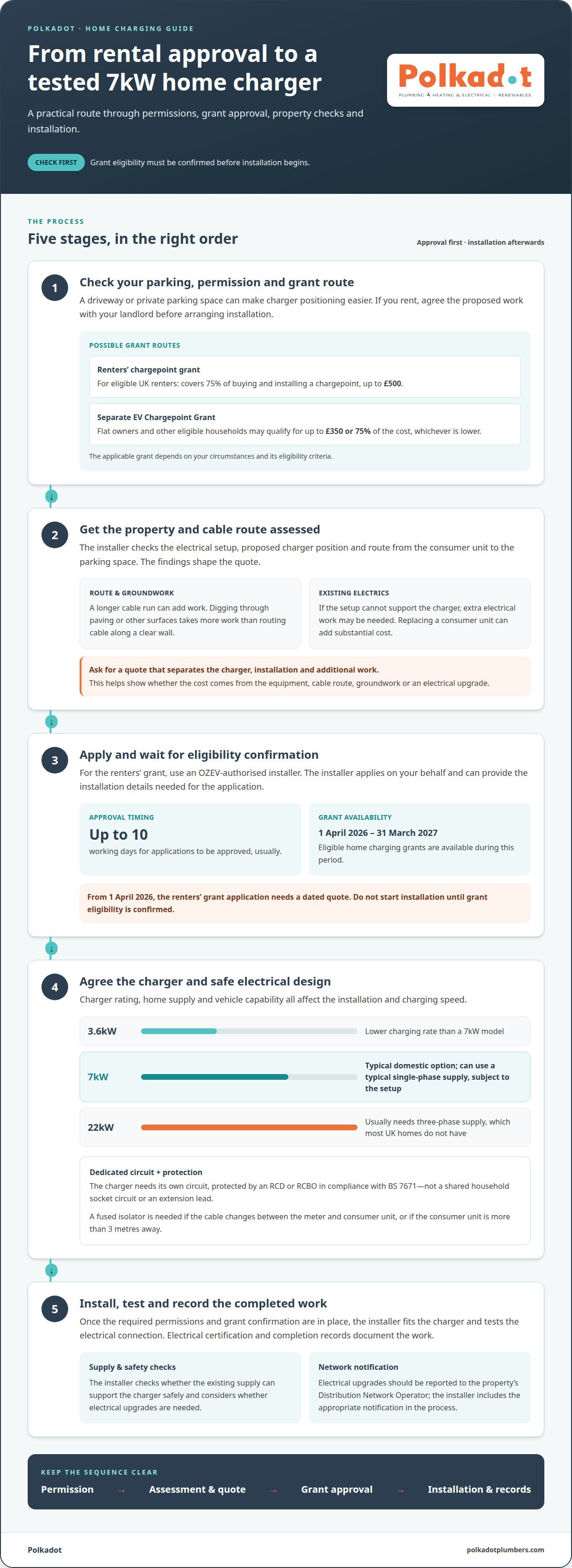
What to expect during a professional home charger installation
A professional installation proceeds from property assessment to fitting, testing and handover. The assessment informs the work, including the charger position, cable route and any required electrical changes.
First, the installer reviews the parking location, route to the consumer unit and existing electrical supply. A clear route to private off-street parking can simplify planning, while a longer route or underground cable may change the work involved. The installer also confirms the proposed charger is suitable for the vehicle and household supply.
For a rented home, arrange landlord permission before installation. If you’re applying under a government grant scheme, confirm eligibility before the charger is installed. If the application requires an authorised installer, that installer supports the process using the relevant quote and installation details.
Next, the electrician prepares the dedicated circuit and installs the charger in the agreed position. A straightforward installation is often completed in a single visit. Additional electrical work or groundwork can change the scope, so the work is based on the property assessment rather than a fixed template.
After fitting, the installer tests the charger and its electrical connection before explaining its operation. The installation must have suitable electrical protection and comply with BS 7671. If an electrical upgrade is needed, it should be reported to the property’s Distribution Network Operator. The installer also provides the relevant electrical certification for the completed work, giving you a record of the installation.
At handover, clarify how the charger connects to your vehicle, how to start and stop charging, and what the controls mean. Keep the certification with the property’s electrical records, especially if you rent or move home. A clear handover helps you use the charger safely and understand what work was completed.
For a professional assessment of your home charging requirements, arrange a home charger installation.
Polkadot: Electrical Installations
Polkadot provides Electrical Installations for homeowners planning a home EV charger. Turn to Polkadot when you’re ready to move from understanding the installation requirements to arranging the work. The assessment can account for the charger position, cable route, existing electrical supply and any required upgrades, helping the installation fit the property.
For a 7kW home charger installation, professional electrical work covers the dedicated circuit, protection, testing and certification. These details matter whether you own your home or have landlord permission to proceed. A clear explanation of the proposed work also helps you understand how the property’s electrical setup shapes the installation.
Contact Polkadot to discuss your home charger installation.
Plan your charger around the home
A 7kW home charger installation is a practical opportunity to plan how charging will fit your property over time. Consider where you usually park, how you’ll use the vehicle and whether future home improvements could affect the charger’s position or electrical setup. A clear plan helps make the installation a considered part of your home, rather than an isolated addition.
Polkadot provides Electrical Installations for home charging projects, alongside Air Conditioning, Refurbishment and Heating for wider property needs. If you’re ready to discuss the installation and how it could work at your home, contact Polkadot about your installation.
Taking the next step can turn your charging plans into a clear project. Start the conversation when you’re ready.
Frequently Asked Questions
How much does a home EV charger cost after the grant?
The amount payable depends on the eligible grant and installation total, rather than one fixed nationwide figure. Renters may be able to get financial support towards buying and installing a home charger, depending on their eligibility. The EV Chargepoint Grant can cover up to £350 or 75% of buying and installing a chargepoint socket, whichever is lower. The applicable scheme depends on household and property eligibility.
What does a 'standard installation' include?
A standard installation generally involves fitting the charger, routing cabling and connecting it to the home’s electrical supply. A typical quote includes up to 10-15 metres of cabling from the consumer unit to the charger. The work also involves a dedicated circuit, suitable protection and testing. The final scope depends on the existing electrical setup and the route to the chosen charging position.
Do I need planning permission for a home EV charger?
For a single domestic driveway installation in England, planning permission is usually unnecessary when permitted development rights apply. According to UK Government, legislation.gov.uk, permitted development allows a wall-mounted outlet in an area lawfully used for off-street parking or within the curtilage of a dwellinghouse or block of flats. The location matters, so this rule does not automatically apply to every property or parking arrangement.
How long will I wait for an installation?
Installation timing depends on appointment scheduling and the work identified for the property. A straightforward home installation is often completed in a single visit; electrical upgrades or excavation can affect the work involved. Grant approval is separate from installation scheduling and usually takes up to 10 working days. Allow for that application stage before installation if you’re claiming eligible grant support.
How much does EV charger installation cost in 2026?
There isn’t one applicable total for every 2026 installation. For Polkadot’s London car charging installation, the price depends on the property and work required, and is given after a quote request. Key cost factors include cable distance, the consumer unit’s condition, charger choice and any groundwork or electrical upgrades. Grant support may reduce eligible household costs, subject to the scheme’s rules.
Should you get a smart charger?
Smart functionality can be a useful feature to consider when choosing a home charger. Include this requirement when selecting a charger for your property. The installer can account for the unit’s power rating, the vehicle and proposed position when planning the work. This helps ensure the charger suits the installation, rather than focusing on its features alone.
Comments