
How to choose a solar battery for your home and budget
The biggest battery isn’t automatically the best choice. To understand how to choose a solar battery, start with how much electricity your home uses and when you use it, then compare that demand with your solar generation. A typical UK home battery has a capacity of around 10 kWh, but the right size depends on your household’s needs.
It makes sense to want a solar battery that uses your surplus solar power without paying for storage you are unlikely to need. A battery stores excess electricity for later use, such as in the evening. Its usable capacity and power output should match your household’s routine, not just its headline size.
This guide explains how home batteries work and what to compare, from capacity and power to battery chemistry, monitoring, costs and safety. It also covers how your daily electricity use and existing equipment affect the choice.
Table of Contents
How do home solar batteries work?
Solar panels generate electricity, and a home battery stores surplus for later use. Its capacity is measured in kilowatt-hours (kWh); a typical UK system might store 10 kWh, although usable capacity is lower than total capacity.
Usable capacity is the energy available to power your home. Depth of discharge is the share of a battery’s total capacity that can be used before recharging. Round-trip efficiency is the share of the energy used to charge the battery that is returned when it discharges.
There is no single best battery brand or model for every UK home. Compare usable capacity, power output, chemistry and compatibility with your inverter, then match them to your household’s electricity use.
For VAT relief, HM Revenue & Customs states that the UK zero-rate VAT treatment for home solar and batteries is stated to end on 31 March 2027.
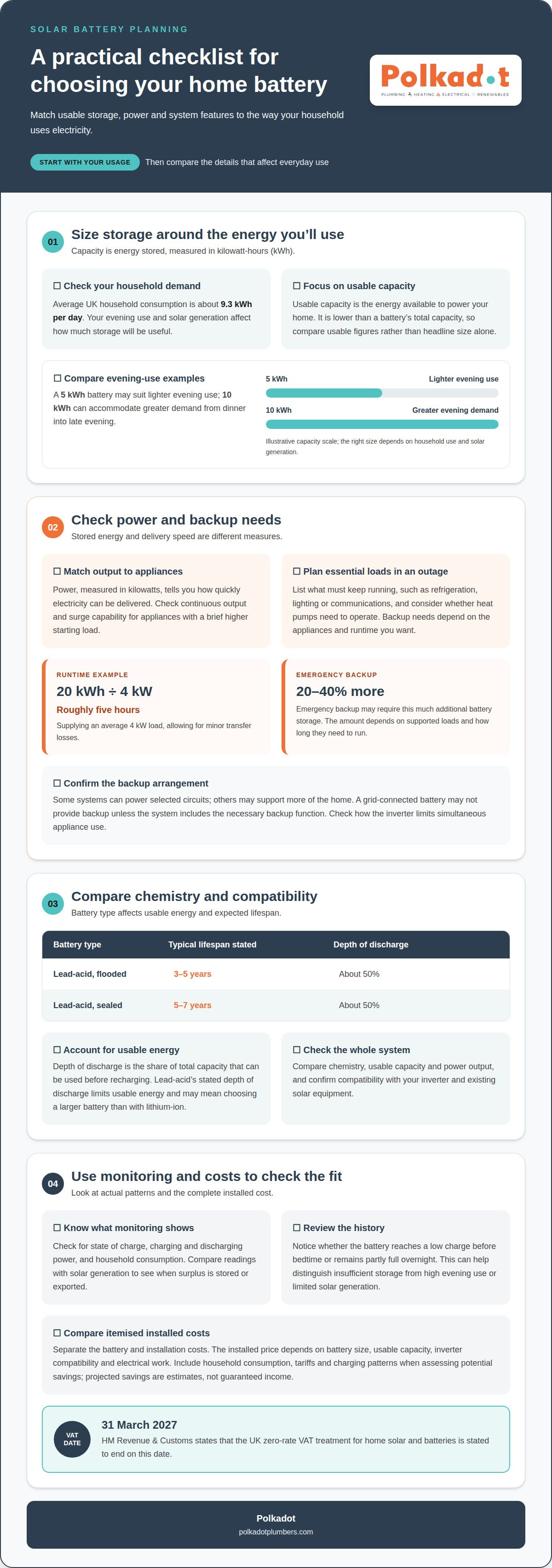
Use your electricity use to set a starting capacity. Average UK household consumption is about 9.3 kWh per day, but evening demand and solar generation affect the amount of storage that will be useful.
Compare usable capacity with the energy you want after sunset. A 5 kWh battery may suit lighter evening use, whilst 10 kWh can accommodate greater demand from dinner into late evening.
Match power output to appliances running at the same time. Capacity tells you how much energy is stored; power, measured in kilowatts, tells you how quickly it can be delivered. Check surge capability for appliances that need a brief higher starting load.
Plan runtime around essential loads during an outage. A 20 kWh battery supplying an average 4 kW load can run it for roughly five hours, allowing for minor transfer losses. Backup needs depend on which appliances remain in use.
Compare lifespan and usable capacity across chemistries. Lead-acid batteries typically last 3-5 years when flooded and 5-7 years when sealed, with about 50% depth of discharge. That limits usable energy and may mean choosing a larger battery than with lithium-ion.
Monitoring battery state of charge and power
Choose monitoring that shows state of charge, charging and discharging power, and household consumption. State of charge tells you how much stored energy remains; power readings show how quickly the battery system is filling or supplying electricity. Compare these readings with solar panel generation to see when surplus power is being stored or exported.
Use the monitoring history to understand your daily pattern, not just a single percentage. For example, note whether the battery reaches a low charge before bedtime or remains partly full overnight. That pattern helps distinguish insufficient storage from high evening consumption or limited solar generation.
Set backup priorities before sizing for an outage. List essential appliances, such as refrigeration, lighting or communications, and consider whether heat pumps must keep running. Emergency backup may require 20-40% more battery storage. The right amount depends on the loads you want supported and how long you need them to run.
Compare backup arrangements as well as battery capacity. Some systems can supply selected circuits during a power cut; others may be configured to support more of the home. A battery’s inverter also limits how much power appliances can draw together, so consider simultaneous demand, including appliances with a brief starting surge.
Ask how the system behaves when the grid fails and how monitoring displays that status. A grid-connected battery may not provide backup unless its system includes the necessary backup function. For savings, monitoring can show when stored electricity offsets imports and whether charging from the grid fits your tariff.
Consider whether participation in a virtual power plant suits your priorities. These programmes coordinate connected home batteries to support the wider electricity network, while the household may receive a benefit under the programme’s terms. Check how participation affects battery availability, charging schedules and your own backup reserve before opting in.
Solar battery costs and installation costs
Compare the full installed cost, not just the battery unit. Assess potential savings from shifting electricity use against the value of storing solar power for later.
Compare battery costs and energy arbitrage
Compare usable storage with the electricity you could shift between cheaper and more expensive periods. Energy arbitrage means charging when electricity costs less, then using or exporting stored power when rates differ. Check import and export rates, charging rules and how much capacity your household will need. Treat projected savings as estimates, not guaranteed income.
Separate storage and installation costs
Ask for storage and installation costs to be itemised. The installed price depends on the battery size, usable capacity, inverter compatibility and electrical work required. Itemised costs make it easier to compare similar systems rather than choosing by headline capacity alone.
Compare the battery size with the amount of solar electricity your panels generate and your household can use. A larger system may store more, but its value depends on how much capacity you regularly fill and discharge.
Review what installation includes, such as connecting the battery to the inverter and integrating it with existing solar equipment. Site layout and any additional electrical work can affect the scope.
Include ongoing use in your budget. A battery’s savings depend on household consumption, tariff rates, charging patterns and how much stored electricity replaces imports.
Factor in VAT when planning the timing. According to HM Revenue & Customs, the UK zero-rate VAT treatment for home solar and batteries is stated to end on 31 March 2027.
Choosing battery chemistry and checking safety
Planning permission and building-control requirements depend on the property and installation. For electrical safety, UK battery installations follow the Institution of Engineering and Technology’s Code of Practice for Electrical Energy Storage Systems and BS 7671.
Compare chemistry against your household’s use and priorities. Lithium-ion batteries are the most common solar battery type in the UK. Within that category, lithium iron phosphate (LFP) is a chemistry to consider for regular cycling and efficiency.
Look beyond the headline capacity to cycle life and round-trip efficiency. LFP batteries are described with a cycle-life range of 6,000-10,000 cycles to 80% capacity, and round-trip efficiency of 92-96%. These measures help compare how much energy is returned and how capacity may change with use.
Consider the battery’s operating environment. LFP operating temperature is typically 0 to 50°C, with reduced performance below 5°C. Choose a suitable location rather than assuming a cold or exposed space will perform like a protected indoor setting.
Plan the position around separation and clearance. Installation guidance calls for 30-minute fire separation between the battery and habitable rooms, and typically 100-300 mm clearance from combustible materials. These details affect where the unit can be placed and should be built into the installation plan.
Match the system to your wider setup. A household with a heat pump may have different electricity demand from one using power mainly for evening appliances. Consider the battery’s efficiency alongside its inverter, expected charging pattern and tariff, rather than choosing chemistry in isolation.
Have the electrical design and installation assessed against the applicable standards. Clear plans for location, separation, ventilation and connections help address practical safety considerations before the battery is installed. For help planning a safe battery installation, discuss your installation requirements.
Polkadot
Polkadot installs solar panels and batteries in London and can help you consider how your plans fit your home’s electrical setup and wider property needs. Think about capacity, backup arrangements and installation requirements alongside how your household uses electricity, rather than treating the battery as a standalone purchase.
When you are ready to discuss your home’s electrical requirements and energy plans, contact Polkadot in London. You can also discuss related property work, such as heating or refurbishment, if it affects how you use energy at home.
Contact Polkadot to discuss your home and next steps.
Turn your battery priorities into a practical next step
Turn your preferences into a practical plan: decide what you want the battery to do, how it should fit your existing electrical setup and whether future changes could affect household demand. These points give your discussion a clear focus and keep the decision centred on your needs, not just a product’s headline specifications.
If you are still deciding how to choose a solar battery, Polkadot can help you consider the wider property context in London. Its services include solar batteries, heating, air conditioning and refurbishment, which may all relate to broader plans for your home. Start by discussing your priorities and the practical requirements of the installation.
Discuss your solar battery plans with Polkadot, and take the next step with a clearer view of what your home needs.
Frequently Asked Questions
5 KWh vs 10 kWh vs 15 kWh battery sizing guide?
Treat the three capacity options as a shortlist, not a room-by-room rule. Decide whether stored power should cover essential circuits or broader household use, then compare usable energy and inverter output for that purpose. If your needs may grow, consider whether a modular system can expand later. The largest initial unit is not automatically the best fit.
How much battery storage do I need?
No single storage capacity suits every home. First decide whether you want the battery to reduce reliance on grid electricity, provide backup or do both. Those priorities affect how much energy you need available for everyday use. Consider whether future changes, such as adding an electric vehicle, could alter your household’s electricity use.
How to size a battery based on daily usage?
To decide how to choose a solar battery, estimate what share of your daily electricity you want stored power to supply. Separate flexible uses, such as running a dishwasher later, from appliances that need power at a set time. This gives you a realistic storage target without assuming the battery must cover everything.
Are home batteries a worthwhile investment?
Assess the investment against your main reason for installing a battery. If backup matters most, consider the value of keeping selected household functions available during an outage. If managing bills is the priority, check whether your tariff and routine offer useful opportunities to store or use electricity. Weigh those practical benefits against the cost and complexity of adding storage.
What battery capacity is ideal for high evening usage?
For an evening-heavy home, list the appliances and systems that usually run at the same time. Cooking, entertainment and hot water create a different demand pattern from lighting and refrigeration alone. Consider whether shifting flexible appliances to another time could meet some needs without extra storage, then choose a system around the evening use you want to support.
AC vs DC coupled, which one for your install?
If you already have solar panels, consider how the battery will connect to your existing equipment. An AC-coupled battery connects on the alternating-current side, while a DC-coupled system connects on the direct-current side before conversion for household use. The right arrangement depends on your inverter and system design, since each setup has different integration requirements.



Comments