

Are Heat Pumps Worth It? A 2026 Guide for London Homeowners
- James Nathan
- 2 days ago
- 13 min read

Could your traditional gas boiler actually be a "legacy tax" on your monthly finances? If you're like many London homeowners, you've likely asked yourself: are heat pumps worth it in a city known for its older, draughty housing stock? It's natural to feel hesitant when faced with high installation costs or confusing headlines about government grant eligibility. You want a home that stays warm during the coldest winter nights without your energy bills spiralling out of control.
We understand that making the switch to renewable energy is a significant decision that requires professional guidance. This guide provides a clear, data-driven look at the real-world costs and savings associated with air source heat pumps in 2026. We'll explore how the £7,500 Boiler Upgrade Scheme and 0% VAT incentives change the financial landscape for your property. You'll see how bespoke engineering can future-proof your heating system, reduce your carbon footprint, and finally deliver the lower monthly bills you've been looking for.
Table of Contents
The Financial Reality: Are Heat Pumps Worth the Upfront Investment?
Deciding whether to replace a traditional gas boiler can feel like a significant hurdle. The central question for many remains: are heat pumps worth it when the initial price tag is higher? In 2026, the answer is found in the shifting balance between government support and long-term energy security. Whilst the capital expenditure is greater than a standard boiler, the combination of grants and tax relief has narrowed the gap considerably, especially for London property refurbishments where energy efficiency is now a key driver of market value.
Understanding the Boiler Upgrade Scheme in 2026
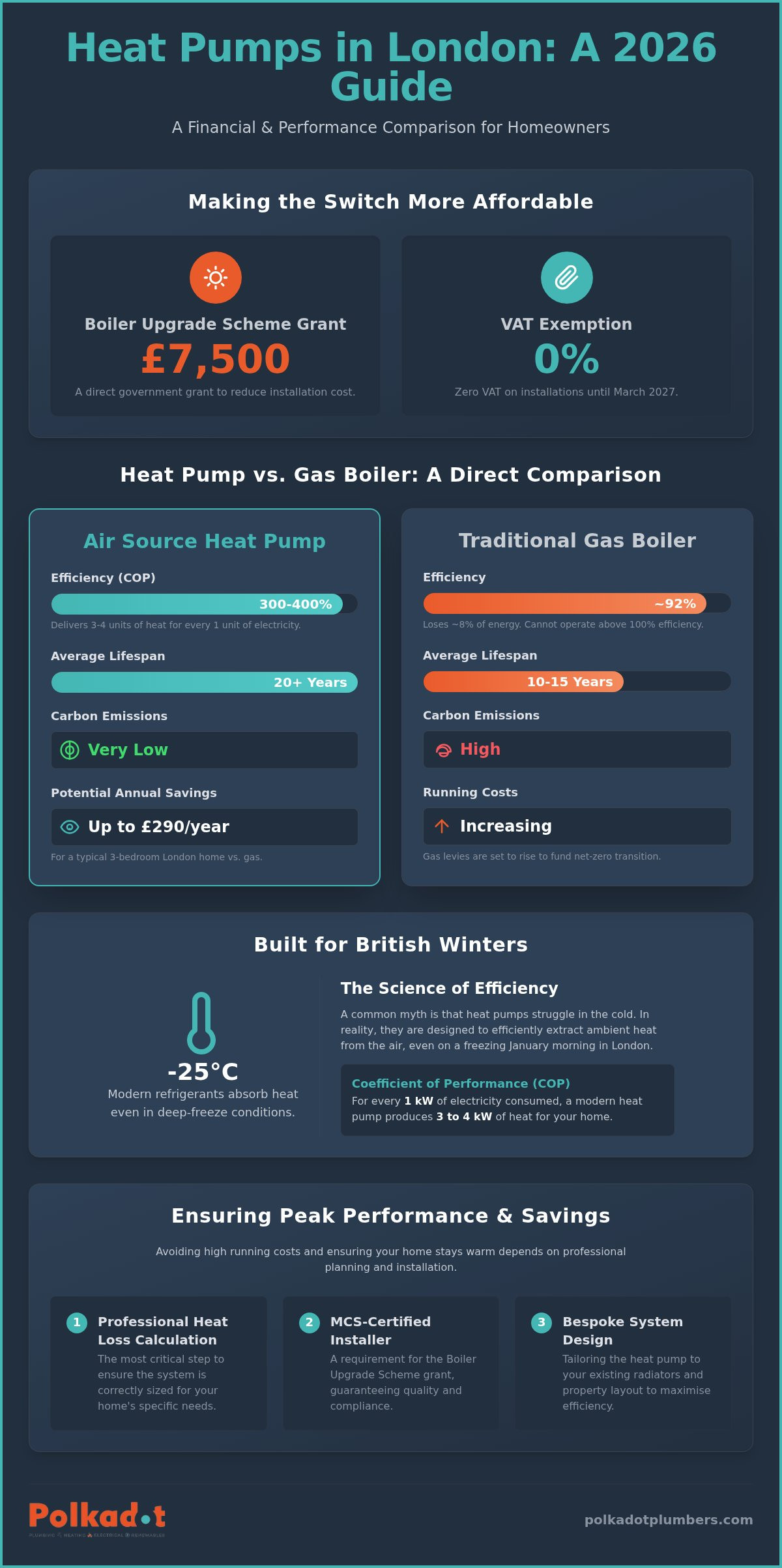
London homeowners currently benefit from a robust support framework designed to make renewable heating accessible. The Boiler Upgrade Scheme (BUS) provides a £7,500 grant for air source heat pump installations. If your property isn't connected to the gas grid and you're replacing an oil or LPG system, you may be eligible for a temporary uplift to £9,000, which is available until March 31, 2027. To qualify, you must use an MCS-certified installer. This ensures the system meets strict quality standards and operates at peak efficiency. We handle the application process on your behalf to ensure a stress-free experience. Additionally, the 0% VAT rate on installations remains in effect until March 2027, providing a significant saving compared to traditional home improvements.
Long-term Savings vs Initial Capital Expenditure
Calculating the payback period requires looking beyond the first year of ownership. For a typical three-bedroom London home, switching from a gas boiler can save up to £290 annually on energy bills. These savings are driven by the high efficiency of the technology; it's useful to understand what a heat pump is technically to appreciate how it extracts ambient heat rather than burning fuel. With electricity prices at 26.11p per kWh and gas at 7.33p per kWh as of mid-2026, the efficiency of a heat pump helps offset the higher unit cost of electricity.
ROI for a heat pump in 2026 is defined as the total financial gain from reduced energy bills and increased property value minus the net installation cost over the system's 20-year lifespan. As gas levies continue to increase to fund the net-zero transition, fossil fuel systems will naturally become more expensive to run. Investing now future-proofs your property. This adds a premium to refurbishments in the competitive London market where buyers increasingly prioritise homes with high Energy Performance Certificate (EPC) ratings and sustainable infrastructure. To support this transition, homeowners can explore Energy efficient home improvements that work in tandem with renewable heating to maximise savings.
Performance and Efficiency: How Heat Pumps Fare in the British Climate
A common anxiety for Londoners is whether a system reliant on outside air can actually handle a damp, freezing January morning. When evaluating if are heat pumps worth it, you have to look at the Coefficient of Performance (COP). Most modern units achieve a COP of 3.0 to 4.0. This means for every 1kW of electricity used, the system delivers 3kW to 4kW of heat. In comparison, even the most efficient gas boilers struggle to reach 0.92kW. Because our climate is varied, we also look at the Seasonal Coefficient of Performance (SCOP), which averages this efficiency across the entire year to give you a realistic view of annual running costs.
The Science of Extracting Heat from Cold Air
It's a misconception that heat pumps stop working when the temperature drops. The refrigerant inside the unit has a boiling point far below freezing, allowing it to absorb heat energy even on the coldest days. Whilst older technology sometimes struggled in deep freezes, modern high-temperature models can now provide flow temperatures similar to gas boilers. This makes them a viable option for older London properties with traditional radiators. Several factors influence this cold-weather performance:
Refrigerant properties: Modern gases can evaporate at temperatures as low as -25°C.
Inverter technology: This allows the pump to modulate its output rather than simply switching on and off.
System sizing: A correctly sized unit doesn't need to overwork to maintain a steady indoor temperature.
We ensure your Boiler Upgrade Scheme installation is perfectly matched to your home's specific thermal needs, preventing the efficiency drops associated with poor design.
Dispelling the Noise and Vibration Myths
Are you worried about a loud humming sound disturbing your neighbours? Modern air source units are remarkably quiet. At a distance of a few metres, most operate at around 40 to 45 decibels, which is similar to the hum of a domestic refrigerator or a quiet dishwasher. We use anti-vibration mountings and strategic placement to ensure the system remains a silent partner in your home comfort. In London, where space is at a premium, we also navigate the specific planning requirements for external units. If you're unsure about the best location for a unit in a terrace or flat, a professional heating assessment can clarify your options and ensure your installation remains within Permitted Development rules.
Heat Pump vs Gas Boiler: A Direct Comparison for 2026
When comparing a modern condensing boiler to a renewable system, you're looking at two entirely different philosophies of home heating. A gas boiler typically lasts between 10 and 15 years before efficiency drops or major parts fail. In contrast, a well-maintained air source heat pump has a lifecycle expectancy of 20 years or more. This longevity is a major factor when homeowners ask: are heat pumps worth it? Whilst the upfront cost is higher, you aren't just buying a heater; you're investing in a piece of infrastructure that outlasts two generations of gas boilers. To learn about the professional maintenance required for long-term efficiency, you can read more about the specialist care provided by Christensen Heating and Cooling.
Are you worried about the daily user experience? Most people are used to the "on-off" cycle of a boiler, where radiators get scorching hot and then go cold. Heat pumps operate differently, providing a consistent, low-level warmth that maintains a steady temperature. This results in a more comfortable living environment without the draughts and cold spots often found in older London properties.
Running Costs: The Electricity vs Gas Debate
The debate often centres on the unit price of energy. As of mid-2026, electricity costs roughly 26.11p per kWh, whilst gas sits at 7.33p. At first glance, gas seems cheaper. However, because a heat pump is 300% to 400% efficient, it uses significantly fewer units of energy to produce the same amount of warmth. You can further tip the scales by using smart "time-of-use" tariffs that offer cheaper electricity overnight. Integrating Solar Power Batteries allows you to store this cheap energy or self-generated solar power, making your running costs almost negligible. For a detailed breakdown of these costs and savings, independent data shows that replacing a gas boiler can save a typical household up to £290 a year.
Environmental Impact and Future-Proofing
The environmental argument is clear. Homes are responsible for 26% of the UK's carbon emissions. By switching to a heat pump, you could reduce your household's carbon footprint by several tonnes of CO2 every year. This isn't just about ethics; it's about regulation. The Future Homes Standard already mandates that new builds produce 75-80% less carbon, effectively ending the era of the gas boiler. Choosing a heat pump now ensures your home meets future standards, avoiding the need for expensive retrofitting later. Maintenance is straightforward, requiring only a simple annual service to check the refrigerant and filters, mirroring the schedule you're already used to with a boiler.
Beyond heating, a truly future-proofed home often incorporates other renewable technologies; for example, the Carbon Saving Group highlights how home EV charging installations are becoming a standard part of energy-efficient property upgrades.
Assessing Your Property: Is Your London Home Heat-Pump Ready?
A Victorian terrace in Fulham presents different challenges than a modern apartment in Greenwich. When considering are heat pumps worth it for your specific property, the conversation must start with a room-by-room heat loss calculation. This isn't just a cursory glance; it's a technical audit of your windows, wall construction, and floor levels. This data dictates the exact size of the unit you need. If your home is poorly insulated, the pump will work harder and cost more to run. We often recommend simple upgrades like loft insulation or draught-proofing before the installation begins to ensure the system operates at its highest efficiency. If you need to find qualified professionals for these preparatory improvements, you can visit Trade-Hive to connect with local tradespeople who can help get your home ready.
As you improve your property's airtightness through insulation, you can learn more about how Melbourne Hydronic Heating uses heat recovery ventilation systems to maintain air quality while preserving thermal efficiency.
Radiators, Pipework, and Underfloor Heating
Contrary to common myths found on social media, you don't always need to replace every radiator in your house. We analyse your existing emitters to see if they can provide enough heat at the lower flow temperatures used by renewable systems. In many cases, only a few radiators in larger rooms require upgrading to double-panel or triple-panel models to increase their surface area. If you're undertaking a full refurbishment, this is the perfect time to install underfloor heating. Heat pumps and underfloor systems are a natural match because they both operate optimally at low temperatures, providing a gentle, even heat throughout your living space.
Internal pipework also needs a close inspection. Older systems often use 8mm or 10mm microbore piping, which can restrict the flow rate required for a heat pump. We check if your existing infrastructure can handle the volume or if certain sections need upgrading to 15mm or 22mm copper. This attention to detail prevents the "noisy pipe" syndrome and ensures heat reaches every corner of your home efficiently. By addressing these technical elements during the design phase, we remove the uncertainty and ensure your investment delivers the comfort you expect.
For homeowners looking to further enhance their property's organisation during these technical upgrades, Floorguard offers bespoke storage solutions that help maximise available interior space.
In addition to plumbing, a thorough assessment of your home's electrical capacity is vital. To ensure your property is fully prepared for the increased load of a heat pump, you can find out more about the professional rewiring services offered by specialists like Foster Electrical.
Space Constraints in Urban Environments
Space is a premium in London, and finding a spot for an outdoor unit or an indoor hot water cylinder can be tricky. For homes without large gardens, we look at wall-mounting options or placing units in small courtyards. Most installations fall under Permitted Development, meaning you won't usually need full planning permission, provided the unit meets specific size and noise criteria. If you're also looking to manage summer heatwaves, you might consider how air conditioning installation London can complement your home's climate strategy.
Ultimately, the question of are heat pumps worth it depends on this initial groundwork. A system that is "dropped in" without a property assessment will underperform, but a bespoke-engineered solution will provide reliable, low-carbon warmth for decades. For a clear understanding of your property's potential, you can book a professional plumbing survey to identify the most efficient installation path for your home.
Making the Switch: Why Professional Installation is the Deciding Factor
The hardware you choose is only half the battle. Whilst the technology behind air source units is proven, the real answer to whether are heat pumps worth it lies in the quality of the system design. A poorly planned installation can lead to inefficient operation, higher electricity bills, and a home that never quite feels warm enough. This is why we prioritise a bespoke engineering approach for every London property. We don't just "swap" your boiler; we redesign your heating infrastructure to ensure the new technology works in harmony with your home's unique thermal profile.
Choosing an MCS-certified installer is your most important safeguard. This certification is a mandatory requirement for accessing the £7,500 Boiler Upgrade Scheme grant, but it also provides vital consumer protection. It guarantees that your system is designed, installed, and commissioned to strict national standards. Our local London team understands the specific challenges of urban installations, from navigating tight access in terraced streets to ensuring external units comply with borough-specific noise regulations.
The Danger of Under-Sized or Over-Sized Systems
Incorrect sizing is the most common cause of system failure and high running costs. If a unit is too large for the property, it will frequently switch on and off in a process called "short-cycling," which leads to premature wear on the compressor and wastes energy. Conversely, an undersized unit will struggle to maintain temperature during a cold snap, leaving you reliant on expensive backup immersion heaters. We use advanced diagnostic tools and room-by-room heat loss software to find the perfect balance for your specific needs. Professional commissioning is essential for the BUS grant, as it provides the documented proof of efficiency required by the government to release your funding.
Integrated Home Maintenance and Renewables
One of the greatest stresses in home improvement is managing multiple contractors who don't communicate. We solve this by acting as a "one-stop-shop" for your entire transition to renewable energy. Our team handles the complex electrical upgrades, the internal plumbing adjustments, and any necessary roofing work for integrated solar panels. This joined-up approach ensures that your Air Source Heat Pumps are perfectly synchronised with your broader home systems, such as solar batteries or underfloor heating.
Reliability is built on transparency and professional integrity. Rather than guessing if your property is suitable, we recommend starting with a technical assessment. This removes the uncertainty and provides you with a clear roadmap for your energy transition. If you are ready to move away from fossil fuels and secure a more sustainable future for your property, you can book a professional plumbing survey to get a definitive answer on your home's potential.
Secure Your Home's Energy Future Today
The 2026 energy landscape offers a unique window of opportunity for London homeowners. With the £7,500 Boiler Upgrade Scheme grant and 0% VAT incentives still in effect, the financial gap between traditional fossil fuels and renewable technology has narrowed significantly. We've explored how modern systems handle the British winter with ease, provided they are bespoke-engineered to match your property's specific thermal requirements. When you consider the long-term energy security and the reduction in your household's carbon footprint, the answer to are heat pumps worth it is increasingly clear.
Choosing the right partner for this transition is essential for ensuring peak performance and reliability. Our London-based expert team provides full 2026 grant support and technical guidance to make the process as straightforward as possible. As MCS Certified Installers, we take pride in delivering systems that offer both comfort and efficiency for decades to come. Book a professional heat pump survey with Polkadot today to discover the exact savings potential for your property. Take the first step toward a future-proofed home that stays warm whilst costing you less.
Frequently Asked Questions
Is a heat pump worth it if I live in a Victorian terrace?
Heat pumps are certainly viable for Victorian terraces, but success depends on a professional heat loss calculation. Whilst older homes often have solid walls, targeted insulation and correctly sized radiators ensure the system remains efficient. We specialise in London refurbishments where we integrate these systems into period properties without compromising their character. A bespoke design ensures your home stays warm whilst keeping running costs manageable.
How much can I actually save with the Boiler Upgrade Scheme in 2026?
In 2026, most London homeowners can claim a £7,500 grant through the Boiler Upgrade Scheme. If your property is off the gas grid and currently uses oil or LPG, you may be eligible for an increased grant of £9,000 until March 2027. This government support, combined with the 0% VAT rate, significantly reduces the initial investment and helps you decide if are heat pumps worth it for your budget.
Do I need to replace all my radiators to install a heat pump?
You don't always need to replace every radiator in your home. We assess your existing heating emitters to determine if their surface area is sufficient for the lower flow temperatures used by heat pumps. In many cases, you might only need to upgrade radiators in the largest rooms or those with the highest heat loss. We'll identify these specific needs during your technical survey to ensure the system is perfectly balanced.
How noisy is an air source heat pump for my neighbours?
Modern air source units are remarkably quiet and typically operate at decibel levels between 40 and 45dB. This is comparable to the background hum of a quiet kitchen appliance or a refrigerator. By using anti-vibration mounts and selecting the optimal location, we ensure the unit remains unobtrusive for both you and your neighbours. Most London boroughs accept these noise levels under Permitted Development rules without any issues.
Can a heat pump provide enough hot water for a large family?
A correctly designed heat pump system provides ample hot water for large households by using an unvented hot water cylinder. These cylinders are designed to store water at the required temperature and deliver it at mains pressure to multiple bathrooms simultaneously. During our design phase, we calculate your family's peak usage to ensure the storage capacity meets your specific daily demands. This ensures you never run out of hot water.
What happens to a heat pump during a power cut?
Like a modern gas boiler, a heat pump requires electricity to operate and will stop during a power cut. However, because heat pump-ready homes are typically well-insulated, they retain warmth for much longer than draughty properties. For those seeking extra security, we can integrate solar power batteries that provide backup power to keep your heating and essential circuits running. This is a common consideration when asking are heat pumps worth it for energy independence.
Do I need planning permission for a heat pump in London?
Most air source heat pump installations in London fall under Permitted Development, meaning full planning permission isn't required. There are specific criteria regarding the size of the unit and its distance from property boundaries that must be met. However, if you live in a Conservation Area or a Listed Building, you must check with your local council first. We provide guidance on these specific regulations as part of our comprehensive installation service.
How long does it take to install a full heat pump system?
A standard installation for a three-bedroom London home typically takes between three and five days to complete. This timeframe includes the removal of your old boiler, the installation of the external unit, and any necessary upgrades to your hot water cylinder or radiators. We coordinate the plumbing and electrical work to minimise disruption, ensuring your new system is commissioned and running as efficiently as possible before we leave your property.


Comments