

Commercial Solar: Strategic Guide for London Firms (2026)
- James Nathan
- 1 day ago
- 12 min read

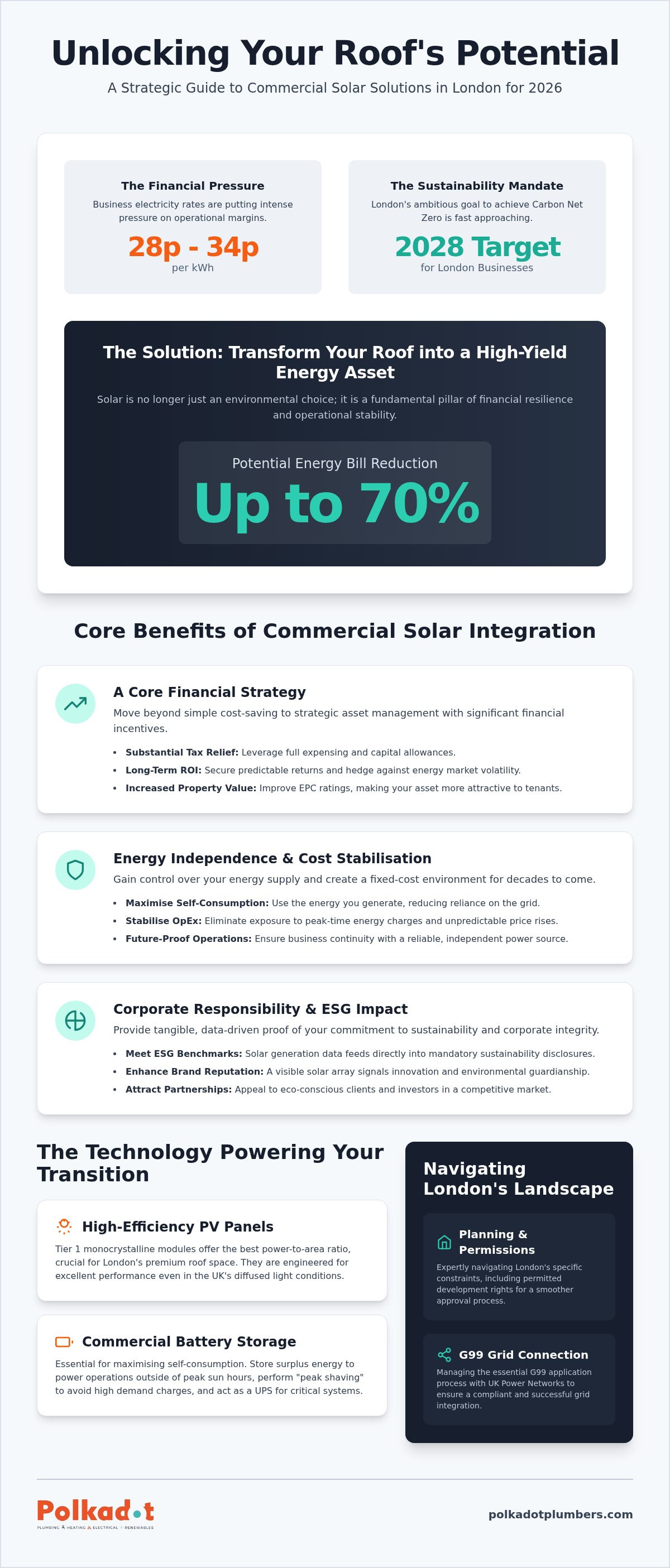
Could your roof be the most underutilised asset on your balance sheet? In 2026, commercial solar solutions have shifted from a sustainability "nice-to-have" to a fundamental pillar of financial resilience. With business electricity rates averaging between 28p and 34p per kWh, the pressure on operational margins in the capital has never been more intense. We understand that the path to energy independence often feels blocked by complex London planning permissions and the uncertainty of G99 grid applications.
You likely agree that meeting Carbon Net Zero targets by 2028 whilst protecting your bottom line feels like a difficult balancing act. This guide promises to clarify how you can transform your commercial property into a high-yield energy asset, leveraging current tax reliefs like full expensing to secure a long-term ROI. We'll explore the technical realities of London's infrastructure, from navigating permitted development rights to managing grid capacity, ensuring your transition to renewable power is both smooth and strategic.
Table of Contents
The Business Case for Commercial Solar Solutions in 2026
In 2026, the conversation around renewable energy has matured. We've moved past the era where solar was a peripheral "green" add-on. For modern organisations, commercial solar solutions are now viewed as a strategic energy asset. This shift is driven by a 2026 economy where operational costs are under constant scrutiny. When electricity rates for businesses average between 28p and 34p per kWh, generating your own power is a matter of financial necessity. It's a way to turn an empty rooftop into a productive part of your business infrastructure.
This transition is particularly relevant for London firms aiming for Carbon Net Zero by 2030. The capital's unique economic pressures mean that volatility isn't just a risk; it's a certainty. Solar mitigates this risk by providing a predictable, low-cost energy source that operates independently of global market fluctuations. It provides a level of budget certainty that traditional energy contracts simply can't match.
Many organisations across the country are already capitalising on this shift; for instance, you can discover Sol PV Group to see how turnkey PV installations are being deployed at scale to ensure long-term financial resilience.
Energy Independence and Cost Stabilisation
How much of your monthly budget is lost to peak-time energy charges? Reducing your reliance on the National Grid during the busiest business hours is one of the most effective ways to stabilise your OpEx. By installing commercial rooftop PV systems, you can predict your energy expenditure for decades. This isn't just about saving money today. It's about creating a fixed-cost environment for the future. You're essentially pre-purchasing your electricity at a fraction of the grid price.
For commercial landlords, the impact on property value is significant. Improving EPC ratings through solar installations ensures your buildings remain compliant with evolving regulations. It makes your property more attractive to tenants who are increasingly wary of high utility bills. A solar-equipped building is a future-proofed building. It commands better lease terms and ensures long-term asset viability in a competitive market.
Corporate Responsibility and ESG Reporting
Stakeholders are no longer satisfied with vague environmental promises. They want to see tangible results. Solar generation data feeds directly into mandatory sustainability disclosures, providing the transparency that eco-conscious clients and investors expect. It’s a clear, data-driven way to prove you’re meeting ESG benchmarks. You can track every kilowatt generated and every tonne of carbon saved in real-time.
Beyond the data, there’s the brand impact. Visible renewable commitments through solar arrays signal that your organisation is an innovator. It shows you’re a responsible guardian of your property and the local environment. In the competitive London market, this reputation for integrity can be a deciding factor for new business partnerships; for companies looking to showcase this forward-thinking attitude at corporate gatherings, chrisdoddmagic.com offers a unique way to engage stakeholders. Customers want to work with firms that lead on sustainability.
Scalable Solar Technologies: PV Panels, Batteries, and Beyond
Selecting the right hardware is the first step in de-risking your investment. In 2026, high-efficiency Tier 1 monocrystalline PV modules are the standard for commercial rooftops, and specialists such as MarGav Solar can provide the consultancy needed to identify systems offering the best power-to-area ratio. This is vital in London, where roof space is often at a premium. Unlike older technologies, these modern panels perform exceptionally well in the UK's diffused light conditions, ensuring your generation remains consistent even on overcast days.
We often see businesses struggle with high cooling costs during summer heatwaves. Integrating your array with an air conditioning installation London firms can rely on creates a perfect synergy. Since solar generation peaks exactly when cooling demand is highest, you're essentially using the sun to keep your office comfortable for free. Smart monitoring systems now allow you to track this generation and consumption in real-time. This provides total transparency over every watt used. You can see exactly how much your commercial solar solutions are contributing to your daily operations, allowing you to adjust your energy-heavy processes to match peak generation times.
Commercial Battery Storage Solutions
Why let your excess energy go back to the grid for a lower rate? Commercial battery storage is essential for maximising self-consumption in 2026. By storing surplus power during the day, you can support early morning or late evening shifts without drawing from the grid. This also allows for "peak shaving," where you use stored energy to avoid the most expensive demand charges. For firms with critical data centres, these batteries act as a high-capacity Uninterruptible Power Supply (UPS). This offers peace of mind against local outages and grid instability.
The integration of battery storage often serves as a precursor to wider electrification. For businesses looking at how these systems scale, Eastern Electric offers a detailed look at implementing professional EV charging infrastructure in high-demand urban environments like Glasgow.
Solar and EV Charging Integration
The transition to electric transport is no longer optional. With the 2030 internal combustion engine ban approaching, forward-thinking firms are already future-proofing their car parks. Powering your company fleet with energy generated directly from your roof is the ultimate circular economy. Modern systems manage load distribution intelligently, ensuring that EV charging doesn't compromise the building's primary power needs. When you align these systems, your commercial solar solutions become the engine for your entire logistical operation. While the hardware is impressive, it must be installed in accordance with UK planning regulations to remain compliant. If you're unsure which technology fits your specific roof profile, our team can help you design a bespoke solar strategy.
Assessing Financial ROI and ESG Impact
How quickly will your investment pay for itself? This is the central question for any London board of directors considering commercial solar solutions in 2026. In the current economic landscape, the answer is increasingly favourable. We see solar not as a simple equipment purchase, but as a high-yield financial instrument that generates predictable returns through avoided energy costs. Every kilowatt-hour you generate is a pound saved from your operational expenditure.
Delaying this decision carries a hidden price. As carbon taxes continue to rise, the "opportunity cost" of sticking with grid-only power grows every month. Beyond direct savings, many commercial lenders now offer preferential rates for properties with high ESG credentials. Your insurance provider might also view the upgrade positively, as modern solar installations often coincide with roof refurbishments that reduce the risk of leaks and structural degradation. It’s about building a more resilient, bankable business.
Investment Recovery and Tax Benefits
Under current 2026 regulations, businesses can claim 100% first-year relief through "full expensing" for qualifying plant and machinery. This includes solar panels, allowing you to deduct the entire cost from your taxable profits in the year of purchase. Alternatively, the Annual Investment Allowance (AIA) remains a robust option for investments up to £1,000,000. For any energy you don't use, the Smart Export Guarantee (SEG) currently offers between 4p and 12p per kWh, though many larger firms now opt for Corporate Power Purchase Agreements (PPAs) to secure long-term revenue stability.
In 2026, London businesses can typically expect a payback period of between four and eight years for their commercial solar solutions, depending on system size and self-consumption rates.
To help you visualise these figures for your own site, the solar savings tool from Jelvis can provide a useful starting point for calculating your potential energy savings.
Operational Efficiency and Maintenance
Maintenance is often a source of anxiety for property managers, but it shouldn't be. Unlike the mechanical complexity of traditional HVAC or heating systems, PV arrays are solid-state and remarkably resilient. We recommend a proactive maintenance schedule that includes annual thermal imaging and string testing to ensure every panel is performing to its maximum potential. For property managers who want to ensure their wider workplace remains safe and compliant, you can check out A Plus Compliance Services for professional electrical testing. This diagnostic approach mirrors how we handle all property services, moving from uncertainty to a clear state of resolution.
At Polkadot, we manage the entire lifecycle of your energy assets. From the initial electrical design to long-term performance monitoring, we act as the guardian of your property’s infrastructure. This end-to-end service ensures that your transition to renewable energy is steady, professional, and entirely stress-free. We prioritise your comfort and convenience, ensuring the installation works in harmony with your existing building systems.
Navigating London Planning and Grid Constraints
Installing commercial solar solutions in the heart of the capital presents unique challenges that suburban projects rarely face. You might worry that London's dense architecture or strict local councils will block your progress. In reality, most rooftop installations now fall under Permitted Development Rights. Since late 2023, these rights have expanded to cover commercial rooftops of any size, provided the panels are at least one metre from the roof edge. However, if your premises are in a conservation area in Westminster or the City, or if you occupy a listed building, you'll still need full planning permission. We manage these delicate applications to ensure your project respects the heritage of the building whilst meeting modern energy standards.
One of the most critical steps in your journey is the G99 application to UK Power Networks (UKPN). For any system larger than 3.68kW per phase, you must receive approval before connecting to the grid. This process typically takes between 45 and 65 working days. We handle this technical liaison for you, navigating potential grid bottlenecks to keep your timeline on track. Before a single panel is lifted, we also conduct a comprehensive structural roof survey. This ensures your building can safely support the additional weight of the PV array and mounting system, protecting the long-term integrity of your property.
The Planning Process in Greater London
Feasibility and Shade Analysis: We begin by mapping your roof to identify the most productive zones and any potential shading from neighbouring high-rise buildings.
Local Authority Approval: If your property is listed or in a sensitive area, we prepare and submit the necessary documents to secure council consent.
Grid Management: We submit the G99 application early in the process, ensuring that grid capacity issues don't cause unexpected delays to your commissioning date.
Health, Safety, and Roofing Integrity
Safety is our absolute priority, especially for high-rise London installations where access is complex. We organise all necessary scaffolding and safe access systems, ensuring compliance with the latest Work at Height regulations. Fire safety is another vital consideration; we design systems with rapid shutdown capabilities and high-quality DC isolators to meet stringent commercial insurance requirements. Because we are multi-trade experts, we ensure your roof warranty remains fully intact. We don't just bolt panels down; we integrate them into the roof structure to maintain a weather-tight seal. If you're concerned about your roof's suitability, book a structural solar survey with our specialist team today.
Implementing Your Commercial Solar Strategy with Polkadot
Why is selecting a multi-trade partner so vital for your project's success? Many providers focus solely on the panels, often overlooking the complex electrical and structural requirements of a London commercial property. At Polkadot, we act as the authoritative expert for your entire building. We combine our expertise in electrical installations and roofing refurbishment to provide a truly integrated service. This means you don't have to juggle multiple contractors or worry about communication breakdowns between trades. We take full responsibility for the project, from the first structural survey to the moment the system starts generating power.
Our commercial solar solutions are designed to be seamless. We've refined a methodology that prioritises your business continuity. It begins with a diagnostic process where we identify your specific energy needs and roof constraints. We then handle the complex G99 applications and planning queries discussed earlier in this guide. Once the installation begins, our team works with precision and professional integrity to ensure every component meets our high standards. We don't just walk away once the panels are up; we provide ongoing monitoring to guarantee your energy yields remain at peak levels throughout the system's life.
The Polkadot Difference: Reassuring Dependability
We understand that a major installation can feel disruptive. To alleviate this stress, we organise our work programmes around your operational needs, often performing the most intrusive work during your quietest periods. This customer-first approach is why we've become a favourite choice for London firms seeking stability. Whether we're helping a warehouse in Park Royal or an office centre in the City, our commitment remains the same: to be the trustworthy guardian of your property. We've successfully helped a variety of London businesses transition to solar, ensuring their systems are integrated with existing climate control and electrical networks without a hitch.
Taking the Next Step
Are you ready to see how renewable energy can transform your bottom line? The path forward starts with a comprehensive commercial energy audit. This allows us to customise a solution that fits your specific building and budget perfectly. We'll provide a clear roadmap of the expected ROI and technical requirements, moving you quickly from uncertainty to a clear resolution. Contact our London centre today for a bespoke consultation and take the first step toward true energy independence. Our team is ready to help you navigate the 2026 energy market with confidence and professional ease.
Securing Your Organisation's Energy Future
The transition to onsite power generation isn't just a trend; it's a vital response to the 2026 energy market. These systems provide a clear path to cost stabilisation, allowing you to predict your energy expenditure for years to come. By navigating London's specific planning and grid requirements early, you avoid common pitfalls and secure a reliable ROI. It's about turning a passive rooftop into a productive financial asset.
Success depends on choosing a partner that offers full electrical and roofing integration. As accredited renewable energy specialists, we provide the reassuring dependability you need for such a significant project. Our expert London-based installers manage every technical detail, ensuring your installation works in harmony with your building. We're here to guide you from initial feasibility to final commissioning with professional integrity and care.
Ready to take control of your energy bills? Enquire about our commercial solar solutions today and let us help you achieve your 2026 sustainability targets. Your property is in safe hands.
Frequently Asked Questions
How much roof space is required for a commercial solar solution?
The amount of space depends on your specific energy goals and the efficiency of the panels chosen. As a general guide, a small 10kW system typically requires around 50 to 60 square metres of unobstructed roof area. For larger 100kW installations, you should plan for approximately 500 to 600 square metres. We use high-efficiency monocrystalline modules to ensure you get the maximum power output from the smallest possible London footprint.
What is the typical ROI for a London-based business installing solar in 2026?
Most London firms achieve a full return on investment within four to eight years. This timeframe is influenced by high local electricity rates, which currently average between 28p and 34p per kWh, and the ability to claim 100 per cent tax relief through full expensing. Since these systems are designed to last 25 years or more, your business will enjoy over a decade of essentially free electricity after the initial payback period.
Can I install solar panels on a listed commercial building in London?
Yes, you can install solar on listed buildings, but you must obtain Listed Building Consent from your local planning authority first. While many commercial solar solutions fall under permitted development, heritage properties in areas like Westminster require a more sensitive approach. We specialise in managing these complex applications, ensuring that the installation respects the building's historical integrity whilst delivering the modern energy performance your organisation needs to stay competitive.
How long does a commercial solar installation take to complete?
The physical on-site installation usually takes between one and three weeks, depending on the complexity of the roof. However, the entire project timeline is typically three to four months. This includes the essential pre-installation stages, such as structural surveys and the G99 grid connection application with UK Power Networks, which alone can take 45 to 65 working days. We manage this entire schedule to ensure a smooth, predictable transition.
Do I need a battery storage system for my business solar panels?
While not strictly mandatory, battery storage is highly recommended for maximising your self-consumption. It allows you to store the surplus energy generated during the sunniest parts of the day for use during early morning starts or late evening shifts. This is particularly effective for "peak shaving," helping you avoid the most expensive grid tariffs. It also provides a level of energy independence that protects your operations from local grid instability.
What happens to my solar energy generation at night or on cloudy days?
Solar generation stops at night and reduces during heavily overcast weather, but modern panels are designed to perform well in the UK's diffused light. When your panels aren't producing enough power, your building automatically draws electricity from your battery storage or the National Grid. This happens seamlessly, so your computers, machinery, and lighting continue to run without any interruption. You'll always have a steady, reliable power supply regardless of the weather.
Are there any government grants available for commercial solar in the UK for 2026?
There isn't a single national grant, but the financial incentives remain very strong through the tax system. Businesses can utilise "full expensing" or the Annual Investment Allowance to deduct the total cost of commercial solar solutions from their taxable profits. Additionally, the Smart Export Guarantee allows you to earn between 4p and 12p per kWh for any surplus energy you export back to the grid, providing an ongoing revenue stream.
How does solar integration affect my existing commercial air conditioning system?
Solar power is the perfect partner for your air conditioning. Because cooling demand is usually at its highest when the sun is at its brightest, your panels generate the most electricity exactly when your HVAC system needs it most. This synergy allows you to run energy-intensive cooling systems using "free" power from your roof. It significantly lowers your summer operational costs and reduces the mechanical strain on your electrical infrastructure during heatwaves.


Comments