

Are Solar Panels Worth It? 2026 Guide for London Homeowners
What if the grey skies over London were actually the key to your energy independence rather than a barrier to it? Many homeowners find themselves staring at rising electricity bills whilst wondering if the capital's unpredictable weather makes renewable technology a poor investment. You might be asking yourself, are solar panels worth it when the upfront costs seem high and the sun rarely seems to shine? It's a valid concern, especially when you want to protect your property value and reduce your carbon footprint without the stress of a complicated installation process.
We understand that the conflicting information surrounding solar efficiency can feel overwhelming. This guide provides a clear, professional look at the real-world ROI and energy savings you can expect in 2026. You'll discover how modern systems perform in typical British weather, the impact on your home's market value, and the path to genuine energy independence. We'll examine the latest Smart Export Guarantee rates and the benefits of integrating battery storage to ensure your investment stands the test of time. From installation logistics to long-term financial benefits, here is everything you need to know about future-proofing your London home.
Table of Contents
The 2026 Verdict: Are Solar Panels Still a Good Investment?
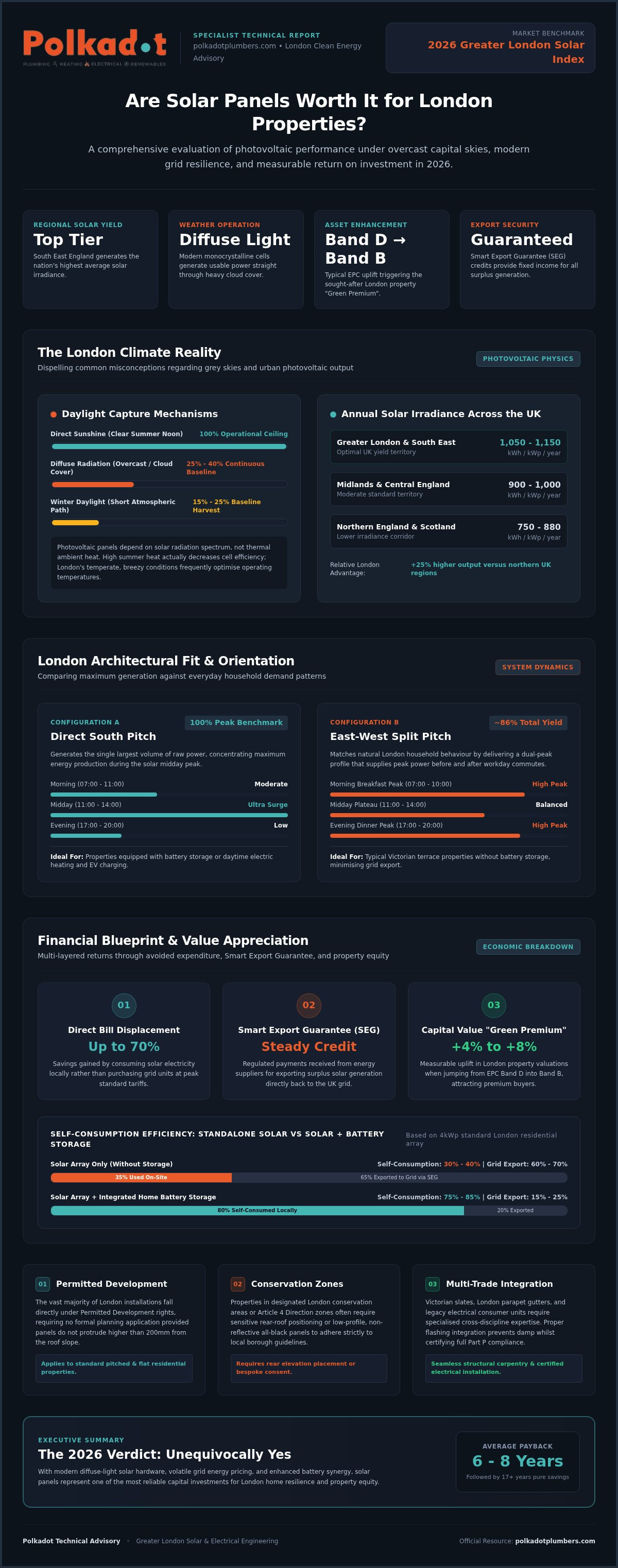
In 2026, the question of whether are solar panels worth it has moved beyond simple arithmetic. While previous years focused purely on how many decades it took to break even, today's homeowners are looking at a landscape defined by volatile energy prices and significantly more efficient hardware. Photovoltaic technology has matured, meaning panels now capture more energy even during those overcast London afternoons. When combined with the fact that hardware costs have reached a plateau of affordability, the financial barrier to entry is lower than ever before.
Most UK households now see a return on investment much faster than a decade ago. This is largely because the cost of drawing power from the grid has remained high, whilst the efficiency of modern installations ensures you generate more usable electricity per square metre of roof space. The shift in focus has moved from saving a few pennies to achieving genuine grid resilience and protecting your home from the instability of the wider energy market.
Why the 2026 Energy Market Changes the Equation
The dynamic between the cost of living and the cost of technology has shifted. Whilst traditional utility bills continue to fluctuate due to global market pressures, the price of solar components has become more predictable. This stability allows for a more accurate financial forecast for your home. The Smart Export Guarantee (SEG) also plays a critical role in 2026, providing a consistent way to earn credits for the surplus energy you send back to the grid. It ensures that every kilowatt you produce has a tangible value, whether you use it or sell it.
Data regarding solar power generation in the UK shows that southern regions, including Greater London, benefit from some of the highest solar yield potentials in the country. Energy independence for a London terrace house means generating enough power to cover your daily essentials whilst reducing your reliance on an increasingly expensive national grid. It's about protecting your household from future price hikes and ensuring your property remains functional regardless of external market volatility.
Solar Panels and Your Property Value
Installing solar panels is a significant step in property maintenance that offers immediate functional upgrades. Beyond the monthly savings, there's a clear impact on resale value. A high EPC rating is no longer just a 'nice to have' feature; it's a primary requirement for many modern buyers who are wary of future energy costs. Moving a property from a D to a B rating can significantly increase its appeal in the competitive London market, making it a much easier sell for estate agents.
Buyers are increasingly willing to pay a 'Green Premium' for homes that are already future-proofed. This means you aren't just saving on bills, you're building equity. For a deeper look at how these systems integrate with local architecture, you can read our Solar Panels London: The Complete 2026 Homeowner’s Guide. Investing in solar today ensures your home remains a premium asset in the years to come, providing peace of mind through both sustainability and financial security.
How Solar Panels Function in the London Climate
It's a common misconception that London's overcast weather makes solar power ineffective. In reality, modern photovoltaic (PV) panels don't need direct, scorching sunlight to generate electricity. They operate on daylight, specifically "diffuse radiation," which is the light that filters through the clouds. This means your system continues to produce power even on a typical grey Tuesday in Croydon. The technology has evolved to a point where efficiency remains high even when the sky isn't perfectly clear.
When considering if are solar panels worth it, location is everything. The South East of England remains the most productive region in the UK for solar energy. Whilst a south-facing roof is the gold standard for maximum yield, East-West orientations are becoming increasingly popular. These setups allow you to capture energy during the morning and evening peaks, which often aligns better with when London families are actually at home using appliances. This "double peak" generation can sometimes be more valuable than a single midday surge if you don't have battery storage.
For 2026 installations, monocrystalline panels have become the industry benchmark. They offer superior efficiency and a sleeker aesthetic compared to older polycrystalline versions. By using higher-grade silicon, these panels convert a greater percentage of available light into usable power, ensuring you get the most out of every square inch of your roof. For those looking for precise figures, the Energy Saving Trust solar cost and savings estimates provide a reliable national benchmark for expected generation and annual bill reductions.
Light vs. Heat: Why London's Temperature is Actually Ideal
Many people assume heat is the driving force behind solar power, but the opposite is true. Solar panels are electronic devices. Like a laptop or a car engine, they perform more efficiently in cooler conditions. London's temperate climate is actually ideal; it provides ample daylight without the extreme heat that can cause panel efficiency to drop or hardware to degrade prematurely. PV cells simply need photons from daylight to knock electrons loose and create a flow of electricity. High temperatures actually increase electrical resistance, which can hinder this process.
Shading and Urban Obstacles
Urban environments present unique challenges, such as shadows from tall Victorian chimneys or neighbouring terrace houses. In the past, shading on just one panel could compromise the output of the entire string. Today, we use micro-inverters or power optimisers to ensure each panel operates independently. This technology ensures that if one section of your roof is in the shade, the rest of the system continues to perform at its peak. It's a technical solution that makes solar viable for even the most cramped London streets.
At Polkadot, we specialise in surveying these complex London roofscapes to find the most efficient layout for your specific property. If you're concerned about how your roof might handle a system, our team can provide a professional Solar assessment to give you total clarity before you commit to an installation.
The Financials: ROI, Payback Periods, and Hidden Savings
When evaluating the financial side of renewable energy, the primary question is usually how quickly the system pays for itself. For a standard 3-bedroom semi-detached home in London, a 4kWp system remains the most popular choice in 2026. One of the most significant financial advantages is the current 0% VAT rate on energy-saving materials. This tax incentive significantly reduces the initial investment compared to other home improvements, ensuring that more of your capital goes directly into high-quality hardware rather than taxes.
To determine if are solar panels worth it for your specific budget, you must look at your self-consumption rate. This is the percentage of generated electricity you use within your home rather than sending it back to the grid. Because import prices remain higher than export rates, every kilowatt you use to run your dishwasher or washing machine during the day is a direct saving on your utility bill. For many London households, this results in hundreds of pounds of annual savings, which dramatically shortens the payback period compared to systems installed a decade ago.
Legal frameworks also support this investment by reducing administrative costs. Most residential installations fall under permitted development rights for domestic solar, meaning you can often avoid the costs and delays associated with full planning applications. This streamlined process ensures your capital starts working for you almost immediately after the installation is complete.
Smart Export Guarantee (SEG) Explained
The Smart Export Guarantee (SEG) is your mechanism for earning from the energy you don't use. In 2026, export tariffs have become much more competitive, with various providers vying for your surplus power. It's vital to shop around for export rates just as you would for your import tariff; some providers offer significantly better returns than others. By receiving a payment for every unit of surplus electricity, you turn your roof into a micro-power station that generates a passive income stream throughout the year, even when you're away from home.
The 'Solar Ecosystem' Multiplier
The true financial potential of solar is unlocked when it powers other renewable technologies. For instance, solar panels can drastically reduce the electricity costs required to run an Air Source Heat Pump, creating a self-sustaining heating system. Similarly, using home-grown electricity for car charging means your fuel costs for an electric vehicle could drop to near zero. At Polkadot, we specialise in designing these integrated ecosystems, ensuring that your electrical, heating, and solar systems work in perfect harmony to maximise your long-term ROI and provide total energy independence.
London-Specific Considerations: Planning and Roof Types
London's urban landscape presents challenges that generic guides often overlook. When asking are solar panels worth it for a property in the capital, you must first consider the local planning environment. Most installations fall under Permitted Development, which allows you to proceed without formal planning permission. However, specific rules apply regarding how far panels can protrude from the roof slope and their proximity to the roof edge. These regulations ensure that while we modernise our energy systems, we maintain the visual character of our streets.
The structural diversity of London properties requires a specialised approach. Whether you own a Victorian terrace with a butterfly roof or a modern apartment block with a flat roof, the mounting system must be tailored to the substrate. Older Edwardian roofs often require a structural survey to ensure the timber rafters can support the additional load of the panels and mounting rails. It's not just about the weight; it's about ensuring the roof remains watertight and wind-resistant for decades to come.
Conservation Areas and Planning Permission
If your home is in a Conservation Area or is a Listed Building, the process changes. You'll likely need to submit a formal planning application to your local London borough. Many councils now look favourably on renewable energy, provided the installation is sensitive. Options like solar slates or black-framed panels can help systems blend into traditional slate roofs. Our team is well-versed in managing London roofing services alongside solar projects, ensuring that heritage requirements are met without compromising on energy output.
Battery Storage: Is It Essential in 2026?
In 2026, a battery is no longer a luxury; it's a core component of the system. Without storage, your self-consumption rate might only reach 20% as you export power whilst you're at work. Adding a battery can push this to 70%, allowing you to use your solar energy during the evening. When deciding if are solar panels worth it for your home, the inclusion of storage often tips the balance toward a much faster ROI. You can choose between AC-coupled systems, which are easier to retrofit, or DC-coupled systems, which are more efficient for new installations. Beyond the savings, batteries provide vital backup power during local grid outages, keeping your essential circuits running.
To ensure your roof is structurally ready for a sustainable upgrade, book a professional solar assessment with our experts today.
Why Choose Polkadot for Your London Solar Installation?
Selecting the right partner is just as important as the technology itself. At Polkadot, we believe that the true answer to whether are solar panels worth it lies in the reliability of the installation. A system is only a good investment if it performs consistently for twenty-five years without compromising your home's structural integrity. Because we're experts in roofing, electrical installations, and property refurbishment, we provide a holistic service that typical solar-only firms simply can't match. We don't just bolt panels to your roof; we ensure the entire ecosystem of your home is enhanced.
Our approach is built on transparency and professional integrity. We understand the anxiety that comes with major home improvements, especially in a busy urban environment. By managing every stage of the process, from the initial electrical design to the final certification, we act as a stabilising force for our clients. You won't have to worry about coordinating between a roofer and an electrician because our multi-trade team handles everything within a single, professional framework. This ensures a seamless integration with your existing services and a much smoother experience for you.
A Reassuring, Customer-First Process
Every project begins with a detailed site survey. We don't believe in "one size fits all" solutions for London's diverse architecture. Our surveyors identify the precise configuration that will maximise your generation whilst respecting the aesthetic of your neighbourhood. During the installation, our focus remains on cleanliness and professional standards. We treat your property with the care it deserves, ensuring the work is completed efficiently and without unnecessary disruption to your daily life. Once the panels are live, we provide ongoing support to ensure your system continues to deliver peak performance for decades.
Ready to Future-Proof Your Home?
The transition to renewable energy is a significant step toward independence and financial security. As a dependable London-based company, we're here to help you navigate the technical and regulatory landscape with confidence. We provide the professional authority you need to make an informed decision about your home's future. Don't leave your property's maintenance to chance; choose a partner that values high standards and long-term reliability.
If you're ready to see how solar technology can transform your energy bills, we're here to guide you. Contact Polkadot for a Solar Consultation today and take the first step toward a more sustainable, energy-independent home.
Future-Proofing Your London Property
Determining if are solar panels worth it depends on viewing your home as a complete, efficient ecosystem. In 2026, the combination of advanced photovoltaic technology and volatile energy costs makes the transition to renewables a logical step for many Londoners. You've seen how modern hardware handles urban shading and how battery storage maximises your daily savings. It's no longer just about the environment; it's about securing your financial independence and increasing your property's long-term market appeal.
As renewable energy specialists and expert London installers, we understand the technical nuances of the capital's unique architecture. Our team provides comprehensive property maintenance to ensure your installation is seamless, professional, and durable. We're here to help you navigate the planning rules and technical choices with total transparency. Book your London solar survey with Polkadot today to receive a professional assessment tailored to your specific roof. Taking control of your energy future is a rewarding journey, and we're ready to help you make it a reality.
Frequently Asked Questions
Do I need planning permission for solar panels in London?
Most London homeowners don't need planning permission because solar installations fall under Permitted Development rights. However, you must follow specific rules regarding the height and positioning of the panels on your roof. If your property is a listed building or situated within one of London's many conservation areas, you'll likely need to submit a formal application to your local borough council before any installation work begins.
How much do solar panels cost for a 3-bedroom house in 2026?
The total investment for a 3-bedroom London home depends on the system size and the specific hardware selected. Factors such as roof accessibility and the inclusion of battery storage will influence the final cost. Whilst we don't provide fixed price lists due to the bespoke nature of urban installations, homeowners currently benefit from a 0% VAT rate on energy-saving materials, which helps keep the initial setup costs more manageable.
What is the typical payback period for solar panels in the UK?
Payback periods in the UK have shortened significantly as energy prices remain high and hardware efficiency improves. Most households now see their system pay for itself through a combination of reduced monthly bills and Smart Export Guarantee payments. When determining if are solar panels worth it, you should consider your self-consumption rate. Using your own generated power during peak times provides the fastest return on your investment.
Do solar panels work on cloudy days in London?
Solar panels continue to generate electricity on cloudy days by capturing diffuse light that filters through the overcast London sky. Whilst output is higher during direct sunlight, modern photovoltaic cells are designed to be sensitive enough to produce power in typical British weather. You don't need constant clear blue skies for your system to be effective; it simply needs daylight to initiate the energy conversion process and power your home.
Can I install solar panels on a flat roof?
You can certainly install solar panels on a flat roof, which is a common requirement for many modern London extensions and apartment blocks. We use specialised mounting frames to tilt the panels at the optimal angle for light absorption and natural drainage. This approach ensures your system remains productive whilst maintaining the structural integrity of the flat roof membrane and ensuring the installation stays wind-resistant during adverse weather conditions.
Is it worth getting a battery with solar panels?
When deciding if are solar panels worth it, adding a battery often provides the definitive answer by allowing you to store free electricity for use when the sun goes down. Without storage, you'll likely export your surplus energy during the day and pay for grid power in the evening. This significantly increases your self-consumption rate and provides an essential layer of energy independence during local grid fluctuations.
How long do solar panels actually last?
Most high-quality solar panels are designed to last between 25 and 30 years. Whilst their efficiency might slightly decrease over several decades, they'll continue to produce a significant amount of electricity long after the initial payback period is over. The inverter typically needs replacing after 10 to 15 years, but the panels themselves are incredibly durable with no moving parts, requiring very little maintenance throughout their long operational life.
Will solar panels increase my property's resale value?
Solar panels can positively influence your property's resale value by improving its Energy Performance Certificate (EPC) rating. Modern buyers in the London market are increasingly looking for homes with lower running costs and sustainable features already in place. This "green premium" makes your home more attractive to energy-conscious purchasers, potentially leading to a faster sale and a higher final valuation in a competitive urban property market.


Comments