
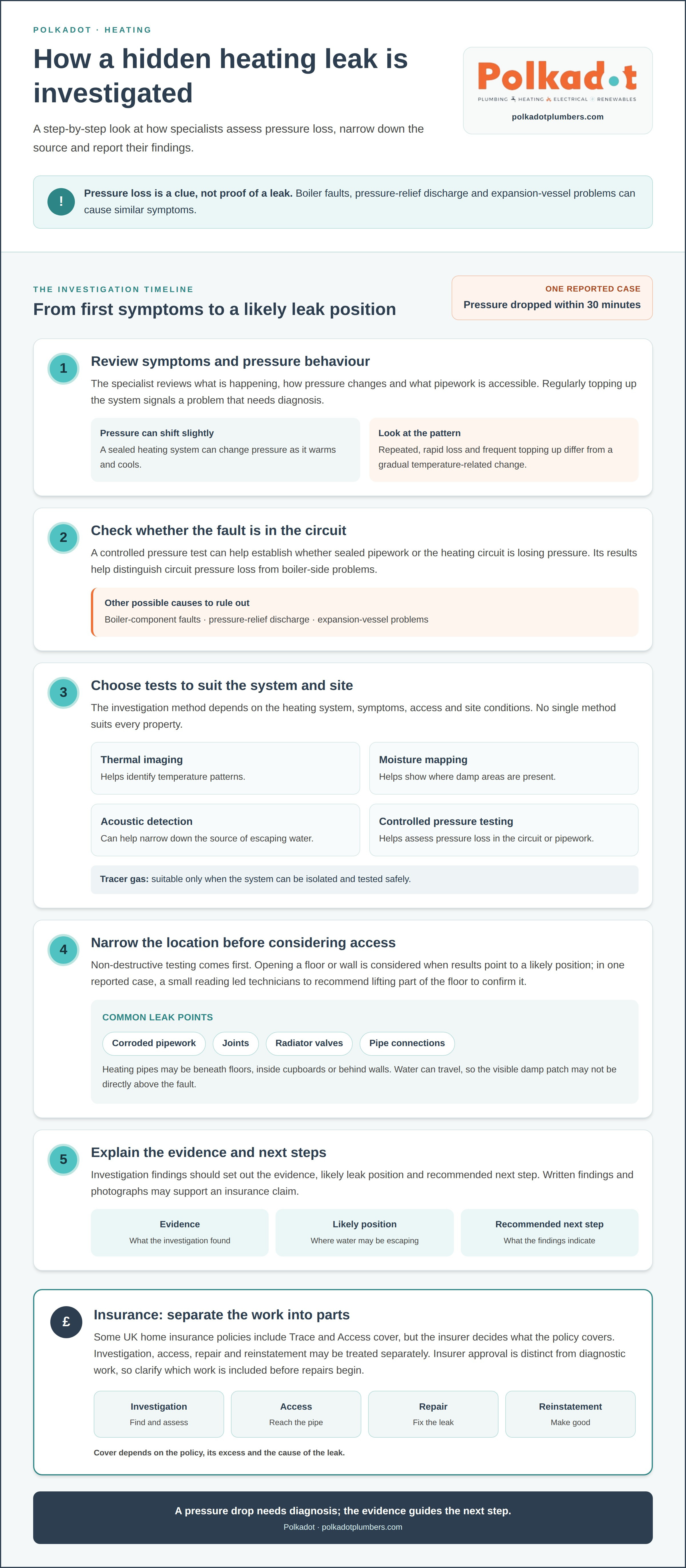
Central heating leak detection and insurance cover
Insurance may help with the cost of finding and accessing a hidden central heating leak, but cover depends on your policy, its excess and the cause of the leak. Some UK home insurance policies include Trace and Access cover; investigation, repairs and making good may be treated differently. Central heating leak detection can help establish where water is escaping and provide findings that may support a claim.
A falling boiler pressure or repeated need to top up the system can signal a leak, but it can also point to a boiler or system fault. It’s understandable to want a clear answer before damage spreads or you make an insurance claim.
This guide explains what insurance may cover, the warning signs to look for and how professionals investigate hidden leaks. You’ll also learn where central heating leaks commonly occur and how specialists distinguish leaks from other causes of pressure loss or poor heating performance.
Table of Contents
Distinguishing leaks from boiler or system faults
Repeated boiler pressure loss needs investigation, but it doesn’t prove there’s a leak. Pressure can shift slightly as a sealed heating system warms and cools. Regularly topping it up signals a problem that needs diagnosis. The cause may be escaping water, a boiler fault or another system issue.
Possible causes include concealed pipework leaks, boiler-component faults, pressure-relief discharge and expansion-vessel problems. Each can cause a pressurised heating system to lose pressure. A visible damp patch supports a leak diagnosis, but hidden pipes may leave no obvious mark. Pressure loss alone cannot show where the fault lies.
A controlled pressure test can help establish whether sealed pipework or the heating circuit is losing pressure. A specialist uses the results to distinguish circuit pressure loss from boiler-side problems. Pressure-relief discharge and expansion-vessel faults may also need to be ruled out. This helps avoid treating every pressure drop as a hidden leak.
Other symptoms add context, but aren’t conclusive on their own. Uneven heating can result from system imbalance, restrictions, trapped air or a leak. Frequent air build-up in radiators can also relate to pressure changes, corrosion or leakage. New or unusually loud gurgling may signal a problem that needs further investigation.
In one investigation, a concealed heating-circuit leak was considered after system pressure dropped within 30 minutes. That timing illustrates why the pattern of pressure loss matters. A gradual change as the system heats and cools differs from repeated, rapid loss that requires frequent topping up. The boiler’s other symptoms also help guide diagnosis.
Can a leaking central heating system be dangerous? Escaping water can damage floors, walls and furnishings, while repeated fresh-water top-ups can dilute inhibitor protection and contribute to corrosion or blockages. Even a small leak may reduce pressure and gradually affect heating performance. If you suspect a leak, turn off the heating to help limit further damage.
Investigation process and likely leak locations
A professional investigation starts with a review of symptoms, pressure behaviour and accessible pipework. The specialist then selects suitable tests based on the heating system, access and site conditions. Thermal imaging, acoustic detection, moisture mapping and controlled pressure testing can help narrow down the source. Not every method suits every property or system.
Common causes include corrosion and leaks at joints, radiator valves or pipe connections. Heating pipes may run beneath floors, inside cupboards or behind walls, so water can travel before appearing elsewhere. Tracer gas testing is suitable only when the system can be isolated and tested safely.
Investigation findings should explain the evidence, likely leak position and recommended next step. Non-destructive testing comes first; opening a floor or wall is considered when results point to a likely location. In one reported case, technicians found a small reading and recommended lifting part of the floor to confirm the position.
Written findings and photographs may support an insurance claim, but the insurer decides what the policy covers. Investigation, access, repair and reinstatement may be treated separately, and insurer approval is distinct from diagnostic work. Agreeing which work is included helps clarify the scope before repairs begin.
There’s no single rate for every investigation. The work involved depends on access, system type, symptoms and testing methods; repair and reinstatement are separate considerations. During an assessment, a professional can also identify corrosion or weak connections and recommend suitable maintenance to help reduce future leaks and pressure loss.
For an investigation that needs specialist assessment, heating support can help establish the next practical step. A professional diagnosis can distinguish a likely pipework leak from other system issues, then guide decisions about access and repair.
Leaks beneath different floor types
Heating pipes can run beneath floors, inside cupboards or behind walls, so a leak may remain hidden while moisture spreads. A wet patch isn’t always directly above the fault. For example, water escaping beneath a hallway floor may travel before showing at an edge or nearby wall. Visible damage is useful evidence, but it doesn’t pinpoint the leak.
Flooring can offer clues. Raised laminate may suggest moisture beneath it, while soft wooden boards can point to dampness below. Loose or hollow-sounding tiles are another warning sign. A warm patch underfoot when the heating is off can also help a professional identify an area for closer investigation.
A faint musty smell with no obvious cause may indicate moisture beneath floors or behind walls. New discolouration on a nearby wall or ceiling can provide another clue. These signs don’t establish the pipe’s exact position, so a professional considers them alongside the heating system’s symptoms and the building’s layout.
To locate a concealed leak, a specialist assesses the affected floor and chooses suitable non-destructive tests. Thermal imaging can help identify temperature patterns, while moisture mapping can show damp areas. Acoustic detection or controlled pressure testing may also help, depending on the system and site conditions. No single method suits every floor or investigation.
What should you do immediately if a central heating pipe is leaking? Turn off the heating to help limit further damage, then assess the affected area and plan a safe investigation. Avoid opening flooring simply to search; consider access work when evidence points to a likely leak position. Renters should report the leak to their landlord or letting agent straight away, as repairs are their responsibility.
Signs of a central heating leak
A hidden leak may leave clues before water becomes visible. Watch for new wall or ceiling discolouration, damp areas, or a musty smell without another clear cause. These signs can indicate moisture escaping from pipework concealed behind a surface. Their position may not match the leak itself, because water can travel through building materials.
Look closely at exposed pipes and valves for white residue, green corrosion or crusty marks. These deposits can form where moisture has escaped around a fitting, even without a fresh wet patch. Dampness near a radiator connection, for example, makes that joint worth investigating. A professional considers nearby pipework and other symptoms before identifying the source.
A persistent cold spot on a radiator can also be associated with a leak. Bleeding the radiator won’t resolve the problem if water is escaping from the heating circuit. Uneven warmth alone has other possible causes, so it’s more significant alongside recurring boiler pressure loss, damp or visible residue.
Notice whether heating performance or energy bills change without a corresponding change in use. A leak can reduce system efficiency, and even a small amount of escaping water may gradually affect performance. Record when symptoms appear, which rooms are affected and whether the boiler keeps losing pressure. This pattern gives a specialist useful context.
No single clue proves there’s a leak. A combination, such as new staining, residue at a valve and repeated pressure loss, gives a clearer reason to arrange professional assessment. Central heating leak detection methods can then be selected to suit the system and evidence, rather than relying on visible water alone. This helps distinguish a concealed pipework leak from other heating problems.
If these signs are appearing together, arrange a professional leak assessment to identify the likely source and next steps.
Polkadot: Heating
Polkadot provides heating and damp and leak detection for homes with suspected central heating leaks across London. Turn to the team when recurring pressure loss, damp patches or staining suggest a problem that needs professional assessment. A careful investigation can help establish whether the issue relates to the heating system or moisture elsewhere in the property.
Share the symptoms you’ve noticed, including where dampness appears and whether boiler pressure keeps dropping. This context helps focus the next steps. If you’re making an insurance claim, keep the investigation findings and photographs, then confirm cover directly with your insurer. Policies can treat leak investigation, access, repairs and reinstatement differently.
For help with a heating or leak concern in London, contact Polkadot to discuss the next step.
Take the next step with confidence
Once you suspect a heating-system problem, a clear record of what you’ve noticed can help move the conversation forward. Note which rooms are affected, where marks or damp appeared, and how the heating has behaved. If boiler pressure has changed, record the pattern without repeatedly topping up the system to mask the issue.
For an insurance claim, keep your policy details and any correspondence together with the investigation findings. Your insurer’s terms determine how the work relates to your claim, so follow its instructions when planning what happens next. A focused professional assessment can give you a clearer basis for deciding how to proceed.
When central heating leak detection is the next step, share the symptoms and any relevant claim information with Polkadot. Contact Polkadot about leak detection to discuss your situation and move towards a practical resolution.
Frequently Asked Questions
Are central heating leaks covered by my insurance?
Some UK home insurance policies include Trace and Access cover, but the policy terms determine what’s covered. The insurer may treat locating the leak, accessing pipework, repairing it and reinstating surfaces separately. Before authorising opening-up or repair work, clarify the claims process with your insurer. Keep the investigation report, photographs and relevant correspondence together to help explain what happened and what work is proposed.
Can tracer gas be used on central heating systems?
Yes, tracer gas can be used when the heating system can be isolated and tested safely. A specialist selects the method according to the system, symptoms and site conditions. It isn’t automatically suitable for every installation. The investigation should establish whether testing is appropriate before the equipment is used, particularly where the system’s layout or access makes isolation difficult.
How do professionals find a hidden heating pipe leak?
Professionals combine symptoms with suitable tests to narrow down the leak’s likely position. Depending on the property, they may use thermal imaging, acoustic detection, moisture mapping or controlled pressure testing. For instance, a pressure test can help assess whether a sealed circuit is losing pressure, while moisture mapping can identify affected areas. The evidence guides the next step in the investigation.
How do professionals find which radiator is leaking?
A specialist examines the radiator, its valves, pipe connections and valve glands for signs of escaping water or residue. If the leak isn’t visible, controlled testing can help assess the relevant part of the heating circuit. A cold radiator alone doesn’t identify a leak, so the professional considers it alongside pressure behaviour and other system symptoms before drawing a conclusion.
What happens after a likely heating leak area is identified?
The professional explains the evidence and recommends how to confirm the suspected position. If confirmation requires access through a floor or wall, agree on that opening-up work as a separate part of the scope. Repair, reinstatement and insurer approval may also be separate. Ask for the findings and proposed next steps in writing, particularly if you’re preparing an insurance claim.
Will floors need to be lifted?
Not necessarily. Specialists can begin with non-destructive investigation methods, then recommend lifting flooring when evidence points to an area that needs direct confirmation or access. For example, a small reading beneath one section may indicate where further inspection is useful. The extent of access depends on the findings, floor construction and work required to reach the pipe.
Comments