

London Commercial Plumbing: A Dependable 2026 Guide
- James Nathan
- 10 hours ago
- 11 min read

What if a single undetected leak beneath your floorboards is currently costing your business more in structural repairs than your annual maintenance budget? Managing a London property in 2026 means balancing high operational costs with increasingly strict environmental standards. You likely already know that a minor pipe failure can quickly escalate into significant downtime; however, the real threat often lies in the complex web of UK health and safety regulations. Finding dependable commercial plumbing services shouldn't be a source of constant anxiety.
We understand that you need more than just a quick fix. You need a partner who ensures your building remains a high-performing asset rather than a liability. This guide will show you how professional oversight protects your bottom line, ensures you meet the 30th June 2026 RPZ valve compliance deadline, and reduces long-term costs through preventative care. We'll explore the transition to energy-efficient systems, the necessity of Gas Safe expertise, and how modern leak detection can prevent the damp issues that plague older London stock.
Table of Contents
Understanding Commercial Plumbing Services: More Than Just Larger Pipes
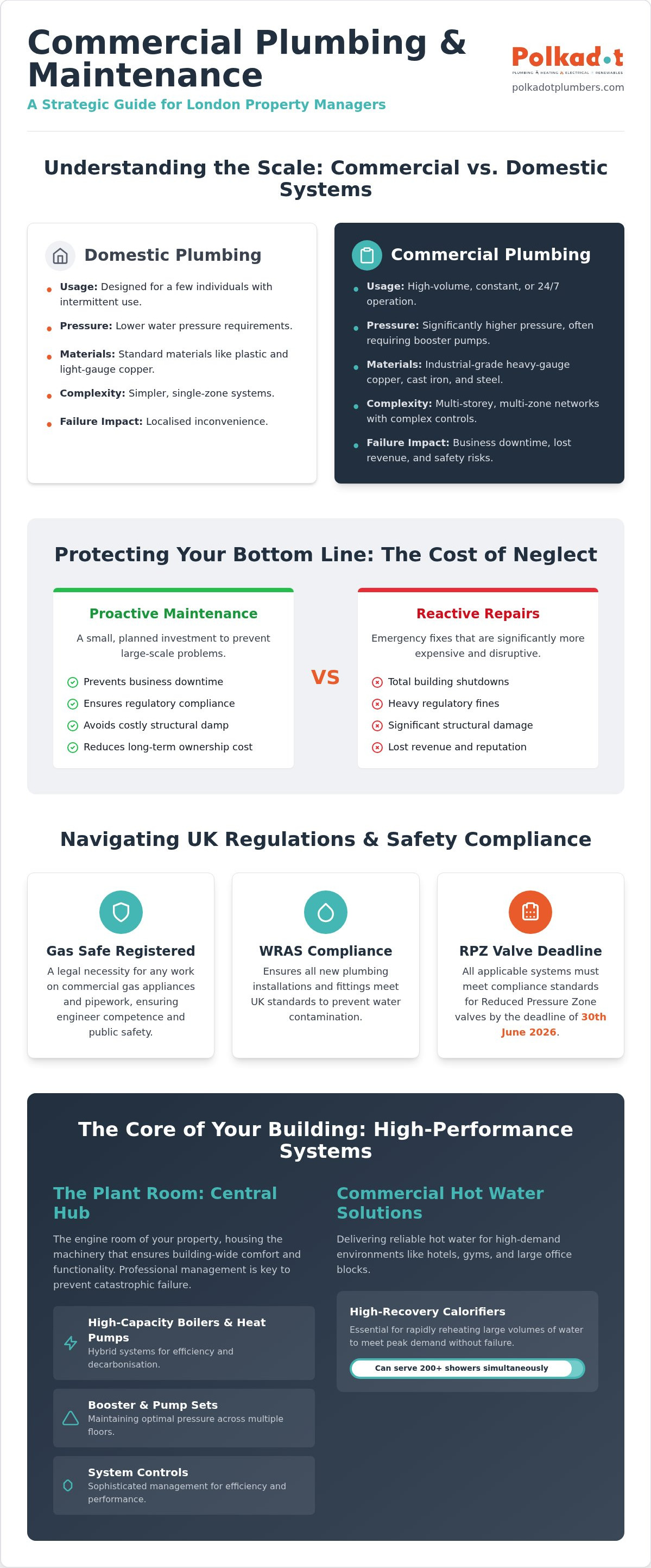
Commercial plumbing isn't simply a scaled-up version of your home setup. Whilst domestic systems are designed for a few individuals, commercial infrastructure must support high-volume usage, often across multi-storey or industrial environments. Investing in professional commercial plumbing services is a strategic move for any London property manager. These systems involve complex drainage networks, significantly higher water pressure requirements, and the use of industrial-grade materials like heavy-gauge copper or cast iron. Understanding the architecture of Plumbing systems within a commercial context allows managers to make informed decisions about maintenance and upgrades.
A standard domestic plumber might excel at fixing a kitchen tap, but they often lack the specialised equipment and certifications required for a commercial plant room. Commercial engineers act as guardians of business continuity. They don't just fix leaks; they manage the intricate balance of pressure and temperature that keeps a building operational and safe. A failure in a commercial setting doesn't just cause a mess; it can lead to total building shutdowns, regulatory fines, and lost revenue.
Scale and Complexity in Business Premises
Managing a London office block requires a deep understanding of multi-zone heating and water distribution. Each floor may have different demand levels, requiring sophisticated pressure-reducing valves and booster pumps to ensure consistent flow. In the hospitality sector, the challenges shift toward managing large-scale grease traps and high-capacity drainage to prevent blockages that could shutter a kitchen. We prioritise the integration of redundant systems; if one pump fails, a backup should immediately take the load. This fail-safe approach is what separates professional commercial management from reactive, "best-effort" repairs.
Usage Patterns and System Stress
Usage patterns in a commercial building are relentless. Unlike a house where pipes rest overnight, many London businesses operate 24/7. This constant stress accelerates the wear and tear on valves, seals, and heating elements. When we design or maintain systems for hotels or gymnasiums, we calculate peak demand with precision. Providing hot water for 200 morning showers simultaneously requires high-recovery calorifiers that a standard boiler simply cannot match. Choosing industrial-grade fixtures is a cost-effective long-term investment because they are built to withstand this punishing cycle, reducing the frequency of emergency repairs and the total cost of ownership over the building's lifecycle.
The Core Components of a Robust Commercial Plumbing System
A plant room is the central hub for building-wide mechanical services. It houses the heavy machinery that keeps a property liveable; from high-capacity boilers to sophisticated pump sets managed by commercial plumbing services. Maintaining these components requires a deep understanding of hydraulic balancing and thermal dynamics. As environmental standards tighten, many London businesses are looking to integrate air source heat pumps alongside traditional systems. This hybrid approach offers a bridge toward decarbonisation whilst ensuring the building can meet peak heating demands even during the coldest months.
Plant Rooms and Centralised Heating
Efficiency in a plant room isn't just about the boiler's age. It's about how well the pumps and controls talk to each other. We follow the strict professional standards set by the Chartered Institute of Plumbing & Heating Engineering to ensure every installation meets the highest safety benchmarks. Regular servicing of these centralised hubs prevents the catastrophic failure of building-wide services. If a pump fails in a twenty-storey building, the disruption is immediate and widespread. We focus on preventative care to keep these systems running at optimal pressure levels.
Commercial Hot Water Solutions
Choosing between centralised hot water and point-of-use systems depends entirely on your building's footprint and usage. For high-demand environments like hotels, high-recovery calorifiers are essential. These units reheat large volumes of water rapidly, ensuring guests never face a cold shower. However, management must balance this with strict temperature control. Storing water at 60°C is vital to prevent Legionella, yet we must use thermostatic mixing valves to prevent scalding at the outlet. Maintenance of these unvented systems should focus on:
Testing temperature sensors and immersion heaters for accuracy.
Checking expansion vessel pressures and relief valves.
Inspecting for internal scale build-up in London's hard water areas.
Verifying the integrity of thermal insulation on all accessible pipework.
Drainage and Backflow Prevention
In high-density London environments, drainage systems face immense pressure. We design strategic drainage solutions that account for the unique vertical challenges of the capital's architecture. Equally critical is backflow prevention. This involves installing and testing devices like RPZ valves to ensure that contaminated water cannot flow back into the public mains. It's a legal requirement under the Water Supply (Water Fittings) Regulations. If you are unsure about your building's current compliance status, a detailed plumbing survey can identify any hidden risks in your infrastructure.
Reliable commercial plumbing services focus on these core components to build a resilient system. By treating these elements as an integrated whole rather than isolated parts, we help property managers reduce the frequency of emergency call-outs and extend the operational lifespan of their mechanical assets.
Preventative Maintenance vs. Reactive Repairs: Protecting Your Bottom Line
Waiting for a failure to occur often means you're already losing money. Whilst reactive repairs deal with immediate crises, they carry hidden costs that far exceed the invoice for the fix itself. Emergency call-out fees, property damage, and the potential for lost revenue during building closures can quickly drain a maintenance budget. By contrast, professional commercial plumbing services focus on identifying "invisible" issues before they manifest as emergencies. A slow-moving leak behind a wall or a failing valve in a plant room might go unnoticed for months, quietly causing structural damp and inflating your water bills.
Proactive care is about more than just checking pipes; it's about ensuring your building remains compliant with UK Building Regulations (Approved Document G). These regulations set strict standards for water efficiency and hot water safety that require consistent monitoring. We recommend tailoring a maintenance schedule to your specific building type. A high-traffic retail centre in the West End will have vastly different stress points compared to a boutique office in the City. Using specialised leak detection London services allows us to pinpoint faults with surgical precision, protecting your property's integrity without the need for invasive trial-and-error digging.
The ROI of Preventative Care
Investing in a maintenance programme delivers a clear return on investment by extending the operational lifespan of expensive assets. Pumps, boilers, and calorifiers are significant capital expenditures; regular servicing ensures they don't fail prematurely. Furthermore, identifying minor leaks across a large site can lead to substantial savings on metered water bills. Beyond the financial figures, there is the vital factor of reputation. For a hotel or a high-end gymnasium, a plumbing failure that forces a closure can cause lasting damage to the brand's reliability in the eyes of its clients.
Diagnostic Technology in Maintenance
Modern commercial plumbing services rely on sophisticated technology to maintain building health. We use thermal imaging and acoustic sensors to provide non-destructive leak detection, allowing us to "see" through surfaces without causing damage. CCTV drain surveys are equally essential, providing a clear view of the health of underground pipework and identifying potential blockages before they cause a backup. Modern sensors can detect moisture levels through solid floors, providing an early warning system before damp becomes visible to the naked eye. This data-driven approach moves maintenance from guesswork to a precise science, ensuring your building remains a stable and efficient environment for your tenants.
Compliance and Safety: Navigating UK Regulations for Business Premises
Compliance isn't just a box-ticking exercise; it's a legal shield for your business. In London's high-density environment, ageing infrastructure often hides regulatory risks that can lead to severe penalties. Professional commercial plumbing services ensure every installation meets the Water Regulations Advisory Scheme (WRAS) standards. This prevents contamination and ensures only approved materials touch your water supply. Neglecting these rules can result in heavy fines or the invalidation of your building's insurance policy. Staying ahead of these requirements protects both your tenants and your professional reputation.
Gas Safety and Plant Room Certification
Every commercial gas appliance, from massive plant room boilers to kitchen catering equipment, must be inspected by a Gas Safe registered engineer annually. It's a non-negotiable legal requirement. You must maintain a clear, auditable trail of service records. These documents are essential for insurance claims and Health and Safety Executive (HSE) inspections. If you manage a site with gas-fired systems, the legal liability for any failure rests squarely on the business owner or property manager. Regular certification ensures your equipment operates safely and efficiently, reducing the risk of carbon monoxide incidents or gas leaks.
Water Hygiene and Legionella Control
Legionella risk assessments are a mandatory requirement for commercial landlords under the L8 Approved Code of Practice. You must monitor water temperatures consistently. Cold water must stay below 20°C, and hot water should be stored at 60°C to kill harmful bacteria. Plumbers play a vital role here by implementing flushing regimes for rarely used outlets and cleaning storage tanks regularly. This proactive approach supports your broader HSE duties and keeps tenants safe. A robust water hygiene plan includes:
Regular temperature logging at sentinel taps.
Annual inspections of cold water storage tanks.
Quarterly descaling of showerheads and spray taps.
Documented remedial actions for any identified risks.
Before you sign a new commercial lease in London, a professional plumbing survey is essential. It identifies legacy issues like lead piping, inadequate drainage, or non-compliant backflow prevention that could cost thousands to rectify later. Don't inherit someone else's plumbing disaster. If you're concerned about your building's current standing, you can book a comprehensive compliance audit with our expert team to ensure every pipe and valve meets modern standards.
Polkadot: Integrated Property Maintenance for London Businesses
Polkadot provides more than just standard commercial plumbing services; we offer a unified approach to property health and longevity. By merging expertise in plumbing, heating, and electrical installations, we eliminate the stress of managing multiple contractors for a single project. Our Gas Safe registered engineers understand the unique pressures of the London market, where Victorian-era infrastructure often meets the high-demand requirements of modern office blocks. We act as a stabilising force for your operations, providing London-wide emergency coverage that prioritises your business continuity and asset protection.
Environmental responsibility is a core pillar of our service. We support London’s transition to net-zero by integrating air source heat pumps and solar power batteries with your existing mechanical systems. This multi-disciplinary insight ensures that your heating and water distribution work in perfect harmony with your renewable energy goals. Whether you're planning a full plant room overhaul or a bespoke washroom refurbishment, we focus on high-efficiency components that reduce long-term operational costs and carbon footprints. Our specialist knowledge in damp and leak detection further protects your building's structural integrity, preventing the long-term decay often found in ageing London stock.
Modern Solutions for Modern Properties
We combine traditional trade craftsmanship with smart building monitoring to give you total control over your assets. Smart sensors allow us to detect anomalies in water usage or temperature fluctuations before they trigger a system-wide failure. This diagnostic precision is vital during complex refurbishment projects, ensuring that new installations are future-proofed against evolving UK regulations. From car charging points to advanced solar installations, we provide the technical depth required to manage a high-performing commercial portfolio in a competitive city. We believe that modern commercial plumbing services should be proactive rather than just reactive.
The Polkadot Promise of Reliability
Reliability is the cornerstone of every interaction we have with our clients. We follow a methodical diagnostic process that keeps you informed at every stage, ensuring complete transparency in both our technical findings and our project timelines. We know that building works can be intrusive for your staff and visitors. Our engineers work diligently to minimise disruption to your employees and clients, scheduling major works to suit your specific operational flow. We don't just fix pipes; we provide a sense of security through professional integrity and unyielding standards. Ensure your property is in safe hands. Contact Polkadot for your commercial plumbing needs today.
Securing Your Property’s Operational Future
Managing a commercial building in London requires a strategic shift from fixing problems to preventing them. Technical scale within business systems demands more than basic repairs; it requires a deep understanding of plant room dynamics and rigid compliance with UK safety standards. By choosing professional commercial plumbing services, you aren't just maintaining pipes; you're protecting your business assets from the costly disruption of structural damp and regulatory non-compliance. Integrating modern leak detection and renewable energy solutions ensures your property remains efficient and future-proof in an evolving market.
We're here to provide the peace of mind that comes with expert oversight. Our team of Gas Safe Registered Engineers offers comprehensive London Emergency Coverage, acting as specialists in leak detection and renewables to keep your operations running smoothly. Taking action now prevents minor issues from becoming major liabilities tomorrow. Book a professional commercial plumbing survey for your London property to ensure your infrastructure is safe, compliant, and ready for the years ahead. We look forward to helping you build a more resilient and sustainable business environment.
Frequently Asked Questions
What is the difference between domestic and commercial plumbing services?
Commercial systems support high-volume, multi-storey usage whilst domestic setups focus on single-family needs. The primary difference lies in the complexity of drainage and the requirement for industrial-grade materials like heavy-gauge copper. Professional commercial plumbing services must also manage higher water pressure and complex plant room machinery that standard domestic plumbers simply aren't equipped to handle or certify.
Do I need a specific plumbing survey for a new commercial property?
Investing in a professional Plumbing Survey is critical before acquiring any business premises. It allows you to identify hidden risks such as ageing lead pipework or non-compliant backflow prevention before you sign a lease. This diagnostic process protects you from inheriting expensive structural repairs or regulatory liabilities that could disrupt your operations and drain your maintenance budget unexpectedly.
How often should a commercial building have a plumbing maintenance check?
We generally recommend at least one major maintenance check annually, though high-usage buildings like hotels or gymnasiums often require quarterly inspections. Regular checks focus on identifying slow-moving leaks and verifying the integrity of pumps and valves. This proactive approach significantly reduces the likelihood of emergency repairs and extends the operational lifespan of your core mechanical assets across the property.
Are your plumbers Gas Safe registered for commercial premises?
Yes, every engineer on our team is Gas Safe registered for commercial premises. This is a non-negotiable legal requirement for maintaining commercial boilers and catering equipment safely. We provide the auditable service records you need for insurance purposes and Health and Safety Executive (HSE) compliance, ensuring your building remains a safe environment for your employees, tenants, and clients.
Can you help with leak detection in a large office building?
We specialise in advanced Damp and Leak Detection for large-scale properties using non-destructive technology. By employing thermal imaging and acoustic sensors, we can pinpoint faults behind walls or beneath solid floors without causing structural damage. This precise diagnostic method is far more efficient than traditional trial-and-error digging, especially in high-density London office blocks where disruption must be kept to a minimum.
Do you provide emergency commercial plumbing services in London?
We provide dedicated London Emergency Plumbing coverage to help businesses recover quickly from sudden system failures. Our focus is on stabilising the situation and protecting your property assets from water damage. Whilst we don't offer 24/7 services, we prioritise rapid response during business hours to minimise downtime and ensure your operations remain functional and safe for everyone on-site.
How can commercial plumbing services help my business become more sustainable?
We support your transition to net-zero by integrating Air Source Heat Pumps and solar power batteries with your existing plumbing systems. Upgrading to modern, energy-efficient components reduces both your carbon footprint and long-term operational costs. We help you design a sustainable infrastructure that meets the latest UK environmental standards whilst maintaining the high performance required for a busy commercial environment.
What are the legal requirements for water safety in commercial buildings?
Commercial landlords must conduct mandatory Legionella risk assessments and ensure all new installations are WRAS compliant. You must also adhere to the 30th June 2026 deadline for updated RPZ valve testing equipment to prevent mains contamination. These regulations are designed to ensure the safety of hot water systems and the integrity of the public water supply across all business premises.


Comments