
No Hot Water from Combi Boiler in London? A Troubleshooting Guide (2026)
Imagine stepping into the shower on a frantic Tuesday morning, only to be met with a blast of icy water that refuses to warm up. Dealing with no hot water from combi boiler London systems is an incredibly stressful way to start your day, especially when you're already balancing a busy commute or a school run. It's a common frustration across the capital, where our heating systems work tirelessly against the elements and the city's notoriously mineral-heavy water supply.
We know that a sudden breakdown feels like an expensive disaster, but it doesn't always mean you're facing a massive repair bill or a complex technical failure. This guide helps you identify the most likely culprits, from simple pressure drops to the impact of London's hard water on your boiler's internal components. You'll discover which quick resets you can safely perform yourself and when it's essential to call a Gas Safe registered engineer. We also explore the latest 2026 safety standards and preventative measures to keep your hot water flowing reliably for years to come.
Table of Contents
Identifying the Symptom: Why Your Combi Boiler Has Stopped Delivering Hot Water
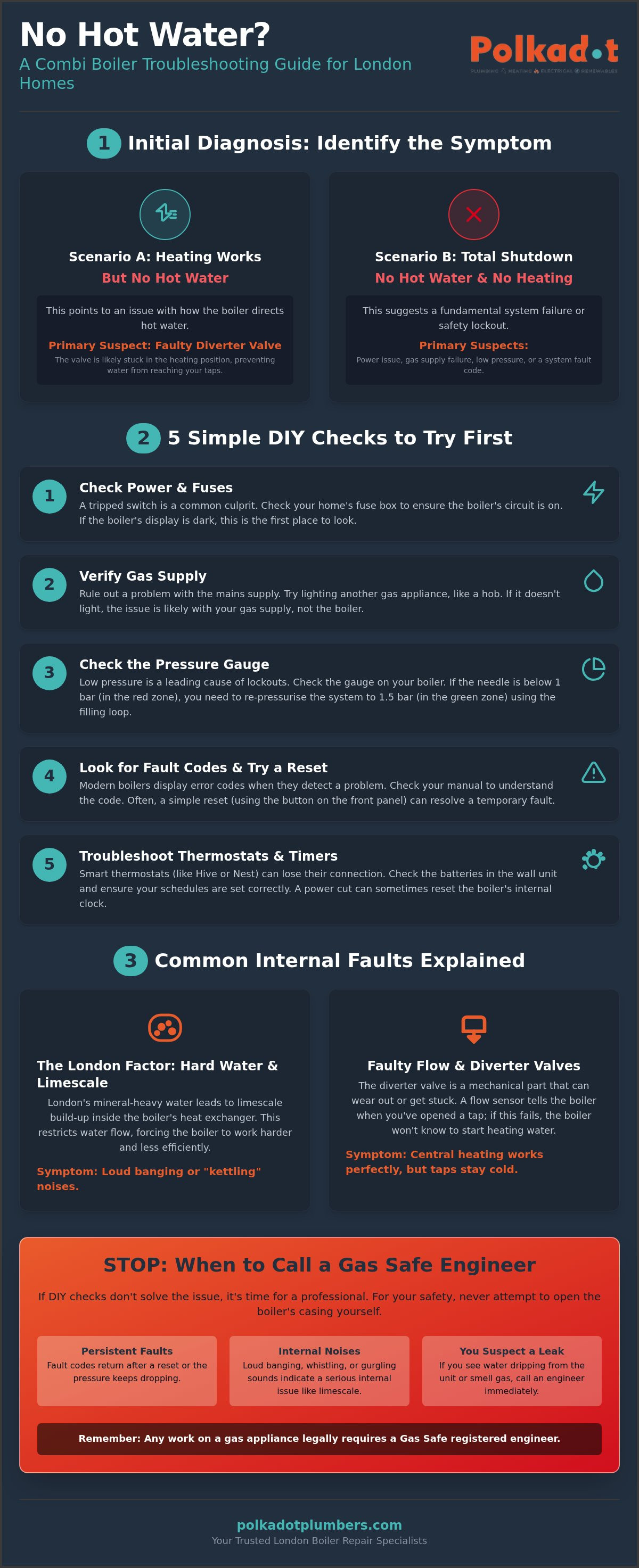
Finding yourself with no hot water from combi boiler London systems often happens at the least convenient moment. Before you begin to worry about repair costs, you need to play detective. The first step is identifying exactly how the system is behaving, as the specific symptoms provide vital clues for a diagnosis. Start by checking every hot tap in your home. If the kitchen tap provides hot water but the bathroom shower remains cold, the issue likely lies with your plumbing or a specific thermostatic valve rather than the boiler itself. However, if the entire property is affected, the boiler is almost certainly the culprit.
Pay close attention to the temperature and the sounds coming from the unit. Is the water completely cold, or is it merely lukewarm? Lukewarm water often suggests a high flow rate or a failing temperature sensor. You should also listen for unusual noises. Whistling, vibrating, or banging sounds, often called "kettling," are frequent occurrences in London due to our mineral-heavy water. These noises usually indicate that limescale has restricted the water flow within the heat exchanger, causing the unit to overheat and shut down prematurely.
Scenario A: Heating Works, But No Hot Water
If your radiators are piping hot but your taps are cold, the issue is likely a faulty diverter valve. This mechanical component acts as a gateway, directing hot water either to your radiators or to your taps. To understand the logic, it helps to look at how central heating works in a combi system. Because these boilers prioritise hot water, the valve should automatically close off the heating circuit the moment you open a tap. If the valve is stuck or the motor has failed, the boiler might "think" it's still in heating mode. You can test this by turning your central heating off at the thermostat and waiting for the radiators to cool. If the taps still don't get hot, the diverter valve is the primary suspect.
Scenario B: No Hot Water and No Central Heating
A total loss of both services usually points to a fundamental power or fuel issue. First, check the boiler's display panel. If it's completely dark, you may have a tripped switch in your fuse box or a blown fuse in the boiler's spur. If the display is active but showing a fault code, the system has detected a safety issue and locked itself out. In many older London properties, you might still have a boiler with a permanent pilot light. If a draught has extinguished this small blue flame, the boiler cannot ignite to provide heat. Dealing with no hot water from combi boiler London units in this scenario requires checking your gas supply first; try lighting a gas hob to see if the fuel is reaching your home.
5 Simple DIY Checks to Restore Your Hot Water
Before you assume the worst, several safe DIY steps can often restore your system. If you're experiencing no hot water from combi boiler London units, your first stop should be the fuse box. A tripped circuit can easily cut power to the boiler's ignition system. You should also verify your gas supply is active by lighting a gas hob. If the hob works, you've ruled out a regional gas outage. Finally, look at the boiler's display for any flashing fault codes. Many modern units simply require a manual reset, which you can perform by following the manufacturer's instructions on the front panel.
Checking Pressure and Re-pressurising Your System
Low pressure is a leading cause of boiler lockouts. Look for the circular gauge on your boiler's control panel. If the needle is resting below 1 bar, the system lacks the necessary water volume to function correctly. To fix this, locate the filling loop, usually a silver braided hose with two small black taps found underneath the unit. Open both taps slowly; you will hear water entering the system. Watch the gauge carefully and close the taps once the needle reaches 1.5 bar. If you notice the pressure dropping again shortly after, you may need to consult the standards for Professional Boiler Repairs in London to find a permanent solution.
Troubleshooting Smart Thermostats and Timers
In many modern London refurbishments, smart controls like Hive or Nest are common. These devices are excellent for efficiency, but they can occasionally lose synchronisation. If your boiler appears to be working but isn't responding to your taps, check the batteries in your wall-mounted thermostat. A weak battery often causes intermittent signal loss. Additionally, London's occasional power cuts can reset the boiler's internal clock or wipe your programmed "Hot Water" schedules. Open your mobile app and ensure your timings haven't defaulted to an "Off" state. If your smart tech is correctly configured but you still have no hot water from combi boiler London, our experts at Polkadot Plumbers can investigate the receiver's wiring.
Common Internal Faults: From Diverter Valves to Scaled Heat Exchangers
When basic DIY checks fail to restore your supply, the issue usually lies deep within the boiler's internal architecture. Modern combi boilers rely on a complex network of sensors and mechanical parts to deliver instantaneous heat. At the centre of this operation is the Printed Circuit Board (PCB), which acts as the system's brain. If the PCB fails or develops a dry solder joint, it won't be able to process signals from other components. This often results in no hot water from combi boiler London systems, even if every other part is technically functional.
Another common culprit is the flow sensor. This small component detects when you have turned on a hot tap. If it becomes clogged with grit or simply wears out, the boiler never receives the command to ignite for domestic water. In older boiler models, you might find a rubber diaphragm that performs a similar task; these frequently perish over time, preventing the mechanical ignition sequence from starting. For more detailed technical background, the Gas Safe Register guide provides an excellent overview of how these various internal mechanisms work together to keep your home safe and warm.
The Diverter Valve: The Gatekeeper of Your Hot Water
A diverter valve is the internal component that directs heat either to radiators or the hot water plate. Because this part moves every time you switch between heating and hot water, it's prone to mechanical wear. In London, the high mineral content in our water often leads to limescale build-up on the valve's internal pin or seat. If debris or scale jams the valve in the "heating" position, you'll find that your radiators stay warm whilst your taps remain cold. A lukewarm shower is another classic symptom, suggesting the valve is only partially opening and allowing heat to bleed into the central heating circuit instead of focusing entirely on your water.
Blocked Plate Heat Exchangers
The plate heat exchanger is responsible for transferring energy from the primary boiler circuit to your domestic tap water. It consists of several thin metal plates stacked together. Over time, "sludge" (iron oxide) from old London radiators can migrate into these narrow channels. This build-up acts as an insulator, preventing efficient heat transfer. If you find your water starts hot but quickly turns cold, it's a sign that the heat exchanger is struggling to keep up with demand. This often leads to the boiler cycling on and off rapidly as it tries to manage the internal temperature, eventually causing a total lockout if left unaddressed. If you are experiencing no hot water from combi boiler London, a professional flush of this component is often the only way to restore full performance.
Why London’s Hard Water and Weather Affect Your Hot Water Supply
London is famous for many things, but its water quality isn't one of them. The city sits on a chalk basin, meaning our mains supply is classified as hard to very hard, often exceeding 300mg of calcium carbonate per litre. This high mineral content leads to rapid limescale build-up inside your appliances. When you experience no hot water from combi boiler London systems, the cause is often this "silent killer" of efficiency. Limescale acts as a thermal insulator on the heat exchanger. This means your boiler must work harder and hotter to heat the same amount of water, which eventually leads to component overheating and safety lockouts. In fact, research shows that limescale can reduce a boiler's efficiency by 15 to 20 percent and is responsible for 80 percent of premature failures in hard water regions.
Many Londoners live in Victorian conversions where the plumbing is a patchwork of old and new. These properties often suffer from "dead legs", which are long stretches of redundant pipework where water sits and cools. If your taps take several minutes to get warm, it might be due to the building's layout rather than a boiler fault. However, if the water never gets hot at all, the environmental factors have likely caused a mechanical failure within the unit itself.
Combating Limescale in Your London Boiler
To protect your system, you should consider fitting a magnetic scale reducer or a whole-house water softener. These devices treat the water before it enters the boiler, significantly extending the lifespan of your heat exchanger. If your system is already sluggish, a professional power flush can clear the "arteries" of your heating circuit, removing the sludge and scale that cause blockages. For those considering a modern, more resilient system, our guide to Boiler Installation London explores the best models designed to handle the capital's challenging water conditions.
Frozen Condensate Pipes: A Hidden Winter Culprit
During a London cold snap, the most common cause of a boiler lockout is a frozen condensate pipe. This is the white plastic pipe that carries acidic waste water away from your boiler to an external drain. If this pipe freezes, the water backs up into the boiler, causing it to shut down for safety. You can often identify this by a specific gurgling sound or a "frozen condensate" fault code. To fix this, simply pour warm (never boiling) water over the external portion of the pipe to thaw the ice. To prevent this from recurring, ensure your external pipework is properly insulated with weather-proof lagging. If your boiler remains locked out after thawing, you can book a Plumbing Survey with our team to ensure your pipework meets the latest 2026 installation standards.
Professional Boiler Repairs in London: When to Call the Experts
While basic troubleshooting can resolve minor issues, there is a strict boundary between safe DIY checks and professional intervention. In the UK, it's a legal requirement that only Gas Safe registered engineers perform work that involves opening the boiler's combustion casing or touching gas-carrying components. If you've tried resetting the system and checking the pressure but still have no hot water from combi boiler London, the fault is likely internal and requires a qualified expert. Attempting to repair complex gas valves or electrical boards yourself isn't just dangerous; it can also invalidate your home insurance and boiler warranty.
You must act immediately if you notice specific danger signs. The smell of gas, soot marks around the boiler's cover, or a pilot light that burns yellow instead of a crisp blue are all indicators of incomplete combustion or a gas leak. Even if your system is still providing "intermittent" hot water, you shouldn't ignore the problem. A boiler that works only occasionally is often signalling a component on the verge of total failure. Addressing these small faults early prevents a complete breakdown and ensures your home remains safe. At Polkadot Plumbers, we specialise in identifying these subtle warning signs before they escalate into an emergency.
The Value of an Annual Boiler Service
Preventative maintenance is the most effective way to avoid the stress of a cold shower. During a standard service, an engineer will inspect the diverter valve and flow sensors for the early signs of wear or limescale build-up mentioned earlier in this guide. This proactive approach ensures that your manufacturer warranty remains valid, as most brands require an annual professional check to maintain their 10 or 12 year guarantees. An annual service is the most cost-effective way to ensure hot water reliability in London properties. It allows us to clear minor debris from the system before it causes a major blockage in your plate heat exchanger.
What to Expect During a Repair Visit
When an engineer arrives to investigate no hot water from combi boiler London, they follow a methodical diagnostic process. This typically begins with electrical testing of the PCB and sensors to pinpoint the exact source of the failure. Once the fault is identified, we focus on transparency; we'll explain exactly which part has failed and why. We only use genuine manufacturer parts for replacements to ensure the long-term reliability of your heating system. Our goal is to restore your comfort with minimal disruption, providing a clear path to a warm home. Facing a cold shower? Contact Polkadot for dependable London emergency plumbing and boiler repairs to get your system back on track today.
Restoring Your Home's Comfort and Reliability
Dealing with no hot water from combi boiler London systems is a significant disruption, but it's often a problem with a clear solution. Whether you've managed to restore pressure yourself or have identified a more complex internal fault like a scaled heat exchanger, understanding your system is the first step toward a warm home. London's hard water remains a constant challenge, making regular maintenance and professional descaling essential for long-term performance and efficiency.
When DIY checks aren't enough, you need a team you can trust. Since 2019, we've served as dependable London emergency plumbing specialists, providing property maintenance that prioritises your comfort. Our Gas Safe Registered Engineers are ready to diagnose and repair your system with the precision and transparency you deserve. Don't settle for another cold morning. Book a Gas Safe Engineer for Your London Boiler Repair today and let us handle the technical details while you get back to your routine. We're here to ensure your hot water stays exactly where it belongs: flowing reliably through your taps.
Frequently Asked Questions
Why do I have heating but no hot water from my combi boiler?
This symptom usually points to a faulty diverter valve. This mechanical component directs hot water to either your radiators or your taps. If it becomes stuck in the heating position, the boiler won't provide domestic hot water even when you turn on a tap. You can test this by turning off your central heating and seeing if the tap water remains cold. It's a common failure in older boiler systems.
Is it safe to reset my boiler if I have no hot water?
Yes, it's generally safe to reset your boiler once or twice using the manufacturer’s reset button. Modern units have built-in safety sensors that trigger a lockout if they detect a fault. A reset can clear minor electronic glitches. However, if the boiler continues to lock out or shows a persistent fault code, you shouldn't keep resetting it. This suggests an underlying mechanical issue that requires professional attention.
How much does it cost to fix a diverter valve in London?
The cost to repair or replace a diverter valve varies depending on the boiler model and the complexity of the installation. Generally, prices for the part itself range from £80 to £200, plus the labour costs for a qualified engineer. In London, hourly rates for Gas Safe registered professionals typically reflect the city's higher operating costs. Always request a clear breakdown of parts and labour before agreeing to any work.
Can hard water cause my boiler to stop producing hot water?
Hard water is a leading cause of boiler failure in the capital. London's high mineral content leads to rapid limescale build-up inside the plate heat exchanger. This scale acts as a thermal insulator, preventing the boiler from heating the water effectively. Over time, these mineral deposits can completely block the narrow channels, resulting in no hot water from combi boiler London systems that otherwise appear to be functioning.
How do I know if my boiler pressure is too low?
You can check your boiler pressure by looking at the circular gauge on the front of your unit. For most modern boilers, the needle should sit between 1 and 1.5 bar when the system is cold. If the needle has dropped below 1 bar, the boiler may enter a safety lockout state. This prevents it from firing up to provide hot water or heating until you top up the pressure via the filling loop.
What does a flashing red light or fault code on my boiler mean?
A flashing red light or a specific alphanumeric code indicates that the boiler's internal computer has detected a problem and shut down for safety. These codes are specific to each manufacturer. You should check your manual to identify the fault. Common codes relate to low pressure, ignition failure, or overheating. If the code persists after a reset, you must contact a Gas Safe registered engineer to diagnose the specific fault.
Why does my hot water only work when the heating is turned on?
This issue often occurs when the diverter valve is partially stuck or the flow sensor has failed. In some cases, the boiler only "notices" the demand for heat when the central heating circuit is already active. This prevents the unit from firing up independently for a hot tap. It's a frustrating symptom of no hot water from combi boiler London setups that indicates your system needs a professional mechanical inspection.
Should I try to fix a boiler leak myself?
No, you should never attempt to fix an internal boiler leak yourself. While you can safely dry up water on the floor, any repair that requires opening the boiler casing must be performed by a Gas Safe registered engineer. Leaks often originate from high-pressure components or the heat exchanger. Attempting a DIY fix is dangerous and illegal if it involves gas-carrying parts. It can also cause significant electrical damage to the control board.


Comments