
Residential Air Conditioning Installation London: The 2026 Homeowner’s Guide
Are you dreading the next record-breaking heatwave because your home turns into a greenhouse? According to the UK Green Building Council, 55% of UK homes are already prone to overheating during relatively cool summers, making sleep nearly impossible. For homeowners considering residential air conditioning installation London presents a unique set of challenges, from strict conservation rules to the delicate balance of maintaining a property's historic character. You likely worry that a cooling system will mean bulky units clashing with your period features or noise complaints from the neighbours. It is a common concern in a city where space and silence are at a premium.
We believe your home should be a sanctuary, not a sauna. This guide shows you how to achieve whisper-quiet, high-performance cooling that respects your property's aesthetics and stays well within local regulations. We will explore the latest 2026 energy standards, discreet installation techniques for period homes, and how to navigate the planning complexities of different London boroughs whilst keeping your running costs manageable.
Table of Contents
Why Residential Air Conditioning is Essential for London Homes in 2026
London's microclimate has shifted significantly over the last decade. The "Urban Heat Island" effect means the city's dense infrastructure absorbs solar radiation during the day and releases it slowly at night. This phenomenon prevents your home from cooling down naturally, even when you leave the windows open. For many homeowners, the decision to seek residential air conditioning installation London is driven by the simple need for a reliable night's sleep. It is no longer just about surviving a few peak summer days; it is about managing a local climate that remains consistently warmer than the surrounding countryside.
We should also reconsider what air conditioning is in a modern context. These systems have evolved into sophisticated climate control centres. Beyond regulating temperature, they manage humidity levels and, crucially for London residents, filter out urban pollutants and fine particulate matter. This technological shift has transformed cooling from an occasional luxury into a fundamental requirement for a healthy, productive home environment.
Air Conditioning vs. Air-to-Air Heat Pumps
Many homeowners are surprised to find that modern air conditioning units are actually highly efficient air-to-air heat pumps. This technology is remarkably effective because it moves heat rather than creating it from scratch. During a London summer, the system extracts warmth from your living spaces and transfers it outside. In the winter, the process reverses to provide supplemental heating. This dual-purpose functionality makes these systems a favourite amongst Londoners who want one energy-efficient solution for year-round comfort. It's a dependable way to ensure your property remains at the perfect temperature regardless of the unpredictable British weather.
The Impact on Property Value and Tenant Demand
The London property market is entering a new phase where thermal comfort is a non-negotiable feature. Buyers and tenants now prioritise climate control, often ranking it as highly as a modern kitchen or a refurbished bathroom. Choosing a professional residential air conditioning installation London service in 2026 is a practical way to future-proof your investment. In the high-end rental sector, properties equipped with integrated cooling see significantly higher demand and fewer void periods. You aren't just investing in your own comfort; you are adding a tangible asset that distinguishes your home from the thousands of overheating properties across the capital.
Choosing the Right Cooling System for Your London Property
London homes vary significantly in layout, from compact studio apartments in converted warehouses to five-storey Victorian townhouses. Every square metre is valuable, so your cooling solution must be as space-efficient as it is powerful. When planning a residential air conditioning installation London properties require a bespoke calculation. We don't just look at floor space; we must account for ceiling height and "solar gain" from large windows or south-facing walls. Over-speccing a system leads to unnecessary energy consumption, while an under-specified unit will work too hard and fail prematurely.
Energy efficiency is another critical factor for the modern homeowner. You should look for high SEER (Seasonal Energy Efficiency Ratio) and SCOP (Seasonal Coefficient of Performance) ratings to keep your electricity bills manageable. In 2026, aiming for an A++ or A+++ rating is the standard for sustainable home management. Legally, any system containing refrigerant must be handled by an F-Gas certified engineer to ensure safety and environmental compliance. This ensures the installation is leak-free and operates at peak performance from day one.
Split Systems vs. Multi-Split Configurations
If you only need to cool a primary bedroom or a home office, a single split system is the most straightforward route. It consists of one internal unit connected to one outdoor condenser. However, for larger homes, multi-split configurations are far more effective. These allow up to five internal units to run from a single outdoor condenser. This is a significant advantage for London properties with limited balcony space or narrow external walls where multiple outdoor units would be unsightly or prohibited by building rules.
Discreet Internal Units and Designer Aesthetics
Modern high-end refurbishments often demand that technology remains hidden. Wall-mounted units are now incredibly slim and minimalist, but they aren't your only option. For the ultimate "invisible" finish, ducted systems are the gold standard. These are tucked away within ceiling voids or joinery, leaving only small, stylish grilles visible. If you are dealing with a loft conversion with slanted ceilings, low-level console units fit perfectly against dwarf walls, providing efficient cooling without dominating the room's visual profile.
Most 2026 models now feature smart home integration as standard. You can adjust your home's temperature via a mobile app whilst on your commute, ensuring a perfect climate the moment you step through the door. If you are unsure which configuration suits your architectural layout, our team can help you organise a professional site survey to map out the most efficient and discreet route for your property.
Navigating London Planning Permission and Local Regulations
Do you need planning permission for a residential air conditioning installation London? This is one of the most common questions we hear from homeowners. The answer depends largely on your property type and its location. For most houses, installing an external condenser unit falls under "permitted development" rights, provided the unit is small and placed discreetly. However, these rights typically do not apply to flats or maisonettes. If you live in an apartment, you will almost certainly need to apply for planning permission from your local borough council and seek consent from the freeholder.
The rules become even stricter for Grade I and Grade II listed buildings. In these instances, you must obtain Listed Building Consent before any work begins. Local authorities prioritise the preservation of the building's historic fabric, so any external alterations are heavily scrutinised. Even if your project does not require full planning permission, we recommend applying for a Certificate of Lawfulness. This document provides legal proof that your installation was compliant with all regulations at the time of fitting. It is an essential piece of paperwork that protects your property value and prevents delays when you eventually decide to sell your home.
Conservation Areas: Keeping London’s Heritage Intact
London is home to hundreds of conservation areas where heritage officers work to maintain the city's unique architectural character. To satisfy these requirements, you must place external condensers where they cannot be seen from the public highway. We often use bespoke acoustic enclosures or colour-matched cages that allow the unit to blend seamlessly into the existing brickwork. In some scenarios, the most effective solution is to collaborate with London roofing services to position units on flat roof sections. This keeps the equipment hidden whilst ensuring it has the necessary airflow to operate efficiently.
Noise Regulations and Neighbourly Relations
Noise is a significant concern in London's densely populated terraced streets. Most councils enforce strict decibel limits and "Night Noise" standards to ensure that mechanical equipment does not disturb the peace. Choosing ultra-quiet condenser units is vital for maintaining good relations with your neighbours. In specific boroughs like Westminster, Camden, or Kensington and Chelsea, you might be asked to submit a professional noise assessment. This technical report measures the background noise levels and predicts the impact of the new system, ensuring your cooling solution remains a quiet, dependable addition to the neighbourhood.

The Professional Installation Process: What Homeowners Should Expect
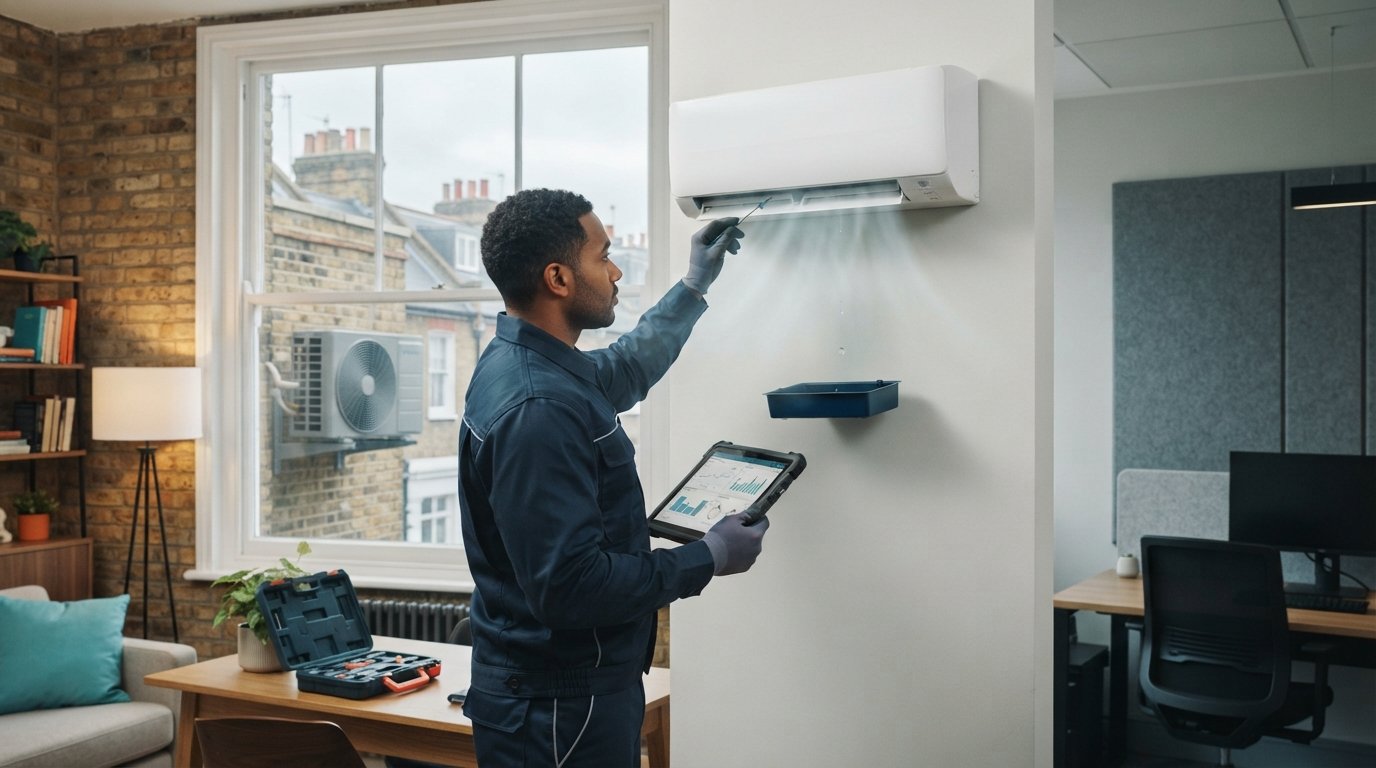
A successful residential air conditioning installation London project relies on more than just high-quality hardware. It requires a methodical, professional approach that begins long before an engineer arrives with a toolkit. Whilst some companies offer virtual quotes based on photos, these often miss the intricate details of London's diverse architecture. An on-site survey is essential to identify structural constraints, drainage requirements, and the most discreet path for pipework. This ensures the final result is both functional and aesthetically pleasing, preserving the interior design of your home.
The Pre-Installation Survey: A Diagnostic Approach
Our engineers treat the survey as a technical diagnostic process. We evaluate your existing electrical installations to ensure there is sufficient spare capacity for the new system. We also perform a heat load calculation, which factors in window orientation, ceiling heights, and insulation levels. This data determines the exact kilowatt capacity needed for each room. By identifying the most efficient route for refrigerant lines and condensate drainage early, we avoid unnecessary drilling and keep the installation as clean as possible.
Minimising Disruption During the Build
We understand that having tradespeople in your home can be stressful. To provide peace of mind, our engineers follow a strict protocol to protect your property. This includes using floor protectors and dust sheets over furnishings. We maintain a "clean-as-you-go" behaviour, ensuring that each workspace is tidied at the end of the day. For a standard single-room installation in a London property, the process typically takes one working day. Larger multi-split systems might require two to three days, depending on the complexity of the pipework routes.
Once the physical build is complete, we move to the final commissioning phase. This involves pressure testing the system to F-Gas standards, which is vital for both safety and your manufacturer's warranty. We then guide you through your new smart controls, showing you how to set schedules and manage the climate from your smartphone. If you are ready to upgrade your home's comfort, you can book a professional site survey with our F-Gas registered team today.
Why Polkadot is London’s Dependable Choice for Cooling
Choosing a partner for your residential air conditioning installation London involves more than just picking a model from a brochure. It requires a team that acts as a dependable guardian for your property. Polkadot provides a unique, integrated approach that combines cooling, electrical, and plumbing expertise under one roof. This means we don't just install a unit; we ensure your home's infrastructure can support it safely. By managing every technical aspect internally, we eliminate the common delays and communication breakdowns that occur when multiple trades try to coordinate on a single site.
Our commitment to transparent communication ensures you are never left in the dark. We use a logical, diagnostic process to explain every step of the installation, from the initial survey to the final commissioning. This professional integrity is why so many homeowners trust us with their property refurbishments. We prioritise your comfort and convenience, making the entire experience as smooth and uncomplicated as possible. You can rely on us to provide steady, solution-oriented advice that puts your long-term needs first.
Synergy with Renewable Energy
We believe that modern cooling must be sustainable. A significant trend in 2026 is the integration of climate control with renewable energy sources. By linking your high-efficiency AC system with solar panels London, you can dramatically reduce your carbon footprint. This synergy allows you to power your cooling during peak daylight hours using free, clean energy. When you add solar power batteries to the system, you can store excess power to keep your home cool through the night. This forward-thinking approach helps you build a "net-zero ready" property whilst protecting you from rising energy prices.
Maintenance: Ensuring Peak Performance for Years
A high-performance cooling system is a significant investment, and annual maintenance is the best way to protect it. Regular servicing is not just a recommendation; it is typically a requirement for maintaining your manufacturer's warranty. Our maintenance programme is thorough and methodical. We perform deep coil cleaning to ensure optimal airflow, check refrigerant pressures, and test all smart control integrations. This proactive behaviour identifies potential technical failures before they cause a breakdown. With Polkadot, you gain a long-term partner dedicated to providing reliable, local London support for the life of your system.
Future-Proof Your London Home's Comfort
Securing a professional residential air conditioning installation London homeowners can rely on is about more than just temperature control. It is an investment in your property's future and your daily well-being. You have seen how modern systems act as sophisticated climate hubs, filtering pollutants whilst providing whisper-quiet cooling that respects your neighbours. By choosing a solution that integrates with renewable technologies, you are also taking a proactive step toward a more sustainable, net-zero ready home.
Polkadot acts as a stabilising force in the often stressful world of home maintenance. As specialists in London period properties, we combine innovative technology with a deep respect for heritage features. Every project is handled by our F-Gas registered engineers, ensuring your system is safe, efficient, and fully compliant with 2026 standards. Our 5-star rated property maintenance team is here to provide peace of mind long after the initial fitting. Book your stress-free London AC survey with Polkadot today and reclaim your home's comfort.
Frequently Asked Questions
Do I need planning permission for air conditioning in London?
Yes, if you live in a flat or a listed building, you almost certainly need planning permission. Most houses fall under permitted development rights unless the property is situated in a conservation area. We always recommend checking with your specific London borough council before starting. Obtaining a Certificate of Lawfulness is a wise step to provide legal proof that your residential air conditioning installation London was completed according to all local regulations.
How much does it cost to run a residential AC unit in 2026?
Modern inverter systems are highly efficient, typically costing between 10p and 30p per hour to cool a medium-sized room. These costs can be further reduced if you integrate your system with solar power batteries. By 2026, smart technology allows you to monitor your energy consumption in real-time via mobile apps. This ensures you only use the cooling you need, preventing energy waste whilst maintaining a perfect indoor climate throughout the summer.
Can I install AC in a London flat without a balcony?
You can absolutely install air conditioning in a flat without a balcony. Internal water-cooled systems are a popular solution as they do not require an external condenser unit. These systems use the building's internal water supply to dissipate heat, making them ideal for apartments with strict planning restrictions or no outdoor space. They are discreet, effective, and often bypass the need for planning permission in many densely populated London boroughs.
How long does a typical home AC installation take?
A standard single-room installation typically takes one working day to complete. For larger properties requiring a multi-split system, the project may take between two and three days. The duration depends on the complexity of the pipework routes and the distance between the internal units and the condenser. Our engineers prioritise a clean-as-you-go approach to minimise disruption to your home life, ensuring all work areas are tidy before they depart.
Is modern residential air conditioning noisy for neighbours?
Modern residential air conditioning units are designed to be whisper-quiet, with internal units often operating at levels below 20 decibels. External condensers must meet strict local council noise ordinances, especially in terraced streets. We use acoustic enclosures and vibration-dampening mounts to ensure your system does not disturb the peace. Selecting high-quality, modern hardware is the most dependable way to ensure a quiet environment for both you and your neighbours.
What is the difference between AC and an air-to-air heat pump?
There is very little difference between the two; in fact, most modern air conditioning units are actually air-to-air heat pumps. This technology allows the system to provide powerful cooling during the summer and efficient supplemental heating during the winter months. It works by transferring heat rather than generating it from scratch, which is why it is considered one of the most sustainable ways to manage your home's temperature year-round.
How often should I have my home air conditioning serviced?
You should have your system professionally serviced at least once a year. This annual check is vital for maintaining your manufacturer's warranty and ensures the system operates at peak energy efficiency. A standard service includes cleaning the filters and coils, checking refrigerant levels, and testing all electrical connections. Regular maintenance prevents small technical issues from becoming expensive failures, providing long-term reliability and peace of mind for your home cooling system.
Can air conditioning help with my hay fever and allergies?
Air conditioning is remarkably effective at reducing hay fever symptoms. Modern units feature advanced filtration systems that capture pollen, dust mites, and fine particulate matter from the London air. Because you can keep your windows closed during high-pollen days whilst staying cool, you significantly reduce the amount of allergens entering your living spaces. This creates a much healthier indoor environment for anyone suffering from respiratory sensitivities or seasonal allergies throughout the year.


Comments