

Solar Panel Payback: Debunking Myths and Calculating Real ROI for 2026
- 12 minutes ago
- 12 min read
If you're waiting for a "perfect" moment to switch to renewable energy, you might actually be watching your potential savings evaporate under the current energy price cap. Most London homeowners are told that solar panel payback is a static ten-year wait, but does that figure still hold true as we move through 2026? It's understandable to feel hesitant when you're faced with conflicting estimates or worries about whether a system can actually perform under London's often grey skies and amongst neighbouring shadows. You want to know that your investment is a dependable force for your household budget, not a technical gamble.
This guide will strip away the industry jargon to reveal the real-world ROI you can expect right now. We'll help you calculate a precise break-even point whilst avoiding the common myths that often lead to confusion. You'll discover how to maximise your self-consumption through smart battery integration, navigate the latest Smart Export Guarantee (SEG) rates, and take advantage of the current 0% VAT incentive. By the end, you'll have the clarity needed to move from uncertainty to a confident, sustainable solution for your home.
Table of Contents
Debunking the 'Ten-Year Fixed' Solar Payback Myth
Solar payback is the point where the total money you've saved on your energy bills, combined with any payments you've received for exporting excess power, equals the amount you originally spent on the installation. For a long time, the industry relied on a "ten-year rule of thumb" for solar panel payback as a standard answer. This is no longer accurate. In 2026, several factors have converged to shorten this window for many households.
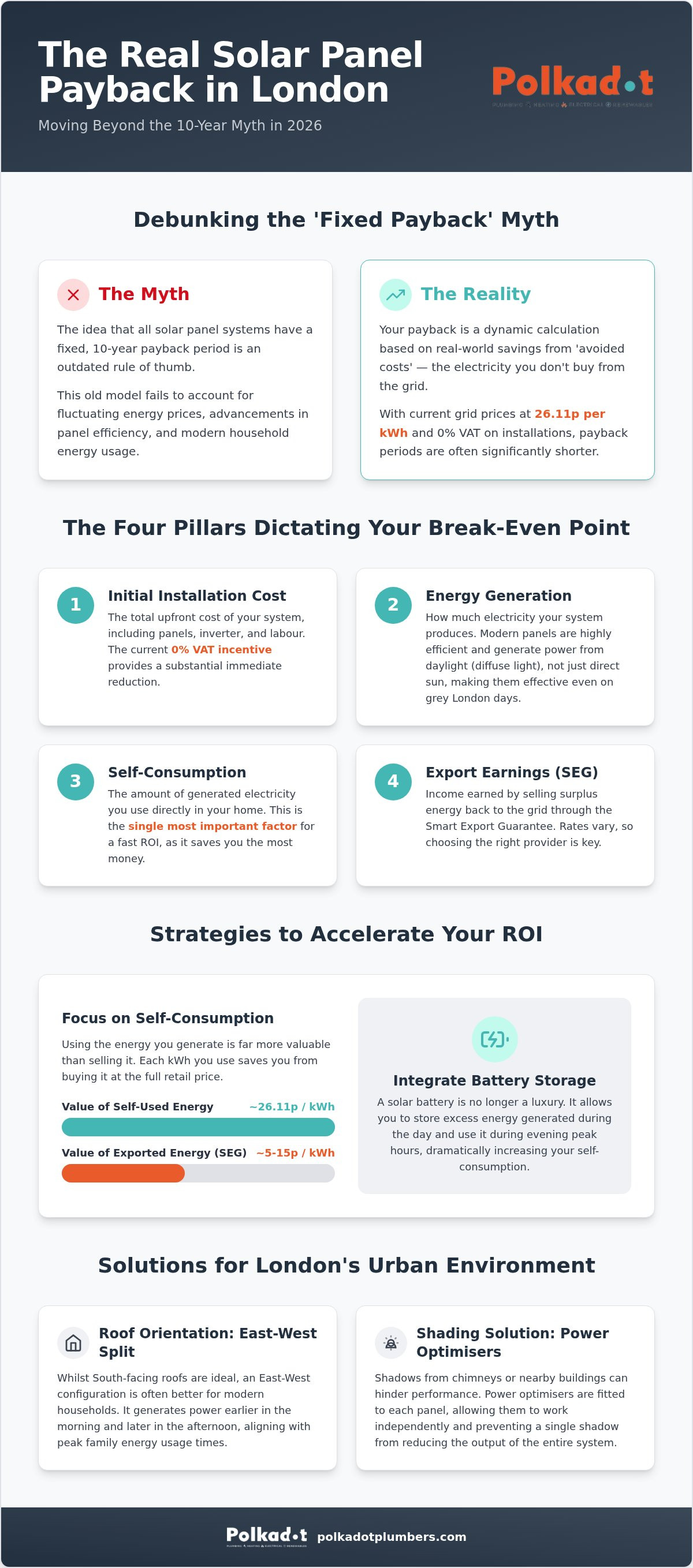
The primary engine behind your ROI is "avoided cost." This refers to the money that stays in your pocket because you aren't buying electricity from the grid at the current Ofgem price cap rate of 26.11p per kWh. When you generate your own power, you're essentially insulating yourself against market volatility. Because technology has advanced and installation costs have stabilised, the idea of a single "correct" timeframe for every UK home has become a misconception.
Myth: 'Solar Panels Don't Work on Gloomy London Days'
One of the most frequent anxieties we hear from Londoners is that our local weather isn't sunny enough to make the investment worthwhile. It's a common misunderstanding of how photovoltaic (PV) cells function. These systems don't require direct, scorching sunlight to produce electricity; they rely on daylight. Even on a standard grey morning in the South East, panels capture "diffuse" light that filters through the clouds.
Modern panels are significantly more efficient in these conditions than the models available even five years ago. For a deeper overview of solar power and how these cells operate, the science confirms that light intensity, not just heat, is the key. You can rest assured that your system is contributing to your ROI from the moment the sun rises, regardless of the cloud cover.
Why the 'Fixed Period' Model is Outdated
Calculating a return based on a "fixed period" fails because it assumes energy prices and household behaviour never change. In reality, your financial projections can shift overnight if the energy price cap fluctuates or if you change how you use your appliances. We've moved away from a "sell-back" mindset where the goal was to push as much power as possible back to the grid.
Today, the most successful strategy is a "self-consumption" mindset. By using your own green energy to power your home, you're saving far more than you would earn by selling it. You'll also find that solar panels London homeowners install today are more sophisticated; they start generating earlier in the morning and continue later into the evening. This increased efficiency, combined with the current 0% VAT rate on installations, means the traditional solar panel payback period is often significantly shorter than expected.
The True Variables: What Dictates Your Break-Even Point?
Your personal solar panel payback timeline isn't a guess; it's a calculation based on four specific pillars. First, there's the initial installation cost. Then, we look at how much energy your system generates and, crucially, how much of that energy you actually use, known as self-consumption. Finally, any surplus you sell back to the grid adds to your export earnings. When these four factors align, your system begins to pay for itself.
Why does this investment look better over time? Energy price inflation means that every unit of power you generate yourself becomes more valuable as grid prices rise. It's a hedge against the future. Whilst South-facing roofs are often cited as the gold standard, don't dismiss an East-West split. This configuration can actually be better for modern families because it provides power earlier in the morning and later in the afternoon, matching the times when we're most active at home.
Roof Orientation and Shading in Urban London
London's architecture presents unique challenges for renewable energy. Tall neighbouring buildings or ornate Victorian chimneys can cast long shadows that significantly reduce a panel's output. If one panel in a traditional string is shaded, the performance of the entire row can drop. To fix this, we use power optimisers. These devices allow each panel to work independently, ensuring a bit of shade doesn't stall your ROI. This is why a professional London solar survey is essential to map these obstacles accurately before you commit.
Your Energy Usage Profile
How you live determines how fast you break even. A family that's home all day using the washing machine and dishwasher during daylight hours will see a faster solar panel payback than professionals who are out from 9-to-5. If you're in the latter group, the strategy shifts to "load shifting." This involves setting timers on your heavy appliances to run at midday, or investing in a battery to store that midday sun for your evening return. For more on the fundamentals of system planning, you can consult this Homeowner's Guide to Going Solar for a broader perspective on residential setups.
Myth: Battery Storage Is a Luxury You Do Not Need
Many homeowners view battery storage as a high-tech luxury that simply adds cost and extends their solar panel payback period. It's time to correct that assumption. While a battery does increase the initial outlay, it fundamentally changes the maths of your investment. Without storage, you might only use 30% of the energy you generate; the rest is exported for a lower rate than you pay to buy it back. With a battery, that self-consumption can leap to 80% or higher, meaning you buy far less from the grid.
When comparing a solar-only system to one with integrated storage, the latter often provides a more dependable financial return. In fact, 94% of UK installations now include a battery because homeowners recognise that energy independence is the fastest route to ROI. By keeping your green energy within your own four walls, you're protecting yourself from future price cap rises and ensuring your system works for you 24 hours a day, not just when the sun is out.
Maximising Self-Consumption with Storage
Batteries act as a buffer for your home's energy needs. They store the midday peak generation, which usually happens when the house is quiet, and save it for the expensive evening period when everyone is home. This shift is why the london solar battery installation 2026 price guide shows that storage is increasingly becoming the standard choice for urban properties. Beyond the financial savings, a battery offers the peace of mind of backup power. If the local grid requires maintenance or suffers an outage, your essential circuits can remain powered, keeping your home functional and safe.
Smart Tariffs and Battery Synergies
Modern batteries are innovators in how they manage your money. They allow for "arbitrage," where the system automatically charges from the grid during the night when prices are at their lowest. You can then use this cheap, stored electricity during the day if the weather is particularly overcast. This level of automation ensures your energy flow is always organised for maximum savings. To help you decide if the extra equipment is right for your budget, it's worth asking: Are Solar Panels Worth It? The answer is almost always a firmer "yes" when a battery is involved. Additionally, adding storage can improve your property’s EPC rating, which is a significant factor in maintaining or increasing your home's resale value in a competitive London market.
Strategy and SEG: How to Accelerate Your ROI
While the physical installation is the first step, your solar panel payback timeline is largely dictated by how you manage the energy you produce. You shouldn't view your system as a "set and forget" technology. Instead, think of it as a financial tool that requires a bit of strategic oversight. The most important administrative step is ensuring your system is MCS certified. Without this certification, you won't be able to access the Smart Export Guarantee (SEG) or any other financial incentives, effectively locking you out of a significant portion of your potential earnings.
Many homeowners assume they must accept whatever export rate their current energy provider offers. This is a mistake. You're free to shop around for the best export tariff independently of who supplies your evening electricity. By decoupling these two, you can ensure you're getting the highest possible return for every kilowatt-hour you send back to the National Grid.
Navigating the Smart Export Guarantee
As of August 2026, the market for exported energy has become highly competitive. If you have a solar battery, you can access premium rates, such as Octopus Energy's average of 27p per kWh. Even without storage, providers like E.ON are offering up to 16.5p per kWh, whilst the best rate available without switching your supplier sits at around 12p per kWh from Scottish Power. To access these payments, you'll need a smart meter to accurately track your surplus power. We recommend reviewing your export provider every twelve months to ensure your ROI remains on the fastest possible track.
Behavioural Changes to Shorten Payback
Small adjustments to your daily routine can shave years off your break-even point. This "solar behaviour" involves shifting your heaviest energy usage into peak generation hours, typically between 10 am and 4 pm. Instead of running the dishwasher or laundry at night, set timers for midday. If your system produces more than your battery can hold, you can use an immersion heater or an EV charger as an "energy dump" to soak up that free power rather than exporting it for a lower rate than you'd pay to buy it back later. Solar ROI acceleration is the process of synchronising your home's energy demand with your system's peak supply to minimise reliance on the grid.
If you're ready to see how these strategies could work for your specific property, we can help you design a system that matches your lifestyle through our Solar and Electrical Installations service.
Professional Installation: Why Quality Protects Your Investment
Why is a professional survey so critical? It's the difference between a generic estimate and a system that actually delivers on its promises. A "cheap" quote often hides poor workmanship or sub-standard components that degrade faster than high-quality alternatives. If your system's efficiency drops by even a small margin due to poor wiring or incorrect panel placement, your solar panel payback timeline can be pushed back by several years. Investing in quality from the start isn't just about peace of mind; it's a strategic financial decision to protect your long-term returns.
Professional maintenance and monitoring ensure your system performs at its peak for 25 years or more. Without expert oversight, small technical failures can go unnoticed, quietly draining your ROI whilst you remain unaware. By choosing a dependable installer, you're ensuring that the technical integration between your panels, inverter, and battery is seamless, preventing the system degradation that often plagues DIY or budget-focused setups.
The Polkadot Approach to Renewables
Our approach focuses on taking the stress out of the transition to green energy for London homeowners. We're specialists in London property maintenance, which means we understand the structural nuances of urban roofs and the electrical complexities of integrating solar with batteries or EV chargers. Whether you're dealing with a complex Victorian roofline or a modern refurbishment, we handle every aspect from the initial survey to the final electrical integration. Having a local partner who understands London’s unique property landscape means you get a system designed specifically for the challenges of the capital, not a one-size-fits-all solution.
Next Steps for Your Solar Journey
How do you move from a general interest in renewables to a specific plan for your home? The first step is a professional survey. This allows us to provide a bespoke solar panel payback calculation based on your actual roof orientation, potential shading, and energy usage patterns. During the installation process, our dependable team manages the project with minimal disruption to your daily life, ensuring all MCS standards are met for your peace of mind. If you're ready to secure your energy future and start accurately calculating your returns, you can contact Polkadot for a dependable solar assessment today.
Securing Your Energy Future with Confidence
The traditional myth of a fixed ten-year solar panel payback has been replaced by a more exciting reality. By integrating modern battery storage and navigating the latest Smart Export Guarantee rates, you can actively shorten your path to a break-even point. Success in the London market depends on addressing urban challenges like shading and roof orientation with professional precision rather than guesswork.
As trusted property maintenance experts since 2019, Polkadot specialises in delivering full MCS-compliant installations that ensure your system hits its financial targets. We understand the unique architectural landscape of the capital and provide the dependable, high-quality service needed to protect your investment for decades to come. You shouldn't leave your ROI to chance with generic estimates or sub-standard components that degrade over time.
The path to lower bills and energy independence is clear once you have the right data. Book your expert London solar survey with Polkadot today to receive a bespoke calculation for your home. You'll gain the peace of mind that comes from working with local renewable energy specialists who prioritise your long-term comfort and household savings.
Frequently Asked Questions
How long does it take for solar panels to pay for themselves in London?
Your solar panel payback timeline typically falls between six and ten years, though this depends heavily on your household's energy consumption. By using more of your own power and exporting surplus to the grid, you can accelerate this process. London's high electricity costs actually make the return faster than in lower-priced regions. A professional survey will provide a bespoke calculation based on your specific roof and lifestyle.
Do solar panels still work when it is cloudy or raining?
Yes, solar panels continue to generate electricity during overcast or rainy weather. Photovoltaic cells capture daylight and diffuse light rather than just direct, scorching sun. While output is lower on a grey London morning than on a clear summer day, modern systems remain highly efficient. Rain even provides a benefit by naturally cleaning dust and debris off the panels, which helps maintain their long-term performance.
Can I get paid for the extra electricity I do not use?
You can receive payments for surplus energy through the Smart Export Guarantee (SEG). Any electricity you don't use or store in a battery is sent back to the National Grid; providers pay you for every kilowatt-hour. You aren't forced to stay with your current supplier for these payments; you can shop around for the best export rates. This income stream is a vital component in reducing your overall solar panel payback period.
Is a solar battery worth the extra investment for a London flat?
A battery is often a strategic part of the system for urban properties. It allows you to store energy generated during the day for use in the evening, which is when most flat dwellers are actually home. While it adds to the initial cost, it significantly increases your self-consumption. For those in flats, compact wall-mounted units are available to save space whilst providing the same financial benefits as larger systems.
Will solar panels increase the value of my London home?
Research from organisations like Rightmove suggests that improving your home's EPC rating can increase its market value. Solar panels are one of the most effective ways to boost this rating from a D or E up to a B or A. In a competitive London market, buyers increasingly look for properties with lower running costs and sustainable technology already installed. This makes the system an asset rather than just an expense.
Do I need planning permission for solar panels in London?
Most domestic solar installations fall under Permitted Development rights, meaning you don't need formal planning permission. However, exceptions apply if you live in a Conservation Area or a Listed Building. London has many such protected zones, so it's essential to check with your local council first. A professional installer can usually guide you through these requirements and ensure the placement of the panels meets all local aesthetic regulations.
What is the average lifespan of a modern solar panel system?
You can expect modern panels to last between 25 and 30 years. Most manufacturers provide performance guarantees that ensure the panels still produce at least 80% of their original capacity after a quarter of a century. The inverter and battery components typically have a shorter lifespan of around 10 to 15 years and may need replacing once during the system's life. This long lifespan ensures your investment continues to pay dividends.
How much maintenance do solar panels actually require?
Solar panels are remarkably low-maintenance because they have no moving parts. In the UK, our frequent rainfall usually does a good job of keeping the panels clean. You should arrange a professional inspection every few years to check the electrical connections and ensure the inverter is operating at peak efficiency. Monitoring your system's output via a smartphone app will help you spot any performance drops that might need attention.


Comments