

Solar Power Batteries London: The Complete 2026 Energy Storage Guide
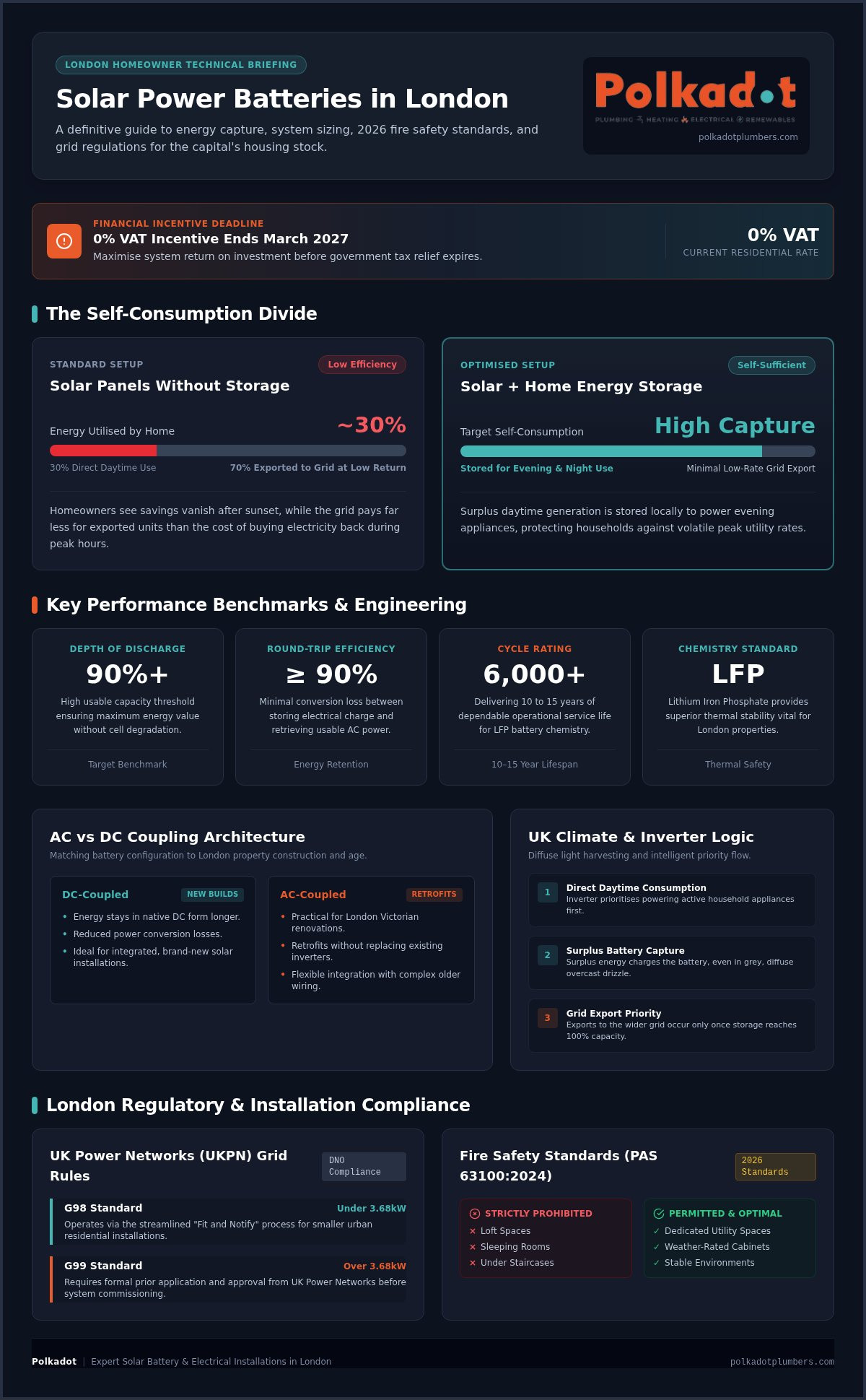
Did you know that without storage, a typical solar-only home in the capital only uses about 30 per cent of the energy it generates? It is a common frustration for homeowners who see their potential savings vanish as soon as the sun sets, whilst the grid pays them far less than the cost of buying electricity back. If you are researching solar power batteries london to bridge this gap, you are likely looking for a way to stop relying on volatile utility prices. We understand that the technical divide between AC and DC coupled systems can feel like a barrier to making an informed decision for your property.
Choosing the right energy storage is about more than just hardware; it's about securing your energy independence and protecting your family from unexpected power cuts. This guide provides the clarity you need to maximise your self-generated green energy and slash your bills before the 0 per cent VAT incentive ends in March 2027. We will walk you through the essential 2026 fire safety standards, the impact of UK Power Networks regulations, and how smart tariffs can turn your battery into a tactical financial asset for years to come.
Table of Contents
What is a Solar Power Battery and Why Does London Need Them?
A solar power battery is a hardware system designed to capture the electricity your solar panels generate during the day so you can use it at night. In the past, these were simple storage units; today, they have evolved into sophisticated home energy storage systems that act as the brain of your property's electrical network. For homeowners considering solar power batteries london offers a unique set of challenges. High peak electricity rates in the capital, combined with an urban grid that is increasingly under pressure from electric vehicle chargers and heat pumps, make local storage a tactical necessity rather than a luxury. By 2026, integrated battery storage has become a core requirement for meeting new sustainable home standards across Greater London.
The Core Technology: Lithium-ion and Beyond
Most modern installations now rely on Lithium Iron Phosphate (LFP) chemistry. We prefer LFP because it offers superior thermal stability compared to older nickel-based alternatives, which is vital for safety in compact London homes. Whilst 2026 has seen the early emergence of solid-state options for residential use, LFP remains the dependable standard for longevity and reliability. When comparing models, pay close attention to the Depth of Discharge (DoD). This figure tells you how much of the battery's total capacity you can actually use without damaging the cells. A high DoD, typically 90 per cent or above, ensures you get the most value from your investment over its lifespan.
AC vs DC Coupling: Which is Right for Your London Home?
Deciding between AC and DC coupling often depends on whether you're upgrading an existing system or starting from scratch. DC-coupled systems are usually more efficient for new builds because the energy stays in its native form for longer, reducing conversion losses. However, for many of the Victorian renovations we handle in London, AC-coupled systems are the practical choice. They allow us to retrofit a battery to your current solar setup without replacing your existing inverter. This flexibility is essential when working with the complex electrical layouts found in older terraced properties. Choosing the right configuration ensures your solar power batteries london installation operates at peak efficiency, keeping your monthly bills as low as possible.
How Solar Energy Storage Works in the UK Climate
Does the London drizzle stop your battery from charging? Not at all. Modern solar power batteries london systems are engineered to harvest diffuse light on overcast days. Whilst peak production happens in direct sunlight, your panels continue to trickle energy into the system even when it's grey. The hybrid inverter acts as the director of this energy. It prioritises powering your appliances first, sends any surplus to the battery, and only exports to the grid once your storage is full. Round-trip efficiency is the ratio of energy retrieved from the battery compared to the energy put in, and we aim for a target of 90 per cent or higher to ensure minimal waste.
Smart Inverters: The Brains of the Operation
Managing the solar power batteries london homeowners rely on requires an intelligent interface. Today's inverters use internet connectivity to monitor local weather forecasts in real-time. If a storm is predicted, the system might hold onto its stored charge to ensure you have backup power during potential outages. They also integrate with smart home platforms to trigger appliances like dishwashers or washing machines automatically when your battery reaches a full state. In the capital, navigating the grid connection is a vital step. Systems under 3.68kW usually follow the G98 "fit and notify" route, whilst larger setups require a G99 application to UK Power Networks (UKPN). Getting this right ensures your system is legal and safe. If you're unsure which category your home falls into, our team can help you plan your electrical installations to meet local urban standards.
Battery Lifespan and Degradation Factors
What can you expect from your battery over the next decade? Most Lithium Iron Phosphate (LFP) units are rated for 6,000 cycles or more, typically providing a dependable service life of 10 to 15 years. However, where you place the unit matters significantly. Under the latest PAS 63100:2024 standards, batteries are no longer permitted in lofts, sleeping rooms, or under staircases due to fire safety and temperature concerns. A stable environment, such as a dedicated utility space or an external weather-rated cabinet, prevents the cells from overheating during fast discharge cycles. Proper placement also ensures that the system can manage Ofgem's Smart Export Guarantee (SEG) exports without unnecessary thermal stress. Avoid constant deep cycling where possible to maintain the health of the cells for the long term.
The Financial Logic: Tariffs, SEG, and ROI in London
London homeowners often face a "Capital Premium" on their utility bills. With the Ofgem price cap rising to 26.32p per kWh in late 2026, the financial argument for solar power batteries london has never been stronger. The core logic is simple: self-consumption is always more profitable than exporting. Whilst the Smart Export Guarantee (SEG) typically offers between 4.0p and 15.0p per kWh, buying that same energy back costs significantly more. By storing your surplus, you avoid that price gap entirely. A correctly sized battery increases your self-consumption from roughly 30 per cent to over 70 per cent, ensuring you aren't giving away green energy for a pittance.
Time-of-Use Tariffs and Grid Trading
Smart batteries allow for "load shifting," which is a game-changer for urban properties. This means you can charge your battery from the grid during the night when rates are at their lowest, often between 7p and 9p per kWh on specific flexible tariffs. You then discharge that cheap energy during the 4 pm to 7 pm peak when prices are highest. Some providers even allow you to join a Virtual Power Plant (VPP). In a VPP, your battery automatically exports energy to the grid during national shortages in exchange for premium payments, sometimes reaching 30p per kWh. This turns your storage unit into a proactive financial asset that works for you even when the sun isn't shining.
Calculating Your Payback Period
Several factors accelerate your return on investment. If you own an electric vehicle or use Solar Panels London systems paired with heat pumps, your daily energy throughput will be much higher, leading to faster savings. A major boost to your ROI comes from the current 0% VAT relief on energy-saving materials. This incentive is legislated to remain at zero until 31 March 2027, before reverting to 5 per cent. For a typical 10 kWh system, this tax saving represents a significant reduction in the initial installation cost. Most London households now see a full payback within 6 to 10 years, which is well within the standard 10 to 12 year manufacturer warranty period. This makes energy storage a dependable long-term hedge against future price hikes.
Choosing and Sizing Your Battery: A Londoner’s Checklist
Selecting the correct solar power batteries london homeowners need involves more than just picking a popular brand. It requires a methodical look at how your household consumes energy. Because London properties vary from compact flats to sprawling Victorian houses, a one-size-fits-all approach often leads to wasted investment. Follow this five-step checklist to ensure your system is perfectly balanced for your needs.
Step 1: Analyse your daily kWh usage. Look at your smart meter data to see your average consumption during the evening peak.
Step 2: Match capacity to your solar array. A battery that is too large for your panels to fill during the day will never reach its full ROI potential.
Step 3: Plan the physical placement. Decide if a wall-mounted unit or a floor-standing stack better suits your available space.
Step 4: Look for modularity. Choosing a system that allows you to add extra battery modules later is a smart way to future-proof your home.
Step 5: Check for MCS certification. Ensure your installer is fully accredited to guarantee the safety and eligibility of your system for export payments.
Sizing for Different Property Types
Property size is the primary factor in determining your storage needs. For a typical two-bedroom London terrace, a 5 kWh battery is often sufficient to cover evening lighting and appliance use. In contrast, a larger detached family home usually requires a 10 kWh or 13.5 kWh unit to maintain independence from the grid. If you have an Electric Vehicle charging point, your requirements will increase significantly. You'll need enough storage to handle the initial surge of a car charger without immediately pulling from the expensive peak-rate grid. Bigger isn't always better. Oversizing your battery can hurt your financial returns if the unit sits half-empty throughout the winter months.
Installation Constraints in Urban London
London's housing stock presents unique physical hurdles. The latest fire safety standards, specifically PAS 63100:2024, strictly prohibit installing batteries in lofts, hallways, or under staircases. This often means we must utilise external weather-rated cabinets or dedicated utility spaces. Noise levels are another factor; whilst most modern units are quiet, the cooling fans can be noticeable in very confined urban gardens. Working with a dependable local expert ensures these constraints are managed during the design phase rather than becoming an issue during commissioning. If you need a professional survey of your current setup, our experts provide comprehensive electrical installations tailored to the specific needs of London properties.
Polkadot: Expert Solar Battery Installation in London
Why should you trust a local specialist for your solar power batteries london project? London properties present unique challenges, from restricted access in narrow terraces to intricate electrical systems in period homes. Polkadot has established itself as a leader in urban renewable energy by prioritising professional integrity and technical precision. We don't just install hardware; we design integrated energy solutions that work in harmony with your existing Boiler Installations and smart home technology. Our locally-based team provides the peace of mind that comes from knowing expert help is always nearby if you need maintenance or advice.
The Polkadot Installation Journey
How do we ensure your system delivers the savings we promise? Our process begins with a detailed diagnostic survey. We don't guess your requirements; we analyse your actual energy patterns to ensure your storage is perfectly sized for your lifestyle. On installation day, our goal is to minimise disruption. Most solar power batteries london setups are completed within a single day, with our engineers handling everything from the physical mounting to the final G98 or G99 commissioning. Once the system is live, we provide ongoing monitoring support. This allows us to verify that your battery is performing at peak efficiency and helps you understand how to adjust your habits to maximise your green energy usage.
Future-Proofing Your Home Energy
What does true energy independence look like for a Londoner? It starts with a single point of contact for all your property's mechanical and electrical needs. Transitioning to a sustainable home is often stressful when dealing with multiple contractors. By choosing Polkadot, you benefit from a unified approach where your solar storage, air source heat pumps, and car charging points are designed to communicate with each other. This holistic view ensures that your home remains efficient as energy standards evolve. We take the complexity out of renewable technology, providing a smooth path toward lower bills and a smaller carbon footprint. If you are ready to secure your energy future, you can organise a consultation with Polkadot’s renewable experts today to discuss a tailored solution for your property.
Securing Your Energy Independence in the Capital
Energy independence in London is no longer a distant goal; it's a practical reality for homeowners who choose the right technology. By understanding the shift from simple storage to smart energy management, you can effectively bypass high peak rates and make the most of every kilowatt your roof produces. Remember that the current 0 per cent VAT incentive and the integration of smart tariffs offer a unique window to maximise your return on investment before 2027. Investing in solar power batteries london allows you to take control of your electricity bills whilst protecting your home against future price hikes.
Choosing the right partner for your installation is the final piece of the puzzle. As local London experts and comprehensive property maintenance specialists, Polkadot ensures your system meets the latest safety standards whilst integrating seamlessly with your home's infrastructure. Our MCS certified installations provide the reliability and peace of mind you expect from a seasoned professional. We're ready to help you navigate the complexities of urban energy storage with confidence and transparency.
Request a dependable solar battery quote for your London property and start your journey toward a more sustainable, self-sufficient household today.
Frequently Asked Questions
Do I need solar panels to have a battery in my London home?
You don't need solar panels to install a battery. Many homeowners in the capital use standalone storage to charge from the grid during cheap off-peak hours. This strategy is particularly effective for those on flexible tariffs who want to avoid high daytime rates. If you decide to add solar later, we can integrate the systems to further reduce your reliance on the grid. It's a versatile way to start your energy independence journey.
How long do solar batteries typically last in the UK?
Most modern Lithium Iron Phosphate (LFP) batteries provide a dependable service life of 10 to 15 years. They are typically rated for at least 6,000 cycles at a high depth of discharge. After this point, the battery won't stop working, but its capacity to hold a charge will gradually decrease. We recommend choosing a system with a long manufacturer warranty to ensure your investment is protected for the long term.
Can a solar battery power my whole house during a power cut?
A solar battery can provide backup power during a cut, but it depends on your specific setup. You'll need an Emergency Power Supply (EPS) or "island mode" configuration. Whilst a standard battery might not run a power-hungry heat pump for hours, it can easily keep your lighting, fridge, and internet router running. We design your system to prioritise these essential circuits so you aren't left in the dark during a local outage.
Is it better to install a battery at the same time as solar panels?
Installing a battery alongside your solar panels is often the most efficient route. This allows for a DC-coupled system, which reduces energy losses during conversion. It also simplifies the installation process and ensures you benefit from the 0 per cent VAT relief on the entire project. Whilst retrofitting is always possible, a combined installation typically offers a faster return on investment and a more streamlined electrical setup for your home.
What is the best location for a solar battery in a London terrace?
Finding space for solar power batteries london terraces can be tricky. Under current safety regulations, you can't place them in lofts or hallways. The best locations are usually a dedicated utility room, a garage, or an external weather-rated cabinet. These spots provide the necessary ventilation and fire safety clearance required by law. Our team specialises in finding discreet, compliant locations that don't compromise your home's aesthetic or living space.
Will a solar battery actually save me money with current energy prices?
Yes, a battery provides significant savings by bridging the gap between generation and consumption. Instead of exporting surplus energy for a low return, you store it for the evening when grid prices are highest. When you combine this with a smart time-of-use tariff, you can charge the unit overnight at a fraction of the standard rate. This tactical approach ensures your energy bills stay manageable despite the rising costs in the capital.
Do I need planning permission for a solar battery in London?
In most cases, you don't need planning permission for a domestic battery installation. These systems usually fall under Permitted Development rights for London properties. However, if your home is a listed building or sits within a sensitive conservation area, you might need specific consent from your local council. We always recommend checking with your borough's planning office if you're unsure, especially if the unit is mounted on a front-facing external wall.
How much maintenance does a solar battery require?
Solar batteries are remarkably low-maintenance because they have no moving parts. Most of the upkeep is handled automatically through remote software updates provided by the manufacturer. We suggest a quick physical check once a year to ensure the area around the unit is clear and the ventilation isn't blocked. Our dependable maintenance team can also monitor your system's health remotely to catch any performance dips before they become a problem for you.


Comments