
The Best Portable Air Conditioner Alternative: Reliable Cooling for London Homes
What if the best portable air conditioner alternative for a London home isn’t another appliance on wheels, but a cooling system planned around the room? If you’re tired of compressor noise, running costs and an exhaust hose taking over your window, you’re not alone. Awkward layouts and the practical limits of flats can make portable units feel like a compromise.
There are quieter, more discreet ways to improve comfort. The right option depends on whether you need air movement or active cooling, and on what your property can accommodate. This guide compares fans and evaporative coolers with fixed air conditioning and air source heat pumps, so you can decide what may work best at home.
You’ll also find practical advice on energy use, installation and London-specific considerations, including flats and conservation areas. With careful planning, cooling can suit your rooms without leaving a bulky unit and hose on show.
Table of Contents
Why Search for a Portable Air Conditioner Alternative?
A portable unit can bring welcome relief, but it can also add noise, use electricity and take up valuable floor space. In a London flat, where layouts and installation options may be limited, these drawbacks can make a temporary fix feel like a daily compromise. Understanding how the unit works can help you decide whether another approach would suit your home better.
The Inefficiency of Single-Hose Systems
A single-hose portable air conditioner draws in room air, cools some of it and sends the rest outside through an exhaust hose. The expelled air has to be replaced. As the unit pushes air out, it can create negative pressure, drawing warmer air in through gaps around windows, doors and adjoining rooms. This can undermine cooling and make the appliance work harder.
A fixed split system works differently. It circulates indoor air through the room unit and transfers heat outdoors through a refrigerant circuit, rather than exhausting room air through a window hose. This avoids the same replacement-air effect, although performance still depends on selecting and installing a system suited to the space.
Noise Levels and Night-time Comfort
With a portable unit, the compressor sits in the room alongside the fan. Its sound can be distracting when you’re trying to sleep, take a call or concentrate. A split system places the compressor outdoors, leaving the indoor unit to circulate air. It can therefore be quieter indoors, although the sound you hear depends on the equipment, settings and installation.
“Quiet mode” can reduce a portable unit’s output, but it doesn’t move the compressor outside. If lower noise is important, compare the indoor units’ sound information and consider where outdoor equipment could be positioned before choosing a system.
There’s also the energy question. Portable air conditioners use electricity to cool a room, and a single-hose design may have to work against warm replacement air. In 2026, that can mean less effective cooling for the energy used, particularly if the hose connection leaks or the unit is poorly matched to the room. Check the appliance’s energy information and consider how many hours you expect to run it.
Then there’s the setup. A heavy unit takes up floor space, while the hose and window kit can interrupt the view and make a window harder to use. For renters or homes where fixed installation isn’t practical, a fan may be simpler. An evaporative cooler is another option to explore, though its suitability depends on indoor humidity. The next step is to weigh these simpler choices against longer-term cooling systems.
Low-Cost Alternatives: Fans and Evaporative Coolers
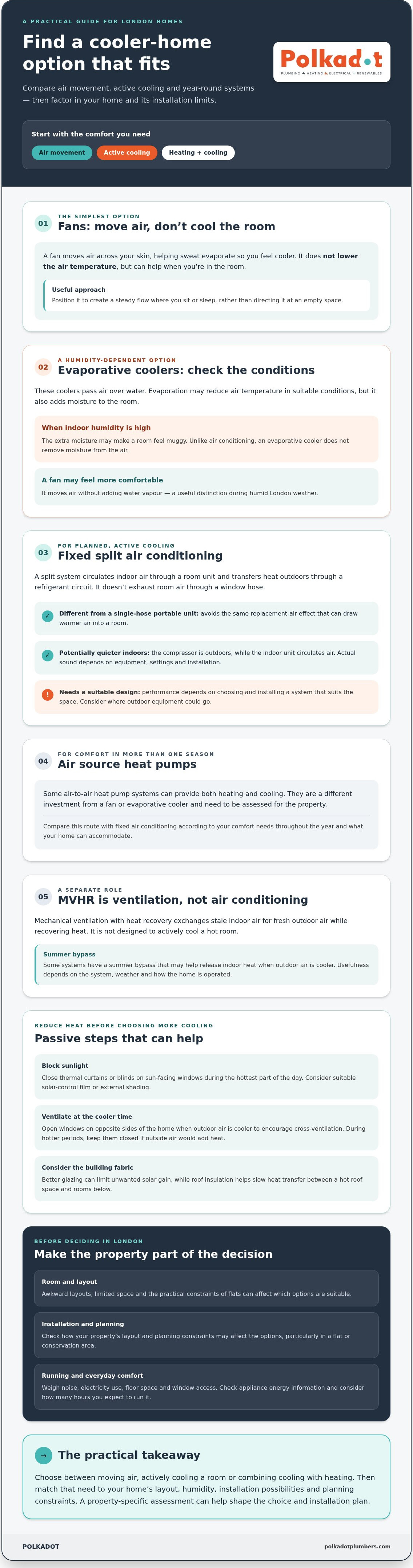
Looking for a low-cost portable air conditioner alternative? First distinguish air movement from room cooling. A fan doesn’t lower the air temperature. It moves air across your skin, helping sweat evaporate so you feel cooler. This can help when you’re in the room. Position the fan to create a steady flow where you sit or sleep rather than pointing it at an empty space.
The Science of Humidity in the UK
Evaporative coolers pass air over water, adding moisture as the water evaporates. This can reduce air temperature in suitable conditions, but it also raises indoor humidity. During a humid spell in London, that extra moisture may leave a room feeling muggy rather than comfortable. Unlike an air conditioner, an evaporative cooler doesn’t remove moisture from the air. If humidity is already high, a fan may feel more comfortable because it moves air without adding water vapour.
Mechanical ventilation with heat recovery (MVHR) is designed to exchange stale indoor air for fresh outdoor air while recovering heat, not to act as air conditioning. Some systems have a summer bypass that can help release indoor heat when outside air is cooler. Its usefulness depends on the system, weather and how the home is operated, so don’t assume MVHR will actively cool a hot room.
Passive Cooling Strategies
Reduce heat gain before it builds up. Close thermal curtains or blinds on sun-facing windows during the hottest part of the day, and consider solar-control film where suitable. External shading can block sunlight before it reaches the glass. Open windows on opposite sides of the home when outdoor air is cooler to encourage cross-ventilation. During hotter periods, keep them closed if outside air would add heat.
Glazing and insulation matter too. Better glazing can limit unwanted solar gain, while roof insulation helps slow heat transfer between a hot roof space and rooms below. If you’re assessing roof-related heat retention, this guide to London roofing services offers a useful property-maintenance perspective.
For a longer-term approach that combines heating and cooling, Air source heat pumps are worth understanding. Some air-to-air systems can provide both, but they’re a different investment from a fan or cooler and need to be assessed for the property. If simple measures aren’t enough, explore air conditioning options for your London home with a professional before choosing a system.
Professional Alternatives: Fixed AC vs Air Source Heat Pumps
If you need dependable cooling beyond a fan or portable unit, a professionally installed system can be planned around the rooms you use and your property’s constraints. Fixed air conditioning and air source heat pumps can both provide cooling, but they serve different needs. Consider how often you’ll cool the home, whether you also want to update its heating, and where equipment could go.
Fixed Air Conditioning Benefits
A split-system air conditioner has an indoor unit and an outdoor unit connected by refrigerant pipework. With the compressor outside, the indoor unit can operate more quietly than a portable appliance with its compressor in the room. It also avoids the exhaust hose and window kit. Temperature controls and filtration features vary by system, so check the specifications rather than assuming every unit offers the same functions.
For more than one room, a multi-split system can connect several indoor units to one outdoor unit. This can reduce the number of external units, but suitability depends on the building, room layout and system design. An air conditioning installation assessment can consider capacity, positioning and the practical requirements of a London home. A well-considered installation may appeal to future occupants, but it can’t guarantee an increase in property value.
Air Source Heat Pumps as a Cooling Solution
Some air source heat pumps can run in reverse cycle. Instead of moving heat into the home, they transfer indoor heat outside. Air-to-air models can therefore provide heating and cooling, making them a dual-purpose alternative to a portable air conditioner. Other types of heat pump are designed for different heating systems, so confirm that the specific system can cool rooms before comparing options.
In 2026, the Boiler Upgrade Scheme includes a £2,500 grant for eligible air-to-air heat pumps that provide heating and cooling. Eligibility and scheme requirements apply, so check current guidance before relying on support. The Energy Saving Trust’s air source heat pump advice explains the technology and installation considerations.
Fixed systems are not automatically cheaper to run in every home. Compare seasonal efficiency information, system capacity and how you plan to use the equipment. Correct design and installation matter. If you have solar panels, consider how cooling demand may align with the electricity they generate, without assuming the panels will cover all usage. Polkadot works with air conditioning and air source heat pumps in London, and can help you explore home cooling and heating options suited to your property.
Choosing an Alternative Based on Your London Property
The right cooling system depends on more than room size. In London, a flat’s shared structure, a terrace’s external appearance and the building’s planning constraints can all affect what’s practical. Before choosing a portable air conditioner alternative, consider where equipment could go, how heat moves through your home and whether you own or rent.
Flats, Terraces and Planning Considerations
For flats, an external condenser may need planning permission. Flats don’t have the same permitted development rights as houses, and permission is typically required for external air conditioning units. In conservation areas, restrictions may be more likely. Some councils also use Article 4 Directions to remove permitted development rights for external alterations. Requirements vary by property and council, so check before committing to a system.
Where an outdoor condenser isn’t practical, an internal-only appliance may be easier to place, though its cooling performance and noise depend on the type of unit. Water-cooled air conditioning, which doesn’t use an external condenser, is another option to investigate for constrained properties. For period terraces, a survey can help assess discreet equipment positioning and pipe routes, without assuming that a particular location will be acceptable.
Plan Around the Whole Home
For family homes, multi-room cooling can be designed so you control rooms separately rather than cooling every space equally. Zoning and smart controls may help limit use to occupied rooms, but the system still needs to be sized and configured for the property. Include the electrical installation in your assessment, particularly if the home has older wiring or other major electrical loads.
If you’re renting, speak to your landlord or managing agent before considering fixed equipment or changes to the building. A portable option may be more practical where installation isn’t permitted, but it still needs a suitable window arrangement for its exhaust hose. Ask what alterations are allowed and whether the building has shared rules on external equipment.
Planning a refurbishment? Coordinating cooling with other work can help you consider pipework, electrical requirements and the appearance of indoor units together. Explore full house renovation planning when considering how system choices fit into a wider project.
Before choosing, arrange a property-specific assessment of the layout, permissions, equipment position and electrical capacity. Discuss air conditioning for your London property with Polkadot to explore options suited to your home.
The Polkadot Approach: Reassuringly Expert Installation
A cooling system should suit the home, not just look suitable on a product box. Before choosing a portable air conditioner alternative or a fixed system, consider the room layout, how sunlight enters, where heat builds up and what installation constraints apply. A professional assessment can help you avoid a “buy and hope” decision, especially in London homes where access, building layout and external equipment placement may limit the options.
The Diagnostic Process
A useful assessment starts with how you use the space. Which rooms overheat? Are they open-plan or separated by doors? Do large windows receive direct sun, and can an outdoor unit be positioned appropriately? The answers help establish whether targeted cooling, a multi-room system or another approach deserves consideration.
Consider electrical capacity and possible pipework routes before installation too. In a flat or period property, planning constraints and the building’s layout may shape what’s feasible. Polkadot provides air conditioning, air source heat pump and electrical installation services in London. Ask for a clear explanation of the proposed system, how it is expected to operate and any property-specific requirements before deciding. This gives you a considered way forward without assuming one solution fits every home.
Installation and Long-term Care
Professional installation involves more than positioning an indoor unit. A suitable design needs to account for the system, its location and the home’s electrical requirements. Installation should be completed by appropriately qualified professionals, with the system checked and commissioned according to the manufacturer’s instructions. Ask what checks are included and what documentation you’ll receive.
Ongoing care matters too. Follow the manufacturer’s guidance for cleaning filters and keeping air inlets clear, and ask what servicing the system requires. Regular attention can help you spot issues early, but maintenance needs vary by equipment and use. Confirm who is responsible for servicing and what support is available before you commit. Don’t assume installation includes ongoing maintenance.
Choose Cooling That Fits Your London Home
The right portable air conditioner alternative depends on your home and what you need from it. Fans offer simple air movement, while evaporative coolers may be less comfortable in humid conditions. For more dependable room cooling, fixed air conditioning can avoid the indoor compressor and window hose of a portable unit. An air source heat pump may also provide heating and cooling, making it worth considering for a longer-term improvement.
In London, the building itself matters. A flat, a period terrace and a family home can each bring different layout, electrical and equipment-placement considerations. A professional assessment helps clarify what’s feasible before you commit, and supports a system choice that considers comfort, noise, efficiency and the appearance of your rooms.
Polkadot provides air conditioning, renewable energy installations and property refurbishment across London. To explore a permanent cooling solution suited to your property, discuss your options with Polkadot.
Frequently Asked Questions
Is an evaporative cooler a good alternative to a portable AC in the UK?
It can help in suitable conditions, but may disappoint during humid weather. Evaporative coolers lower air temperature by evaporating water, which also adds moisture to the room. If the air already feels damp, this can make the space feel muggy. A fan may be more comfortable in that situation because it moves air without adding moisture. Choose based on your room conditions and whether you need air movement or actual temperature control.
Can I install fixed air conditioning in a London flat without an external unit?
Some water-cooled air conditioning systems operate without an outdoor condenser, but whether one is suitable depends on the flat and system design. A portable unit is another option, though it needs an exhaust route. London flats don’t have the same permitted development rights as houses, and planning permission is typically required for external air conditioning units. Check the building’s requirements and seek a property-specific assessment before choosing equipment.
Do air source heat pumps actually provide effective cooling in summer?
Some do. Reversible air-to-air heat pumps can move heat out of the home in summer and provide heating in cooler weather. However, not every air source heat pump offers cooling, so confirm the type and capabilities of the proposed system. Effectiveness depends on the design, installation and home layout. For a London property, ask how the system would serve the rooms you want to cool and where equipment could go.
How much quieter is a fixed split-system compared to a portable unit?
There isn’t one reliable decibel difference for every system. A portable air conditioner has its compressor indoors, while a split system places the compressor outdoors, so the indoor unit can be quieter. Actual sound levels vary by model, operating setting, room and installation. Compare manufacturers’ published noise information for the indoor units, and consider outdoor-unit noise and positioning too, particularly in close-knit London terraces or flats.
What is the most energy-efficient alternative to a portable air conditioner?
It depends on whether you need to cool the room or simply feel cooler. A fan generally uses less electricity than active cooling, but it doesn’t lower room temperature. For regular cooling, compare fixed systems’ energy information and choose a design suited to the space and intended use. There’s no single most efficient option for every London home. Room layout, operating habits and installation all affect energy use.
Do I need planning permission for air conditioning in a London conservation area?
You may need it, particularly for a traditional system with an external condenser. In London conservation areas, permission is more likely to be required, and some councils have Article 4 Directions that remove permitted development rights for external alterations. Rules can depend on the property and council, so check with the relevant local planning authority before proceeding. A survey can help identify equipment-placement options, but it doesn’t replace confirming the requirements.
Can I use a fan as a portable air conditioner alternative if I use ice?
You can place ice near a fan for a temporary cooling sensation, but it won’t work like air conditioning. A fan circulates air rather than actively removing heat from the room, and the effect from ice is local and short-lived. Keep water away from electrical components, and don’t leave melting ice where it could spill. For ongoing comfort, try shading windows and ventilating when outdoor air is cooler.
What should I do if my landlord won’t allow permanent AC installation?
Don’t install fixed equipment or alter windows, walls or services without permission. Ask your landlord or managing agent which reversible options are allowed and whether the building has restrictions on portable units or window fittings. A fan, curtains or blinds, and careful ventilation may help reduce discomfort without permanent changes. If you’re considering an appliance that needs an exhaust hose, confirm that its window arrangement is permitted and can be fitted securely.


Comments