
Toilet cistern not filling? Causes and what to do next
A cistern that won’t refill may have a simple supply issue rather than a broken toilet. When your toilet cistern isn’t filling, you may be unable to flush normally, or it may take far longer than usual to refill. It’s understandable to worry that lifting the lid could make things worse.
If you’re searching for “toilet cistern not filling”, start with the checks that carry the least risk. A closed or restricted water supply, a stuck float and a faulty fill valve are common possibilities, but you don’t need to take parts apart to investigate. This guide explains how to check the supply and visible parts safely, what different refill symptoms can indicate, and when to stop and call a plumber.
Working through the checks in order can help you narrow down the likely cause and decide whether professional help is needed. If the problem persists, Polkadot provides plumbing repairs and maintenance for homes and businesses across London.
Table of Contents
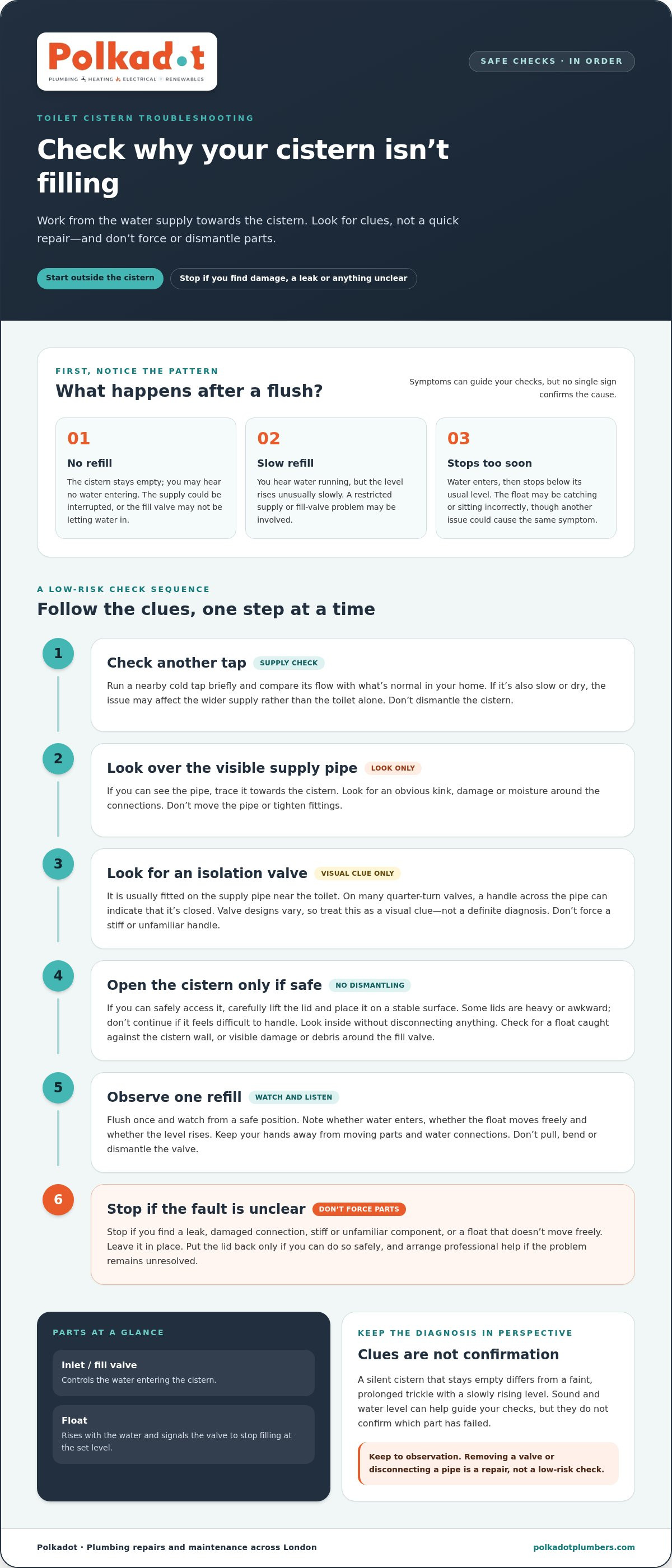
Toilet cistern not filling: what the symptoms can tell you
The cistern stores water for the next flush. After flushing, it should refill and stop once the water reaches its usual level. If your toilet cistern is not filling, or is behaving differently from normal, the symptoms can help you decide what to check first. They may point towards the water supply, float or fill valve, but no single sign confirms the cause.
No refill: The cistern stays empty and you may hear no water entering after a flush. The supply could be interrupted, or the fill valve may not be letting water in.
Slow refill: You hear water running, but the level rises unusually slowly. A restricted supply or a problem with the fill valve may be involved.
Stops below its usual level: Water enters, then stops before the cistern reaches its normal level. The float may be catching or sitting incorrectly, although another issue could cause the same symptom.
How to tell whether the cistern is not filling or just filling slowly
Listen and look after flushing. A silent cistern that stays empty is different from one where you hear a faint, prolonged trickle and see the water level rise gradually. A slow refill still deserves attention, as restricted supply or a fill valve that isn’t working properly can reduce the flow. Sound and water level are useful clues, not a definite diagnosis, so check the system before deciding what has failed.
The main parts involved in refilling a toilet cistern
The inlet, or fill valve, controls the water entering the cistern. A float rises with the water and signals the valve to stop filling at the set level. Outside the cistern, the supply pipe carries water to the toilet, while the isolation valve controls that supply. Understanding how a toilet cistern works can make these parts easier to identify, but their arrangement varies between toilets.
Start by noting which pattern best describes the problem. Then check whether other taps have normal water flow. This can help distinguish a wider supply issue from one affecting the toilet. Don’t assume a quiet cistern means the same fault as a slow trickle, or that a low water level automatically means the float is to blame. Next, check the supply and visible components in a safe, methodical order.
How to check why your toilet cistern is not filling
Work through these checks in order, starting outside the cistern. You’re looking for clues, not trying to force a quick repair. If you find a leak, damaged connection or component you can’t identify, stop and leave it in place.
Start with the water supply and isolation valve
First, check whether other taps in the property have normal water flow. If they’re also slow or dry, the issue may affect the wider supply rather than the toilet alone. If water is available elsewhere, focus your checks on the cistern.
Check another tap. Run a nearby cold tap briefly and compare its flow with what’s normal in your home. If it’s affected too, don’t dismantle the cistern. The supply issue may extend beyond the toilet.
Look at the toilet’s supply pipe. If it’s visible, trace it towards the cistern and look for an obvious kink, damage or moisture around the connections. Don’t move the pipe or tighten fittings.
Look for an isolation valve. This is usually fitted on the supply pipe near the toilet. On many quarter-turn valves, a handle across the pipe can indicate that it’s closed. Valve designs vary, so treat this only as a visual clue. Don’t force a stiff or unfamiliar handle.
Inspect the float and fill valve without forcing parts
If you can safely access the cistern, carefully lift its lid and place it on a stable surface. Some lids are heavy or awkward, so don’t continue if it feels difficult to handle. Look inside without disconnecting anything. Is the float caught against the cistern wall? Can you see damage or debris around the fill valve? Don’t pull, bend or dismantle the valve.
Observe the next refill. Flush once and watch from a safe position. Note whether water enters, whether the float moves freely and whether the level rises. Keep your hands away from moving parts and water connections.
Stop if anything is unclear. A stiff or unfamiliar component, a leaking connection or a float that doesn’t move freely is not a reason to apply force. Put the lid back if you can do so safely, and arrange professional help if the fault remains unresolved.
These checks can help distinguish a wider supply problem from an issue around the toilet’s inlet or float. They won’t confirm which part has failed. If you’re uncertain, Polkadot provides plumbing repairs and maintenance across London. Read more about London plumbing repairs.
Safe fixes to try before replacing a cistern part
If your toilet cistern is not filling, keep your first steps to observation and checks that don’t disturb water connections. Confirm what you can see, but don’t assume a part needs replacing just because it looks unusual. Similar symptoms can have different causes, and a replacement must be compatible with the cistern. Removing a valve or disconnecting a pipe is a repair, not a low-risk check.
When a simple float check may help
Watch the float during a refill. If it’s visibly caught against the cistern wall or another component, it may not be able to move as the water level changes. You can gently check whether it moves freely, but don’t bend an arm, force a mechanism or adjust an unfamiliar design. If it remains stuck, stop. The cause needs further diagnosis.
Cleaning isn’t automatically a safe fix. Only consider it if the part is accessible without dismantling the valve and the manufacturer’s instructions permit cleaning. Follow those instructions, and don’t use tools or products they advise against. If you can’t identify the part or reach it easily, leave it alone.
When to leave the fill valve alone
Don’t remove the fill valve or disconnect its supply pipe as a trial-and-error fix. Stop if you see corrosion, brittle or damaged fittings, water around a connection, or can’t confidently identify how to isolate the water. If water keeps running or starts escaping from a joint, don’t continue adjusting components. A plumber can inspect the fault without guesswork.
Use these boundaries to decide what’s reasonable to do yourself:
Low risk: Observe the float, note whether water enters, and look for visible debris without pulling parts apart.
Only if instructions allow: Clean an accessible component as directed by its manufacturer.
Stop and seek help: If a part resists, a connection leaks, water continues running or you’re unsure how to isolate the supply.
Don’t replace a float or fill valve until the fault has been identified and you know which part is compatible. If simple checks don’t resolve the issue, professional plumbing support can assess the cistern and help prevent a cautious check from becoming a leak.
When a toilet cistern still will not fill: when to call a plumber
Stop troubleshooting and arrange professional help if the fault persists after basic supply checks, or if you’re unsure how to isolate the water safely. Adjusting parts without knowing what’s wrong can turn a manageable fault into a leak or make the cause harder to identify.
Signs the fault needs professional diagnosis
Call a plumber if the cistern still won’t refill despite normal water flow elsewhere, or if you notice water escaping from the cistern, supply pipe or nearby connections. Damaged fittings and an isolation valve you can’t identify or operate confidently are also reasons to stop. Don’t force a handle or try to work around a leak.
Repeated flushing won’t fix a cistern that isn’t refilling. It can leave the toilet unusable and make it harder to observe what happens during a normal refill. Avoid improvised repairs, particularly adjustments to a stiff float or fill valve, until the fault has been diagnosed.
What a plumber may inspect
A plumber can check whether water is reaching the toilet and assess the isolation point, inlet valve, float and flushing mechanism. These components work together, so a symptom that seems to point to one part may have another cause. An inspection helps establish where the problem lies before a repair is chosen.
The right repair depends on the cistern design and confirmed fault. A concealed cistern, for example, may be arranged differently from an exposed one. A part should not be replaced until it’s clear what has failed and what is compatible. An inspection is the sensible next step when the cause remains uncertain, rather than assuming one particular repair will be needed.
If your toilet cistern is not filling and the safe checks haven’t resolved it, Polkadot provides plumbing repairs and maintenance across London. Arrange professional plumbing help to have the supply and cistern components assessed.
Prevent another toilet cistern filling problem
You can’t prevent every cistern fault, but noticing changes early may help you spot a recurring problem before the toilet stops working altogether. Pay attention to refill time, unusual running sounds and whether the water repeatedly stops below its usual level. If the toilet cistern is not filling consistently, note what happens rather than repeatedly flushing or adjusting parts.
Small checks that can help spot a recurring cistern fault
Every so often, listen after a flush and check whether water continues running once the cistern appears full. Look for dampness around visible supply connections, but don’t move or tighten them. Treat any moisture as a warning sign rather than waiting to see whether it spreads.
A brief record can make a persistent or intermittent fault easier to explain. Note whether the cistern:
refills more slowly than it used to;
stops filling completely or only does so sometimes;
makes a running or trickling sound after the refill should have stopped; or
repeatedly reaches a lower level than usual.
These details don’t identify the failed part by themselves, but they give a plumber a clearer picture of what’s happening and when.
Keep the inside of the cistern clear of cleaning blocks, loose objects and anything that could catch against the float or interfere with the flushing mechanism. If the cistern is designed to be opened for visual checks, look for obvious leaks or displaced components without moving internal parts. Follow the toilet manufacturer’s guidance and leave any unfamiliar or concealed mechanism undisturbed.
Get help with a persistent cistern problem in London
If the problem keeps returning, you don’t need to identify the failed part yourself. A plumber can assess the cistern and its supply, then determine what attention is appropriate for that toilet’s design. Sharing notes about refill time, sounds and whether the fault is occasional or constant can help explain what you’ve observed.
For a persistent cistern issue at a London property, Polkadot provides plumbing repairs and maintenance across London. Read about Polkadot’s London plumbing services.
Take the next step towards a reliable refill
A cistern that won’t refill can point to a supply issue, a stuck float or a problem with the fill valve. Check the water supply and visible parts in a safe order, but don’t force components or replace anything until the fault is clear. If your toilet cistern is not filling after those checks, or you spot a leak or damaged fitting, stop and arrange professional help.
Polkadot provides domestic and commercial plumbing repairs and maintenance across London, as well as plumbing surveys and emergency plumbing services. You don’t need to identify the failed part yourself. Find out more about Polkadot’s London plumbing services.
With careful checks and professional help when needed, you can work towards restoring a reliable refill and normal flushing.
Frequently Asked Questions
Why is my toilet cistern not filling after flushing?
A cistern may not refill because its water supply is restricted, the isolation valve is closed, the float is caught or the fill valve isn’t operating correctly. If other taps are also slow or dry, the issue may affect the wider water supply. If they work normally, look for visible clues around the toilet, but remember that one symptom won’t confirm the cause. Stop if you spot a leak or damaged fitting.
Can I use the toilet if the cistern is not filling?
You may be able to flush once if there’s still water in the cistern, but it won’t refill for another normal flush. If the toilet cistern is not filling and the tank is empty, repeated attempts won’t restore the water. Avoid pressing the flush repeatedly if the mechanism isn’t working properly. If you notice water escaping, stop using the toilet and arrange help to assess the fault.
How do I check whether the toilet isolation valve is closed?
Look for a small valve on the supply pipe near the toilet. Some quarter-turn valves have a handle that sits across the pipe when closed and in line with it when open, but designs vary. Use this as a visual clue only. Don’t force a stiff handle or turn a valve you can’t identify confidently. If other taps are affected too, the issue may be beyond the toilet’s isolation point.
What happens if a toilet fill valve is blocked or faulty?
A blocked or faulty fill valve can prevent water entering the cistern or make it refill very slowly. If it doesn’t close properly, water may continue running after the cistern appears full. These symptoms can have other causes, so they don’t prove the valve has failed. Avoid taking it apart or ordering a replacement until the fault and a compatible part have been identified.
Is it safe to move the float in a toilet cistern?
It’s generally safest to observe the float rather than adjust it. If it’s clearly caught and the cistern is safely accessible, you may gently check whether it moves freely, but don’t bend, pull or force the mechanism. Stop if it feels stiff, looks damaged or you’re unsure how it works. Forcing the float can damage components, and a float that remains stuck needs further diagnosis.
When should I call a plumber for a cistern that is not filling?
Call a plumber if the cistern still won’t refill after basic supply checks, if water is escaping, a fitting is damaged or you’re unsure how to isolate the water. Don’t keep flushing or attempt an improvised repair. A plumber can assess the supply, inlet valve, float and flushing mechanism. The appropriate repair depends on the cistern design and confirmed fault. Polkadot provides plumbing repairs and maintenance across London.
Can low water pressure stop a toilet cistern from filling?
Low or restricted water flow can contribute to a slow refill and may leave a cistern unable to fill normally. If the toilet cistern is not filling as expected, check whether other taps have their usual flow. If they’re affected too, the issue may involve the wider supply rather than the toilet alone. If other taps work normally, the toilet’s supply pipe, isolation point or fill valve may need assessment.


Comments