
Commercial Heating Engineer London: Reliable Heating for Business Properties
A heating fault on a busy morning can quickly affect staff, tenants and customers. Finding a commercial heating engineer London businesses can rely on means looking beyond the immediate repair: the system needs to suit the building and the way it operates.
If heating is inconsistent or an older system is difficult to assess, you need clear information before work begins. It also helps to plan access and timing around the people using the property. Polkadot provides commercial heating installation, repairs and maintenance across London, with work shaped around the building’s needs.
This guide explains what commercial heating support can involve, how an assessment helps define the work and what to consider when planning repairs, installation or maintenance around business hours and building access. It also covers how heating fits into a wider property plan, including where air conditioning or heat pumps may be relevant. Use these points to prepare for an assessment and make informed decisions about your building.
Table of Contents
How a London Commercial Heating Engineer Can Help You
Commercial heating engineering covers the assessment, installation, repair and maintenance of heating systems in business properties, planned around the building’s use, occupants and day-to-day operation.
Commercial work has different demands from a typical domestic heating repair. A business property may have several occupied areas, varying heating needs and access routes to coordinate. A commercial heating engineer London businesses engage needs to understand the equipment and how heating affects staff, customers, tenants and the property’s operation.
Heating is one part of the broader Heating, ventilation, and air conditioning (HVAC) picture. The right support may involve investigating a fault, maintaining existing equipment or planning an installation. Polkadot provides commercial heating installation, repairs and maintenance across London.
Which London properties need commercial heating support?
Offices need comfortable working areas, while shops must consider customer spaces and opening hours. Hospitality sites may have several areas in use at different times, and managed buildings can serve tenants with different needs. Occupancy patterns help determine when and where heat is needed, so the system’s operation should suit the property’s daily schedule.
Layout matters too. A plant room may be easy to reach in one property and constrained in another. Shared buildings can require access to be coordinated around occupants and business operations. Before arranging work, note which areas are affected, where the heating equipment is located and any restrictions on access. These details help shape a practical plan for the specific London property.
When should a business arrange heating work?
Arrange an assessment when planning a new installation, organising maintenance or dealing with recurring faults or uneven heating. If one area stays cold while another becomes too warm, record where and when this happens. The cause needs to be investigated before deciding what work is appropriate. A fault doesn’t automatically mean the whole system needs replacing.
An early review can clarify the system’s condition and whether repair, maintenance or replacement is the sensible next step. Share the symptoms, the areas affected, any previous faults and how the building is used. This gives the assessment a practical starting point and helps plan around opening hours, occupants and access.
Commercial Heating Systems in London: Boilers, Plant Rooms and Heat Pumps
Commercial heating systems differ in how they generate and distribute heat. A boiler is a heat source; pipework, pumps, radiators or other emitters then carry warmth around the building. In larger or shared properties, equipment may sit in a plant room alongside controls and other system components. An air source heat pump extracts heat from outside air and transfers it into the property’s heating system.
No single heating system suits every commercial property. The right approach depends on how the building is used, what equipment is already in place and how much heat its occupants need. A commercial heating engineer London businesses work with can assess these factors before recommending a repair, upgrade or installation. For gas systems, employers can refer to the HSE’s guidance on legal duties for gas safety.
How do commercial boilers and plant rooms fit together?
A boiler doesn’t work in isolation. Its heat must travel through the building’s distribution system to reach the areas that need it. An assessment considers the heat source as well as plant-room access, connected equipment and the routes through the property. This helps identify whether the concern relates to the boiler, the distribution system or how the components work together.
When might an air source heat pump suit a commercial property?
A heat pump may be considered for a new heating project or as part of a wider review of building systems. Suitability depends on the property, its heating demand and the technical requirements for connecting the heat source to the system. The assessment should also consider whether existing equipment can be integrated or alterations are needed. For broader climate planning, explore this guide to air conditioning installation.
For heating installation, repairs or maintenance at a London business property, explore Polkadot’s commercial heating support.
How to Keep Commercial Heating Reliable and Reduce Disruption
Planned maintenance gives a business the opportunity to review its heating system before a developing concern interrupts normal operations. Rather than waiting for a breakdown, the property team can consider the system’s condition, previous faults and the building’s needs together. Maintenance can’t guarantee that faults won’t occur, but it helps build a clearer picture of what needs attention.
A commercial heating engineer London businesses engage can use this context to plan checks and discuss repairs or maintenance with the property team. Keep service records accessible so previous findings and completed work can inform the next assessment.
What should a commercial heating maintenance plan consider?
There’s no single maintenance timetable that suits every system. The approach should reflect the equipment, its condition and any relevant guidance. Include recurring faults, the areas the heating serves and practical access requirements. Records can help staff spot patterns, such as repeated problems in one area, and give the engineer useful background before work is planned.
Note faults, uneven heating and when they occur.
Record previous inspections, repairs and other work.
Identify the system areas and plant-room access points.
Consider occupancy, opening hours and the areas most affected by disruption.
How can heating work fit around a busy London premises?
Before work begins, identify how the engineer can access the equipment, which areas may be affected and who needs to be informed. In an office, this could mean arranging access to a plant room and communicating any impact on occupied areas. In a shop or shared building, consider customer access, tenant arrangements and busy periods. Sharing these details helps the work plan reflect how the property operates.
Planning around the property helps make heating work clearer for the people who use and manage the building. Share access restrictions and known concerns in advance, then agree the areas and timing for the work. Polkadot provides commercial heating maintenance and repairs across London, with the approach shaped around the building and its needs.
What to Expect from a Commercial Heating Assessment and Project
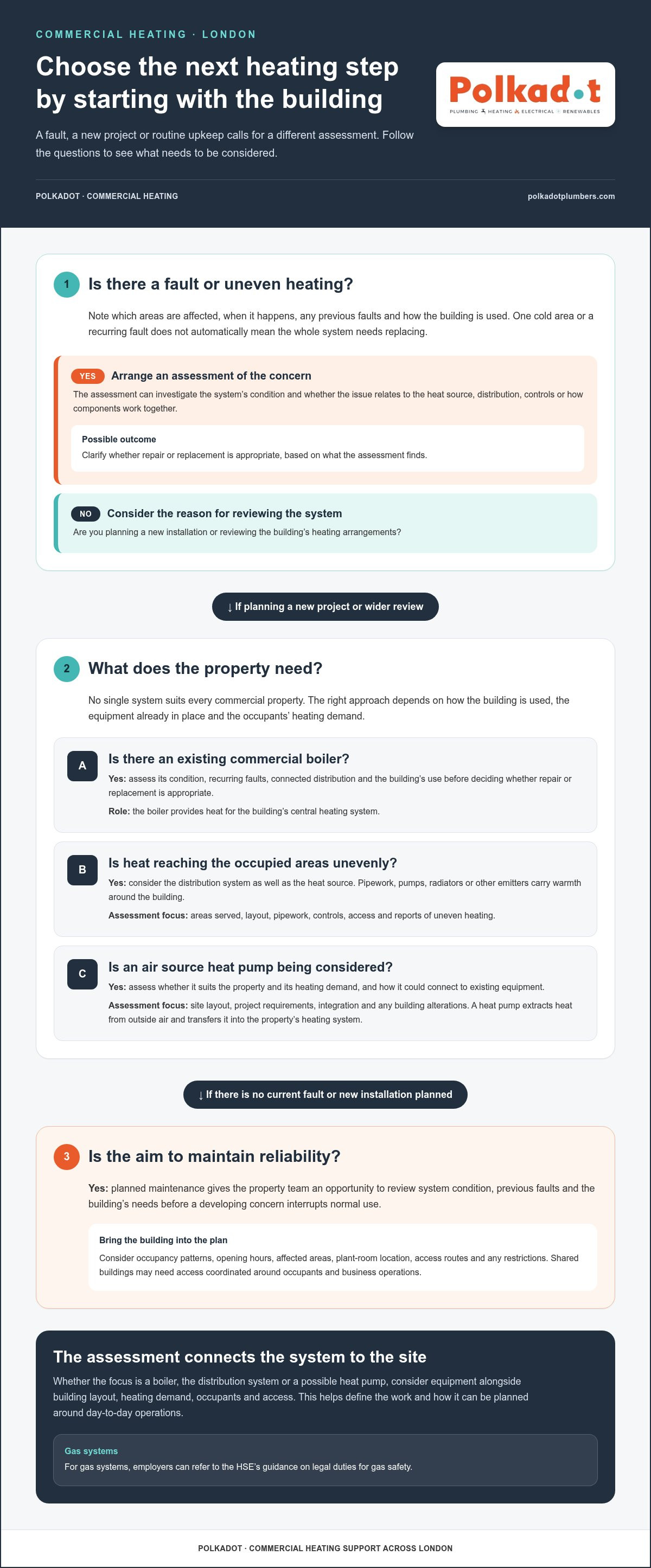
A commercial heating project should start with the property, not an assumed fix. A commercial heating engineer London businesses engage needs to understand the reported issue, the system’s condition and how the building operates before setting out the work. This helps distinguish a repair or maintenance requirement from a larger installation project and gives the property team a clearer basis for planning.
What happens during an initial heating assessment?
The assessment begins with the concern you’ve reported, such as a recurring fault, inconsistent warmth or a planned system upgrade. The engineer considers the equipment type and condition, how the building is used, which areas are affected and how the relevant plant or system components can be accessed. Any safety or compliance considerations should reflect current UK requirements and the system involved.
From there, the project can follow a clear sequence:
1. Understand the issue. Share symptoms, affected areas, previous faults and relevant service records.
2. Assess the system and site. Review the equipment, its condition, building use and access arrangements.
3. Define the proposed work. Use the findings to explain whether repair, maintenance or installation is appropriate, and outline the intended scope.
4. Agree practical arrangements. Confirm working areas, access and coordination with the property contact before work proceeds.
5. Complete the agreed work. Carry out the planned task and communicate any relevant findings.
How are installation, repair or maintenance works planned?
The scope should reflect the assessment, rather than applying the same solution to every property. Planning also needs to account for occupied areas, equipment access and the building’s routine. The property contact should understand the proposed work and which areas may be affected. If you’re considering a new boiler, read this guide to boiler installation in London.
For a commercial heating requirement in London, discuss your heating project with Polkadot. A clear account of the issue, system and site arrangements helps establish a practical next step.
Commercial Heating Engineer London: How Polkadot Supports Your Property
Polkadot provides commercial heating installation, repairs and maintenance across London. Whether you’re addressing a fault, reviewing an existing system or planning new heating, the work starts with the property’s needs. Building use, system condition and access help shape a relevant scope for the site, rather than a one-size-fits-all approach.
For a business seeking a commercial heating engineer London can rely on, the work needs to address the technical issue while recognising how staff, tenants or customers use the building. Clear communication about the concern and affected areas helps make the next steps easier to understand and plan.
A joined-up approach to London property systems
Heating can be connected to other property needs. Plumbing may be relevant where a wider building issue overlaps with heating work, while air conditioning can form part of a broader plan for indoor climate systems. An air source heat pump may also be considered as a heating option, depending on the property and project requirements.
Polkadot’s wider property services include plumbing, air conditioning and renewable energy systems. This makes it possible to discuss related needs as part of the property plan, without assuming every building needs multiple services or a fixed package. The scope is shaped around the building, its existing systems and the work required.
Discuss your commercial heating requirements with Polkadot
To make an initial conversation useful, describe the property type and heating issue or project you’re considering. Mention the affected areas, opening hours, access arrangements and preferred timing. These details provide practical context for discussing the building and next steps, whether you need a repair, maintenance or installation.
Polkadot can discuss commercial heating requirements for your London property. Discuss commercial heating support in London.
Plan a More Reliable Heating Approach for Your Property
Dependable commercial heating starts with understanding the building, its system, how it’s used and what an assessment finds. This helps clarify whether repair, maintenance or installation is the appropriate next step, while allowing the work to be planned around occupants and access.
If you’re looking for a commercial heating engineer London businesses can work with, Polkadot provides commercial heating installation, repairs and maintenance across London. Its wider property services include air conditioning and air source heat pump installation, which may be relevant when considering connected building needs.
Share your heating concern, property requirements and preferred project timing with Polkadot to discuss a practical next step. Discuss your commercial heating requirements with Polkadot.
Frequently Asked Questions
What does a commercial heating engineer do?
A commercial heating engineer assesses, installs, repairs and maintains heating systems in business properties. The work considers how the system serves the building, its occupants and daily operations, rather than focusing only on a household’s needs. A commercial heating engineer London businesses engage may work across offices, shops, hospitality sites and managed buildings. Polkadot provides commercial heating installation, repairs and maintenance across London.
Can a commercial heating engineer work on boilers and plant rooms?
Yes, commercial heating work can involve boilers and the equipment and distribution systems housed in or connected to a plant room. The assessment considers the heat source’s condition, how it connects to the wider system and how the space can be accessed. This helps identify whether the reported problem relates to the boiler, connected equipment or heating distribution, and informs the proposed work.
How often should commercial heating systems be maintained?
There isn’t one maintenance interval that suits every commercial heating system. The appropriate schedule depends on the system, its condition, how the building is used and any relevant manufacturer or current safety guidance. Keep records of inspections, repairs and recurring faults to help inform maintenance planning. A heating assessment can help clarify which checks are appropriate for the equipment and property, rather than relying on a generic timetable.
What happens during a commercial heating assessment?
A commercial heating assessment starts with the issue or project requirement, then considers the system type, its condition, affected areas, building use and site access. Previous faults or service records can provide useful context. The findings guide whether repair, maintenance or installation is appropriate and help define the proposed scope. Any safety or compliance considerations should reflect the system and current UK requirements.
Can commercial heating work be planned around business hours?
Work can be planned with the property’s operating routine in mind. Discuss opening hours, occupancy, access to plant rooms and which areas may be affected before work begins. For example, a shared building may need clear access arrangements and communication with occupants. Agreeing practical details in advance helps shape a plan around the premises, although arrangements depend on the work required and site conditions.
When should a business repair or replace its heating system?
Arrange an assessment if faults recur, heating is uneven or the system is no longer meeting the building’s needs. Replacement isn’t automatically necessary whenever a fault occurs. The system’s condition, the cause of the problem and the property’s requirements help determine whether repair, maintenance or a wider replacement project is more suitable. A clear assessment gives the business a basis for understanding the options before agreeing work.
Can an air source heat pump be used in a commercial building?
An air source heat pump may suit a commercial property, but suitability depends on the building and the project’s technical requirements. An assessment should consider heating demand, existing equipment, how the heat source could integrate with the system and whether building alterations are needed. Treat a heat pump as a project option to evaluate against the property, rather than assuming the same solution will work for every site.


Comments