
Consumer Unit Upgrade in London: Costs and Safety
The cost of a consumer unit upgrade in London depends on the number of circuits, the type of protective devices and the condition of the existing wiring. Replacing a consumer unit is notifiable under Part P of the Building Regulations in England and Wales. Modern units use circuit breakers and residual current devices (RCDs); an RCD can detect a fault and disconnect the circuit in as little as 30 milliseconds.
It’s understandable to want a clear price before work starts, especially if an older fuse box is causing concern. The final cost can change if testing reveals wiring that needs attention or the unit needs to be moved. A quote should therefore reflect the installation, not just the replacement board.
This guide explains what affects the cost, how circuit breakers, RCDs and RCBOs protect a home, and what compliance involves. You’ll also learn what an upgrade typically includes and how to understand the next steps, so you can make a considered decision without unnecessary worry.
Table of Contents
Circuit breakers and residual current devices
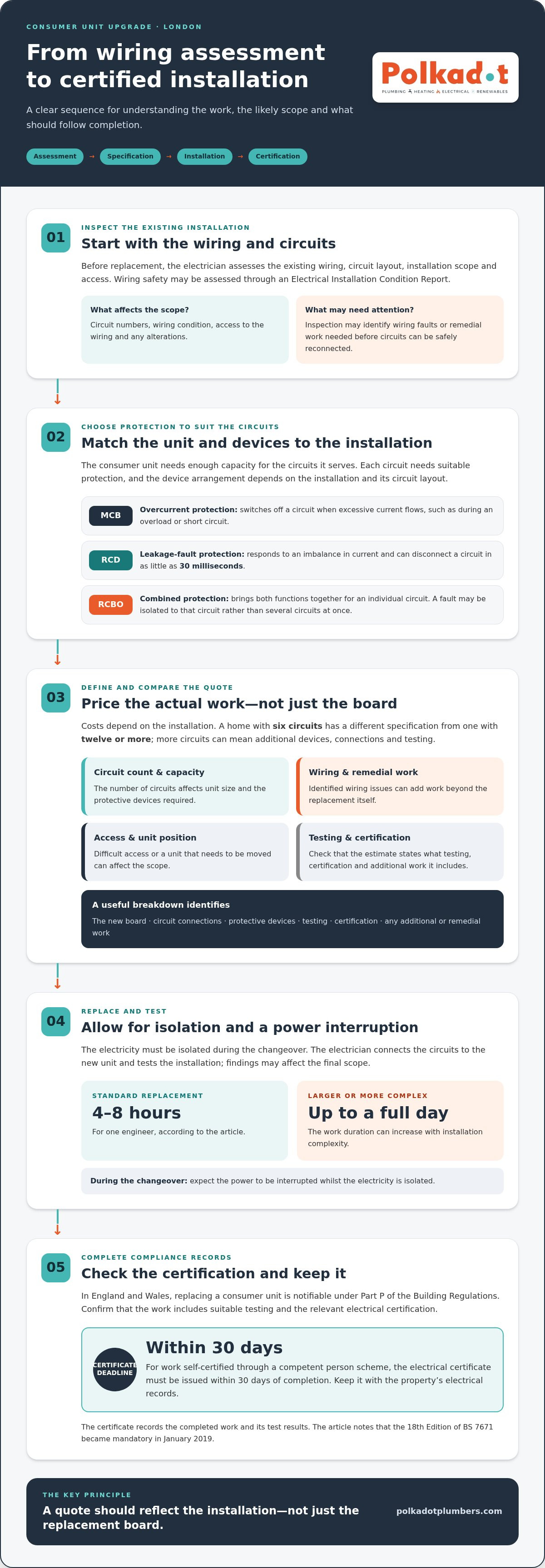
Modern consumer units use circuit breakers and residual current devices (RCDs) instead of traditional fuse wire. A miniature circuit breaker (MCB) switches off a circuit when excessive current flows, such as during an overload or short circuit. An RCD responds to an imbalance in electrical current, which can indicate current leaking from a circuit. It can disconnect the circuit in as little as 30 milliseconds.
These devices serve different purposes. An MCB limits damage caused by overcurrent, while an RCD provides protection against certain electrical faults. An RCBO combines both functions for an individual circuit. For example, if a kitchen circuit develops a fault, an RCBO may isolate that circuit rather than several circuits at once. The right arrangement depends on the installation and its circuit layout.
How does circuit count affect cost? Each circuit needs suitable protection, and the new unit must have enough ways for the circuits it serves. A small flat with fewer circuits may need a simpler setup than a detached home with extra lighting, sockets or electric cooking circuits. More circuits can mean additional protective devices, connections and testing during installation.
Property type alone doesn’t determine the work. A terraced home, semi-detached house or flat can have different circuit numbers and wiring conditions, even if their floor areas are similar. The existing board’s capacity, access to the wiring and any alterations also affect the scope. A cost estimate should reflect the actual installation, not just the property type.
Before choosing a replacement, the electrician assesses the circuits and identifies the protection each requires. They then match the consumer unit’s capacity and device arrangement to the installation. Ask for the proposed device types and circuit coverage to be itemised, so you can see what the upgrade includes and how a fault may affect power around your home.
Consumer unit replacement and UK legal requirements
In England and Wales, replacing a consumer unit is notifiable under Part P of the Building Regulations. The work also involves assessing the existing wiring, installation scope and likely disruption.
Reasons to replace an outdated fuse box
Older fuse boxes may use wire fuses and lack modern electrical protection. Frequent circuit trips, flickering lights, power cuts, a burning smell or no RCD protection are warning signs that need attention. Replacement isn’t always a legal requirement, but these symptoms warrant an electrical assessment. Before installation, an electrician should assess the wiring’s safety, including through an Electrical Installation Condition Report.
Fuse box replacement versus consumer unit upgrade
Replacing a fuse box means removing the old board and fitting a modern consumer unit. An upgrade may also involve changing protective devices or adapting the installation to suit its circuits. The terms are often used for the same job, but the scope can differ. A standard replacement takes four to eight hours for one engineer; a larger or more complex installation can take up to a full day. The electricity must be isolated during the changeover, so expect a power interruption while the work is carried out.
Borough price and requirement differences
Part P applies to consumer unit replacement work across England and Wales, rather than setting separate rules for individual London boroughs. Requirements don’t change simply because a property is in one borough rather than another. Prices can’t be judged by borough name alone: circuit numbers, access, wiring condition and installation complexity shape the work. Compare the proposed scope, including testing and certification, to understand what each estimate covers.
Factors affecting replacement cost
The number of circuits affects the unit size and the protective devices required. A home with six circuits has a different specification from one with twelve or more. Costs can also rise if inspection identifies wiring that needs remedial work or if the consumer unit must be moved. Ask for a breakdown covering the new board, circuit connections, testing, certification and any additional work, so each charge is clear.
Electrician qualifications and compliance
London electrician labour rates depend on the work involved, access to the consumer unit and the time needed for testing. A quote should explain these factors and the work included. For this service, the price depends on the case and is provided after a quote request; circuit numbers, wiring condition and access affect the cost.
Ask how the electrician will assess the installation before replacing the board. The existing wiring needs to be examined, and the circuits tested as part of the work. The electrician should explain any faults found and distinguish necessary remedial work from the replacement itself. This helps you understand why the proposed scope may change after inspection.
Check that the proposed work includes suitable testing and the relevant electrical certification. For work self-certified through a competent person scheme, the electrical certificate must be issued within 30 days of completion. Keep the certificate with the property’s electrical records. It provides a record of the completed work and its test results.
Ask for an installation plan that identifies the circuits, protective devices and any additional work. For example, the electrician may find that a circuit needs remedial attention before it can be safely reconnected. A clear breakdown shows what the original work covers and what an identified fault adds.
Standards matter too. The 18th Edition of BS 7671 became mandatory in January 2019. Ask how the electrician will test the completed installation against the applicable requirements, then make sure you receive the resulting paperwork. For a London job, compare quotes by their stated scope, testing, certification and treatment of remedial work, rather than labour alone.
Consumer unit and protective device costs
The final cost reflects more than the consumer unit itself. A quote can include the board, protective devices, installation labour, testing and certification. The price depends on the case and is provided after a quote request; circuit count, device selection, wiring condition and access affect the scope.
Compare like with like. A populated 10-way board with miniature circuit breakers (MCBs) has a different device arrangement from a 10-way board with residual current breaker with overcurrent protection devices (RCBOs). An RCBO combines overcurrent and residual-current protection for an individual circuit. The number of circuits and the selected protection determine how many devices the board needs.
Board designs also affect the specification. A dual RCD consumer unit divides circuits between two RCDs, while a high-integrity arrangement can use different protective devices across circuits. Ask which design is proposed and why it suits the installation. A supply-only board price, where quoted, doesn’t represent the full cost of fitting, connecting and testing it.
Check whether the estimate separates the consumer unit from labour and additional work. For example, remedial work on a circuit can add to the scope after inspection. Moving the board also involves more than replacing it in its existing position. Ask for each task to be described, including circuit connections, testing and certification.
For a useful comparison, match the number of ways, device type and included work across estimates. A 6-way board and a 10-way RCBO board aren’t equivalent specifications. Confirm whether the quote covers all existing circuits and identifies any exclusions. This makes the proposed installation clearer than comparing a single headline figure.
For a quote based on your circuits and required protective devices, request a consumer unit installation quote.
Polkadot: Air Conditioning
Polkadot provides Electrical Installations for homeowners planning electrical work, including consumer unit replacements. Consider this service when an older fuse box, changes to household circuits or an upcoming refurbishment make it sensible to review the property’s electrical installation. A clear scope should account for the existing circuits, required protective devices, testing and certification, so you understand the work before it begins.
If you’re also planning Air Conditioning, Heating or Refurbishment, raise those requirements alongside the electrical work. Coordinating planned work can clarify how the installation fits into the wider project, while keeping separate requirements and costs distinct. For a consumer unit upgrade in London, describe your property and the issue you need resolved when you contact Polkadot to discuss your electrical installation.
Plan your next electrical step
Use the assessment findings to decide how the electrical work fits into your property plans. If you’re arranging a refurbishment or updating heating or air conditioning, consider the order of work before other trades begin. Coordinating the project can help you plan access and treat related property improvements as part of a coherent plan.
Polkadot offers Electrical Installations, alongside Air Conditioning, Refurbishment and Heating. If a consumer unit upgrade in London is your next project, describe the property, the existing board and any electrical concerns when you get in touch. This gives the conversation a clear starting point and helps shape it around the work you need.
Take the next step at a pace that suits your plans. Contact Polkadot about your upgrade and discuss the electrical work you’re considering.
Frequently Asked Questions
What is a consumer unit upgrade and when is it needed in the UK?
A consumer unit upgrade replaces an older fuse box or updates its protective arrangement to suit the installation. It may be appropriate where the board lacks RCD protection, circuits trip frequently, lights flicker or the fuse box smells of burning. Replacement isn’t automatically required by law simply because a board is old. The condition of the equipment and wiring informs the decision.
How much does a consumer unit replacement cost in London in 2026?
For a consumer unit upgrade in London, the price depends on the case and is provided after a quote request. The proposed board, number of circuits, protective device choice, wiring condition and access all affect the work involved. A useful estimate should describe the installation scope, testing and certification, and identify any additional remedial work separately, rather than relying on a headline figure alone.
What affects the cost of upgrading a consumer unit in London?
The main cost drivers are the number of circuits, the consumer unit’s capacity and the protective devices selected. For example, a home adding an electric vehicle charger may need its circuit included in the design. Wiring faults, restricted access or relocating the board can also add work. Ask the electrician to itemise the board, circuit work, testing and remedial tasks, so the estimate shows what shapes the total.
What UK wiring regulations apply to consumer unit upgrades?
Consumer unit work must follow the applicable wiring standard, BS 7671. Its 18th Edition became mandatory in January 2019. Part P of the Building Regulations also applies to replacement work in England and Wales. In practice, the electrician assesses the installation, completes and tests the work, then provides the relevant electrical certification. Keep that documentation with the property records for future maintenance or sale.
Does a consumer unit upgrade require an EICR or building regulations notification?
Before installation, an electrician must carry out an Electrical Installation Condition Report (EICR) to check the wiring’s safety. Consumer unit replacement is notifiable under Part P in England and Wales. An electrician using a competent person scheme can self-certify the work; the electrical certificate must be issued within 30 days of completion. Keep the EICR and completion certificate together as records of the inspection and work.
What safety features should a modern consumer unit have, including RCDs, RCBOs and surge protection?
RCDs detect certain current leakage faults, while an RCBO combines RCD and circuit-breaker functions for an individual circuit. Surge protection addresses a different concern by limiting the effects of transient voltage surges on the installation. The suitable arrangement depends on the property’s circuits and electrical risks. Ask the electrician to explain which devices are included, what each protects against and how a fault could affect other circuits.



Comments