
Electric Car Charger Guide for London Homeowners
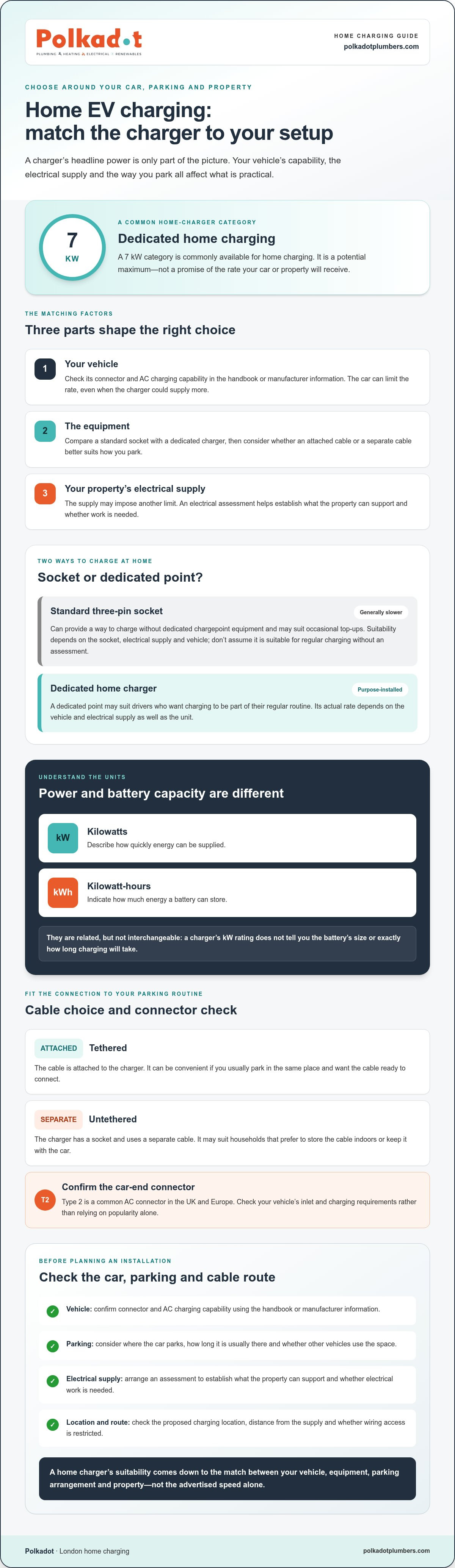
What if the best electric car charger for home isn’t the fastest one, but the one that fits your car, parking space and daily routine? Choosing a charger means weighing up connector types, charging speeds and your property’s electrical capacity.
At a London home, a driveway, shared parking space or older electrical system can affect what’s practical. These details help shape the installation plan, alongside your vehicle and how you expect to charge.
This guide explains the main home charging options and what to consider before choosing. You’ll learn how your car’s connector and charging capability affect your choice, what to think about when parking or wiring could pose a challenge, and what professional installation in London involves. We’ll also cover charging alongside solar panels and battery storage. Polkadot installs car-charging equipment for London homes, with each project planned around the property.
Table of Contents
Why choose an electric car charger for home use?
For drivers with a suitable parking space, a home charging point can make charging part of the time the car is already parked, rather than requiring every recharge to be planned around a public chargepoint.
A home charger is equipment installed at your property to charge an electric vehicle where you park. Public charging remains useful for journeys, top-ups away from home and households without a practical home charging location. The right choice depends on your vehicle, parking arrangement, property and routine, not just the charger’s advertised speed.
How does home charging fit into everyday driving?
Start by considering when your car is parked and for how long. If you return home on a weekday evening and leave the car on your drive overnight, you can connect it while it’s parked and unplug it before leaving the next morning. The charge added depends on the vehicle and equipment, so this routine doesn’t guarantee a particular result.
Regular at-home charging can make it easier to top up as part of your routine, rather than waiting until the battery is low. If you drive infrequently, lack a regular parking space or only recharge occasionally, public chargepoints may still be important. An electric vehicle charging overview explains how charging methods and equipment differ. Your own parking and driving habits are the best starting point for deciding what’s practical.
Is a dedicated charger different from a standard socket?
Yes. A standard three-pin socket can be used for charging in some circumstances, but it generally charges more slowly than dedicated home equipment. It may suit occasional top-ups, while drivers who want charging to be part of their regular routine may prefer a dedicated point. Consider how much charge you typically need between journeys and how long the car is parked.
Charging speed depends on more than the charger. The vehicle’s charging capability, electrical supply and equipment all play a part. A higher-rated charger won’t necessarily deliver its maximum power to every car or property. Check your vehicle’s charging information, then compare its capability with your usual parking time.
Don’t assume every socket or electrical setup is suitable for repeated vehicle charging. An electrical assessment can establish what the property can support and whether electrical work is needed. This is particularly relevant if the parking space is far from the supply or access to wiring is restricted.
Home charging can reduce reliance on public chargepoints when your parking and electrical setup make it practical. Start with your routine and vehicle, then assess the property before choosing equipment. Polkadot installs car chargers in London, with each installation planned around the home and proposed charging location.
Which home charger type, speed and connector should you consider?
Choosing an electric car charger for home means matching three things: your car’s charging capability, the equipment and your property’s electrical supply. A charger’s headline power rating is only part of the picture. The vehicle or electrical supply can limit the rate of charge.
How do charger power and vehicle capability affect charging?
Power is measured in kilowatts (kW), which describes how quickly energy can be supplied. Battery capacity is measured in kilowatt-hours (kWh), indicating how much energy the battery can store. They’re related but not interchangeable: a charger’s kW rating doesn’t tell you the size of your car’s battery or exactly how long it will take to charge.
For AC charging, the vehicle’s onboard charger also matters. If it can accept less power than the home equipment could supply, the car’s capability limits the rate. The electrical supply may impose another limit, so a higher-rated unit won’t necessarily charge every vehicle or home faster.
Check your vehicle’s AC charging capability in its handbook or manufacturer information. Treat the charger rating as a potential maximum, not a guaranteed charging rate. A property assessment helps establish what the supply and installation can support.
Should you choose a tethered or untethered charger?
A tethered charger has a cable attached; an untethered charger has a socket and uses a separate cable. A tethered model can be convenient if you usually park in the same place and want the cable ready to connect. An untethered model may suit households that prefer to store the cable indoors or keep it with the car. Neither option is right for everyone.
Consider where the car parks, how you’ll manage the cable and whether other vehicles use the space. Check the connector at the car end, too. Type 2 is a common AC connector in the UK and Europe, but confirm your vehicle’s inlet and charging requirements rather than relying on its popularity alone.
Once you’ve shortlisted the power category and cable arrangement, the installation route still needs to suit your home. Explore Polkadot’s London car-charging installation service to plan an installation around your property.
Which charger features matter for your home and routine?
Start with the tasks you want charging to fit around, rather than treating every advertised feature as essential. Choosing an electric car charger for home involves both equipment and installation decisions. Cable arrangement, controls and solar integration affect how you’ll use it; cable routes and electrical capacity depend on the property.
Which charger features make a difference day to day?
Consider cable handling first. An attached cable can be convenient if you park in a consistent position and want to connect without fetching a separate lead. A socketed charger lets you use and store your own cable, which may suit you if you prefer to keep it in the car or want less cable visible at the parking space.
Next, think about controls. Scheduling may be useful if you want charging to follow a regular timetable, while app-based controls may suit you if you prefer managing charging from your phone. If you’re unlikely to use these functions, prioritise straightforward operation. Compare the functions in the equipment documentation rather than assuming every smart charger works in the same way.
Keep the equipment shortlist separate from installation requirements. Charger features don’t determine whether your consumer unit, wiring route or supply can support the proposed installation. These depend on the property and need to be assessed. For example, a charger may suit your routine, but its position could require a longer cable route than expected.
Use this quick needs checklist to rank what matters:
Cable handling: Where will the car park, and where can a cable be stored or reached comfortably?
Household routine: Do you want to set a schedule, or is connecting the car enough?
Shared use: Will other drivers or vehicles use the same parking space or charging point?
Future use: Could your vehicle or parking arrangement change, and would your preferred setup still suit it?
Could a home charger work alongside solar panels?
Solar panels generate electricity for household use, while an electric vehicle adds another demand on the supply. If the car is parked at home while solar generation is available, charging may be one way to use that electricity. Generation varies, however, and household appliances also use electricity, so the amount available for the car can change through the day.
Whether charging can respond to solar generation, and how it behaves, depends on the installed panels, charger, any battery storage and their controls. Don’t assume that adding a charger automatically creates a coordinated system or a particular financial benefit. The equipment and installation need to be considered together. Polkadot installs solar panels and battery storage as well as car chargers, so the home’s wider energy setup can be part of the planning. For background on domestic solar, see the Solar Panels London homeowner’s guide.
Once you’ve ranked your preferred features, assess how they fit the property. This keeps the decision grounded in your everyday needs and the electrical work the installation may involve.
What should London homeowners check before installing a home EV charger?
Before arranging an installation, work through four practical questions. This readiness check connects your preferred charger with the realities of your car, parking space and property. It’s especially useful in London, where a parking bay may be shared, access may be restricted or the cable route may be longer than expected.
Vehicle: Check the charging connector and the vehicle’s requirements in its handbook or manufacturer information. These help define which equipment is suitable.
Parking: Identify where the car will usually be parked and whether you have permission to use that space. Consider the charger position, cable reach and a clear, safe route between the unit and vehicle.
Electrical supply: Note where the consumer unit is and whether you know of any existing electrical limitations or recent upgrades. An assessment can establish what the property can support.
Installation route: Consider how wiring might reach the proposed charger location. Restricted access, shared areas or a longer route may affect the work involved.
How do parking and property type affect the installation?
A house with a dedicated driveway often gives the homeowner more control over the parking position and charger location. In a flat, the space may be allocated or shared, the vehicle may be parked some distance from the home, and cabling may need to pass through communal areas. The key question is whether the car can reach the charger without obstructing access or creating a trip hazard.
If you rent or own a leasehold flat, permissions may matter. Check the relevant arrangements with your landlord, freeholder or managing agent before work is planned, particularly if the proposal involves shared infrastructure or communal areas. In a building with several homes, electrical and access arrangements may need consideration beyond one individual parking bay.
Planning rules, electrical requirements and government grant schemes can change, and local circumstances may affect what applies. Check current UK guidance and relevant local planning guidance before making decisions based on a rule, grant or permitted installation route. Advice for a house with a private drive may not apply to a flat or a home with a different parking arrangement.
What happens during a professional site assessment?
A site assessment considers the existing electrical supply, proposed charger position and practical route for the installation. It helps establish how the charging point relates to the parking space, where cabling may need to run and whether the current electrical system needs work. Requirements depend on the property, so an older home or complex access route may call for a different plan from a straightforward driveway installation.
Polkadot installs home chargers in London, with each plan tailored to the property and charging location. Arrange a London home-charging installation with Polkadot.
How can Polkadot help with a London home charger installation?
Once you’ve narrowed down the charger type and considered your parking, plan the installation around your home. Polkadot installs car chargers in London as part of its electrical and renewable-energy work. The installation plan connects your requirements with the property, rather than assuming one setup suits every home.
An electric car charger for home use needs to work with both the vehicle and the property. The electrical setup, proposed charging position and route between them all influence the installation. A straightforward route to a driveway may differ from a flat with allocated parking, restricted access or shared areas.
What should homeowners expect from the installation journey?
The process starts with your requirements: the vehicle, preferred charger arrangement, parking location and how you expect to charge. The property is then considered in context, including its electrical supply and the practical route to the proposed charging point. This helps shape the work around the home and its existing conditions.
Keep useful details to hand, such as the vehicle’s charging information, where it will normally park and any known restrictions on access or wiring routes. If you live in a flat or rented property, note any permissions or building arrangements already in place. Clear information helps the installation plan reflect the actual conditions.
The proposed equipment and installation work can then be considered together. If the existing electrical system needs attention, the work will depend on the property. The plan should reflect what’s found at the home, rather than assume a standard installation or fixed duration.
When should you discuss solar or battery storage too?
Mention any solar panels or battery storage already at the property, as well as renewable-energy equipment you’re planning to add. These systems may affect how you want to use electricity for vehicle charging, but coordination depends on the design and compatibility of the installed equipment. Discussing the wider setup early keeps the charging project in context.
Polkadot also installs solar panels and battery storage, alongside car chargers and electrical installations. This broader view brings the home’s electrical arrangements and charging location into the planning conversation, without assuming every combination of equipment will work in the same way.
To take the next step, talk to Polkadot about home EV charging in London. Share your vehicle, parking setup and any relevant property or renewable-energy details so the installation can be planned around your home.
Turn your charger shortlist into a home plan
Turn the options you’ve considered into a plan that reflects how you use your car and home. Note your vehicle details, preferred parking position and any property constraints, then use these to guide the installation discussion. This gives the project a clear starting point, whether you’re planning a straightforward setup or need to account for more complex electrical arrangements.
Polkadot installs car chargers across London, planning the work around your property’s electrical setup. If you’re also considering solar panels or battery storage, these renewable-energy systems can be part of the wider conversation, with suitability depending on the equipment and system design. A well-planned electric car charger for home should suit the way you live, not just look right on a specification sheet.
Arrange your London home EV charger installation with Polkadot and take the next step towards a charging plan tailored to your property. Start with a clear, practical conversation about your home.
Frequently Asked Questions
Can I install an electric car charger if I live in a London flat?
It may be possible, but the parking arrangement and building permissions matter. A space allocated to your flat may be easier to plan around than shared parking where cables could cross a communal route. Check your lease or tenancy arrangements and whether the freeholder or managing agent needs to approve the proposal. A property assessment can clarify the electrical and layout considerations before installation is planned.
Do I need planning permission for a home EV charger in London?
It depends on the property, its location and the proposed installation, so check current planning guidance for your borough and circumstances before work begins. A typical house may have different considerations from a flat, listed building or property in a conservation area. Planning and electrical requirements are separate matters, and meeting one doesn’t automatically settle the other. If your home is in a managed building, include its approval process in your planning.
Will a home charger work with any electric car?
No, compatibility depends on the car’s charging inlet and the charger’s connector. Type 2 is common for AC charging in the UK, but check the vehicle handbook and equipment specification to confirm they match. If you’re considering a used or imported car, confirm its exact charging requirements rather than relying on assumptions about the make. The car’s onboard charging capability and the property’s electrical supply also affect the charging rate.
How long does it take to install a home electric car charger?
Installation duration varies between London homes. The work can depend on the proposed charger position, access to the parking space, cable route and condition of the existing electrical installation. A driveway close to the supply may present different requirements from a flat with a distant allocated bay. Sharing details about the parking location and property layout helps establish the work involved and support practical planning.
How much does it cost to install an electric car charger at home?
The cost depends on the equipment and work needed at the individual property, so a headline figure shouldn’t be treated as a quote for your home. A longer cable route, access constraints or electrical changes can affect the project scope. When comparing estimates, check that they account for both the selected charger and property-specific installation work. London flats and shared parking may also require additional coordination.
Can I charge my electric car using solar panels at home?
Yes, solar generation can contribute electricity to vehicle charging, but the amount available changes with sunlight and household demand. Panels may generate more electricity during the day, while the car could be parked elsewhere. How charging works alongside the system depends on the installed equipment and its configuration. If you have panels or are planning them, include that in the design discussion rather than assuming every charger automatically prioritises solar electricity.
Can I use a standard plug socket to charge my electric car?
Some vehicles can be charged from a domestic socket with suitable charging equipment, but this differs from using a dedicated home chargepoint. Check the car and equipment instructions, and consider whether the socket and electrical arrangement are appropriate for how regularly you plan to charge. Occasional use may suit a different setup from relying on a socket as your routine solution. An electrical assessment can help clarify what’s suitable for your home and charging habits.

Comments