
London Air Conditioning: When to Book and What to Expect
If your air conditioner is cooling poorly, making an unusual noise or leaking, you may be wondering whether it needs a routine air conditioning service or a repair. These symptoms can be worrying, particularly when you’re unsure what a visit involves or whether work will disrupt your home or business. They are useful clues, but they do not identify the cause on their own. An assessment can help establish whether the system needs maintenance, fault-finding or another next step.
This guide explains when to arrange professional help in London and what to expect during a service visit, from checks on filters and airflow to an assessment of how the system is operating. You’ll learn how routine servicing differs from repair work, which signs need prompt attention and how to prepare for a visit. Whether you have air conditioning at home or in a commercial property, a clear record of the symptoms can help make the assessment more focused.
Table of Contents
When does an air conditioning system need a service in London?
Weak cooling on a warm afternoon, an unfamiliar rattle, a persistent musty smell or water beneath an indoor unit can all prompt the same question: should you arrange a visit or wait to see whether the problem passes? Uneven airflow and rooms that feel less comfortable than usual are also worth noting, particularly when the change continues rather than happening once.
These signs can have several explanations. A blocked filter, drainage issue, control setting or mechanical problem may produce similar symptoms, so it is not sensible to diagnose a fault from one clue alone. Note what has changed and when. A professional air conditioning service can assess the system and help establish an appropriate next step. For general background, see Air conditioning systems and maintenance.
Which air conditioning symptoms should you pay attention to?
Look for changes from the system’s usual behaviour. Cooling that gradually weakens, uneven airflow, repeated starting and stopping, or an odour that remains while the unit is running may warrant an assessment. Water indoors could relate to condensate drainage or another issue, but its presence alone does not confirm the cause.
A brief sound at start-up may be different from a new, persistent buzzing, rattling or grinding noise. Make a note of when it happens and whether cooling or airflow changes at the same time. This gives the technician useful information without requiring you to guess at a repair.
Cooling has faded over time: Arrange an assessment, especially if the room no longer reaches its usual comfort level.
Airflow is weak or uneven: Note which rooms or outlets are affected and whether the pattern changes.
Noise or odour persists: Record what you notice, when it occurs and whether the system’s operation changes too.
Water appears indoors: Move nearby belongings if it is safe to do so, and arrange professional advice rather than assuming the source.
The unit repeatedly cycles: Note how often it starts and stops, then request an assessment if the pattern continues.
When should you stop using the system?
Comfort or performance concerns, such as a gradual loss of cooling, usually call for a planned assessment. Burning smells, smoke, exposed wiring or visible damage are different. Switch the unit off if you can do so safely, keep people away from the affected area and arrange professional attention. If there is smoke or immediate danger, prioritise people’s safety and contact the appropriate emergency service.
Do not open electrical panels or refrigerant components, or investigate wiring yourself. If water is near electrical equipment, avoid touching the unit or wet surfaces around it. A warning sign needs attention, but it does not prove a particular fault. Describe what you have noticed and leave diagnosis to a professional.
What does a professional air conditioning service include?
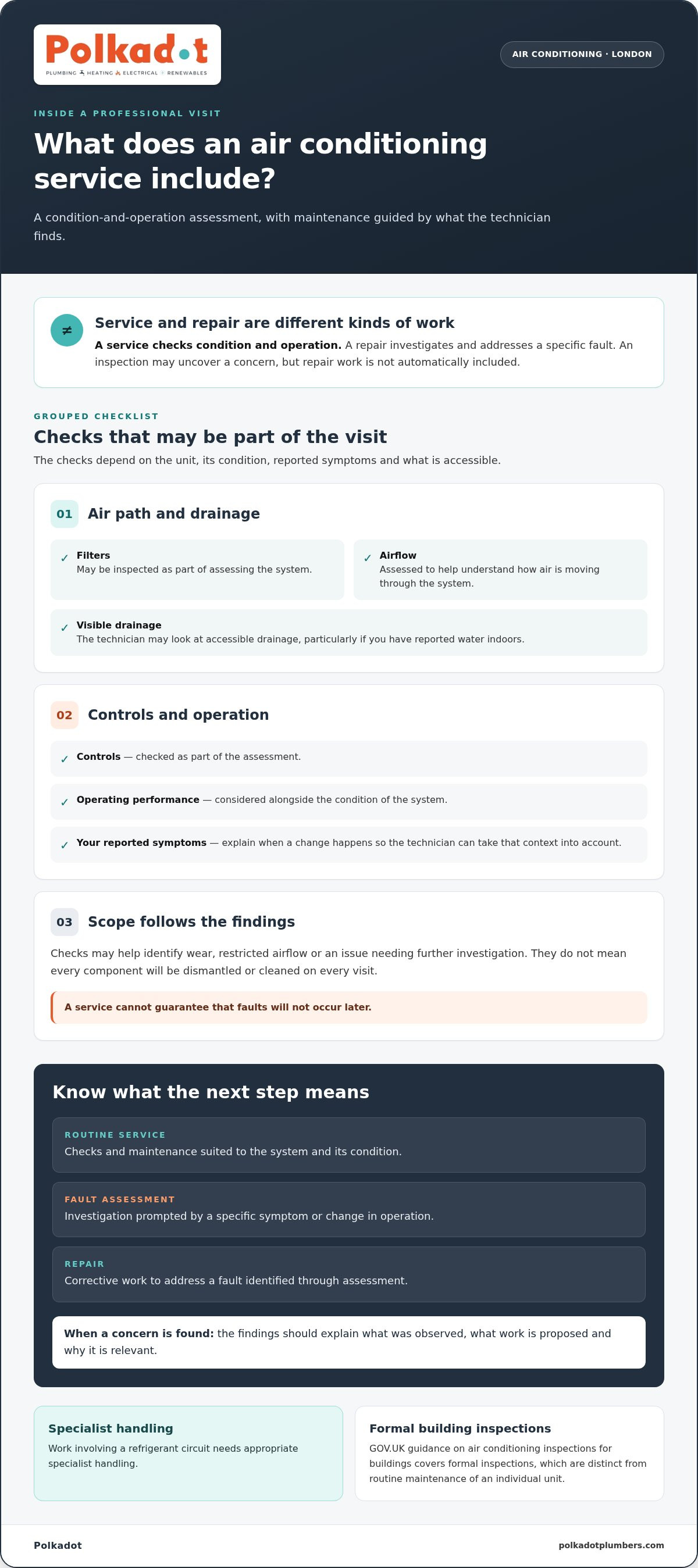
A professional service assesses the system’s condition and operation, with maintenance guided by what the technician finds. The checks may help identify wear, restricted airflow or an issue that needs further investigation. They cannot guarantee that faults will not occur later. The work depends on the system type, its condition and any symptoms you have reported.
A service checks condition and operation; a repair investigates and addresses a specific fault. This distinction helps explain why an inspection may lead to a recommendation for additional work. A service visit does not automatically include repair work.
What checks may be made during an air conditioning service?
Depending on the unit and what is accessible, a technician may inspect filters, assess airflow, look at visible drainage and check the controls and operating performance. These checks help build a picture of how the system is running. They do not mean that every component will be dismantled or cleaned during every visit. If you have noticed a change, explain when it happens so the assessment can take that context into account.
Work involving a refrigerant circuit needs appropriate specialist handling. The GOV.UK guidance on air conditioning inspections for buildings covers formal inspections, which are distinct from routine maintenance of an individual unit.
How is servicing different from air conditioning repair?
Servicing is planned care. A technician assesses the system and carries out maintenance suited to its condition and the agreed scope. Repair work focuses on a particular fault, which may need further diagnosis before the right corrective work is clear. A service visit can uncover a concern, but that does not automatically mean a repair is needed. The findings should explain whether maintenance is sufficient or further work is recommended.
Routine service: Checks and maintenance suited to the system and its condition.
Fault assessment: Investigation prompted by a specific symptom or change in operation.
Repair: Corrective work to address a fault identified through assessment.
If an issue is found, ask for a clear explanation of what was observed, what work is proposed and why it is relevant. This gives you a basis for understanding the next step before deciding how to proceed. It also helps distinguish fault-finding from routine care.
Polkadot provides air conditioning maintenance for homes and businesses across London. For a planned visit, explore air conditioning maintenance in London and describe any symptoms you have noticed so the system can be assessed in context.
Air conditioning service or repair: which does your system need?
Is the system still running, but no longer performing as it used to? A gradual change may be a reason to arrange routine servicing, while a unit that stops unexpectedly or develops a new fault may need diagnostic attention. These are useful starting points, not a diagnosis. Similar symptoms can have different causes, and an assessment is needed to establish what work is appropriate.
Before arranging a visit, check simple user settings such as the selected mode and temperature, and consult the manufacturer’s guidance for basic checks you can carry out safely. If the problem continues, avoid repeatedly restarting the unit or opening its casing. Share what you have checked and what changed, as this can help focus the assessment.
When is routine servicing the sensible next step?
If your system still operates but has reduced airflow, uneven comfort or is due for routine attention, an air conditioning service may be a sensible starting point. The right interval depends on factors such as how often the system is used, its condition and the manufacturer’s guidance. There is no single schedule that suits every property. For practical upkeep, see air conditioning maintenance tips for London homes.
Servicing is planned care, not a guarantee against future breakdowns or lower energy bills. If checks indicate a separate concern, the technician can explain what was observed and why further diagnosis may be recommended.
When may an air conditioning repair be needed?
A unit that will not start, repeatedly stops or develops a sudden change in operation may need a repair assessment. Professional diagnosis helps identify the cause before corrective work is decided. A symptom alone cannot establish which component, if any, is at fault. Note when the issue occurs and any changes you have noticed. This gives the technician useful context without requiring you to investigate the equipment yourself.
In short, gradual decline can point towards planned maintenance, while a sudden or persistent failure calls for fault-finding. An assessment determines the appropriate next step without assuming that servicing or repair is automatically required.
How to prepare for an air conditioning service visit
A little preparation can make an assessment more focused, especially if the system serves several rooms or the problem comes and goes. You do not need to identify the fault or take equipment apart. Note what you have noticed, identify the affected units, share useful system information and make access straightforward.
What information should you have ready?
Write down when the issue occurs and how the system’s behaviour has changed. For example, note whether airflow weakens after the unit has been running for a while, or whether only one room feels different. If there is more than one indoor unit, identify the rooms or zones affected. These details give the technician a clearer description than a general comment such as “it isn’t working properly”.
Record the symptoms: Describe what you have observed, when it happens and whether it is becoming more frequent or changing.
Identify the equipment: Note which indoor unit or units are involved, and where the associated outdoor equipment is located if you know.
Share system details: If the make or model is readily visible, write it down. Do not remove covers or dismantle equipment to find it.
Gather relevant history: Mention any displayed error message and have previous service or repair information available if you already have it.
Keep the information practical. A brief note on your phone is enough. You do not need to interpret an error message or work out what caused the symptom. If a problem is intermittent, describing the circumstances in which it appears can be more useful than trying to recreate it.
How can you make access straightforward?
Clear a sensible route to the indoor units and any outdoor equipment that can be reached safely. Move furniture, stored items or other obstacles where practical, but do not climb, move heavy equipment or attempt to access unsafe areas. Clear access helps the technician see the relevant parts of the system and carry out an assessment without avoidable obstacles.
If you rent your home or occupy a commercial property, arrange appropriate access to the rooms and equipment beforehand. In a building with multiple units, label the affected rooms or zones clearly, especially if the controls or indoor units look similar. This helps identify which parts of the system are showing symptoms.
Preparing for maintenance is different from preparing for a new system. An air conditioning installation in London involves fitting equipment, while a service visit assesses an existing system and its condition.
Ready to arrange professional help? Arrange air conditioning service with Polkadot in London for your home or business.
Book professional air conditioning service with Polkadot in London
Not sure whether your system needs routine attention or a closer look at a fault? Polkadot provides professional air conditioning installation and maintenance for homes and businesses across London. Sharing what you have noticed gives the assessment a useful starting point. The system’s condition then informs the appropriate next step.
Air conditioning support for London homes and businesses
At home, the concern may be comfort in a bedroom, living space or home office, or a system that no longer seems to cool as it used to. In a commercial property, comfortable indoor temperatures may matter across several rooms or occupied zones. The equipment, how it is used and the layout of the property all affect what an assessment needs to consider.
Polkadot’s maintenance work is for existing systems, while installation is relevant when a new system or a broader change to the existing setup is being considered. A professional assessment can help clarify whether the issue is limited to maintenance or points towards a different requirement. The aim is to understand the system and property, rather than assume that the same work is right for every site.
What happens after you describe the issue?
Your description gives the assessment a starting point. Mention whether the change developed gradually or appeared suddenly, which rooms or units are affected, and whether you have noticed anything else about the system’s operation. For a business, identifying the affected areas can help distinguish a local concern from one involving several parts of the space.
The system’s condition and the assessment findings guide the recommendation. That may mean maintenance, further investigation or discussion of another appropriate step. No single symptom establishes the cause, and describing a problem does not commit you to a particular repair. You should be able to understand what has been observed and why a next step is being suggested.
If the assessment indicates that the existing system or its arrangement needs a broader change, installation may be relevant. That is separate from routine maintenance, and the property’s requirements help shape what is appropriate.
For professional air conditioning service in London, contact Polkadot to discuss your system, the symptoms and the assessment required. Arrange air conditioning service in London.
Take the next step towards dependable comfort
You do not need to know exactly what is wrong before arranging help. A clear description of what you have noticed gives a professional a useful starting point, and an assessment can turn uncertainty into a practical way forward. If a change persists, arranging an assessment helps you make an informed decision about the system’s condition and next steps.
Polkadot provides air conditioning installation and maintenance for homes and businesses across London. Whether you are considering planned servicing or need an existing system assessed, the appropriate next step depends on the equipment and the assessment findings.
Arrange air conditioning service in London with Polkadot for your home or business.
Frequently Asked Questions
Is annual air conditioning servicing necessary?
Not every system has the same service interval, so check the manufacturer’s instructions for your model. How often it runs and its condition can also inform the maintenance schedule. For example, a unit used regularly in a busy room may need different attention from one used occasionally. If you cannot find the manual, note the make and model and share it when arranging professional advice.
Can an air conditioning service improve poor cooling?
It may help if reduced cooling relates to an issue that routine maintenance can address, but this cannot be determined without assessing the system. Check that the controls are set to cooling and that doors or windows are not affecting the room temperature. If performance remains poor, a professional can establish whether maintenance is appropriate or a separate fault needs investigation.
How much does an air conditioning service cost in London?
The cost depends on the system and the work required, so a general figure may not reflect your property or the equipment’s condition. Factors can include how many units need attention, access and whether the assessment identifies a need for additional work. Describe your system and its symptoms when arranging a service so the scope can be understood before work proceeds.
Can air conditioning be serviced in a rented flat?
An existing system in a rented flat can be assessed, but let your landlord or managing agent know before arranging access or work. They may need to approve the visit, particularly if outdoor equipment is in a shared area or access involves communal spaces. As a tenant, avoid removing covers or attempting maintenance beyond the user-level care described in the system’s instructions.
What should I do if my air conditioner is leaking water indoors?
Switch the unit off if water is close to electrical equipment, and do not touch wet switches, wiring or the appliance. Move belongings away from the affected area if it is safe, and note where and when the water appears. Do not assume the cause or try to open the unit. Arrange a professional assessment, especially if the leak continues or returns after the system has been switched off.
Can one air conditioning service cover several units?
A service visit can be planned around multiple units, with the scope depending on the equipment and what needs attention. Before arranging it, list each unit’s location and note any differences in performance, such as one office cooling less effectively than another. In a home with several indoor units, identifying the affected rooms helps distinguish a concern with one unit from a wider pattern across the property.
Can an air conditioning system also provide heating?
Some air conditioning systems can provide heating as well as cooling, but this depends on the model and its capabilities. Check the user manual or controls for a heating mode, and do not assume every system has one. If you are unsure how your installed system is intended to operate, a technician can assess the equipment and explain its function as part of professional maintenance.



Comments