
New Boiler Installation: A Practical Guide for London Homes
What if the right new boiler installation starts with your home’s heating system, not just the boiler itself? In London, a choice that suits one property may not work as well in another, particularly when space, hot-water demand and existing pipework differ.
If your boiler is unreliable, it’s natural to wonder whether a repair will be enough or replacement is the sensible next step. You may also be concerned that a new model won’t suit your home, or that installation will bring unexpected disruption. Considering the whole system helps answer these practical questions before work begins.
This guide explains when replacement may make sense, how combi, system and heat-only boilers differ, and what an installer needs to consider in your existing heating system. You’ll also learn what installation can involve and how to prepare your home. Polkadot provides heating-system installation for domestic and commercial properties across London, with the work planned around the property and its current setup.
Table of Contents
When does a new boiler installation make sense for a London home?
Inconsistent warmth, unreliable hot water or faults that keep returning can make you wonder whether it’s time to replace your boiler. These symptoms deserve attention, but they don’t automatically mean the boiler itself is failing. A thermostat or heating control issue, a radiator problem, low system pressure or a fault in another connected component may cause similar discomfort. The boiler is one part of a larger system, so identifying the cause matters.
A boiler heats water for your home’s heating and, depending on the setup, domestic hot water. For general background on how boilers work and the different types in use, see Boiler (heating). For a replacement decision, the useful question is how your boiler and heating system are working together.
Which signs suggest it is time to consider replacement?
Look for a pattern rather than treating one bad day as proof. Repeated faults, hot water that cuts out, or rooms that remain difficult to heat during normal use can point to a reliability issue. Make a note of when problems happen, which rooms are affected and whether heating or hot water is the main concern. This gives a clearer picture than relying on a vague sense that the boiler is “getting worse”.
Consider the boiler’s condition alongside the household’s needs. A system that once met demand may no longer suit a home after changes such as an extension, altered room use or a larger household. Equally, cold rooms may have causes unrelated to the boiler. Age alone isn’t a verdict: condition, reliability, comfort and the state of connected parts all deserve consideration before deciding on a new boiler installation.
Could a repair solve the problem instead?
It may. A single, clearly identified fault can sometimes be addressed without replacing the boiler. But if breakdowns recur, comfort remains inconsistent or the system no longer meets the household’s needs, it’s sensible to assess the wider picture rather than treat each fault in isolation.
A heating professional can examine the boiler alongside relevant components such as controls, radiators, pipework and circulation. This helps distinguish a boiler fault from an issue elsewhere and clarify whether the work is limited to a repair or involves a broader system change. A property-specific assessment also helps establish the appropriate scope, taking account of the home, current setup and how heating and hot water are used.
Replacement decisions should reflect the boiler’s condition, its reliability and your household’s needs, not age alone. This measured approach helps clarify why a particular option is being considered and what needs attention before work is planned. It also reduces the risk of choosing a replacement before the underlying problem is clear.
Which boiler type and setup could suit your London property?
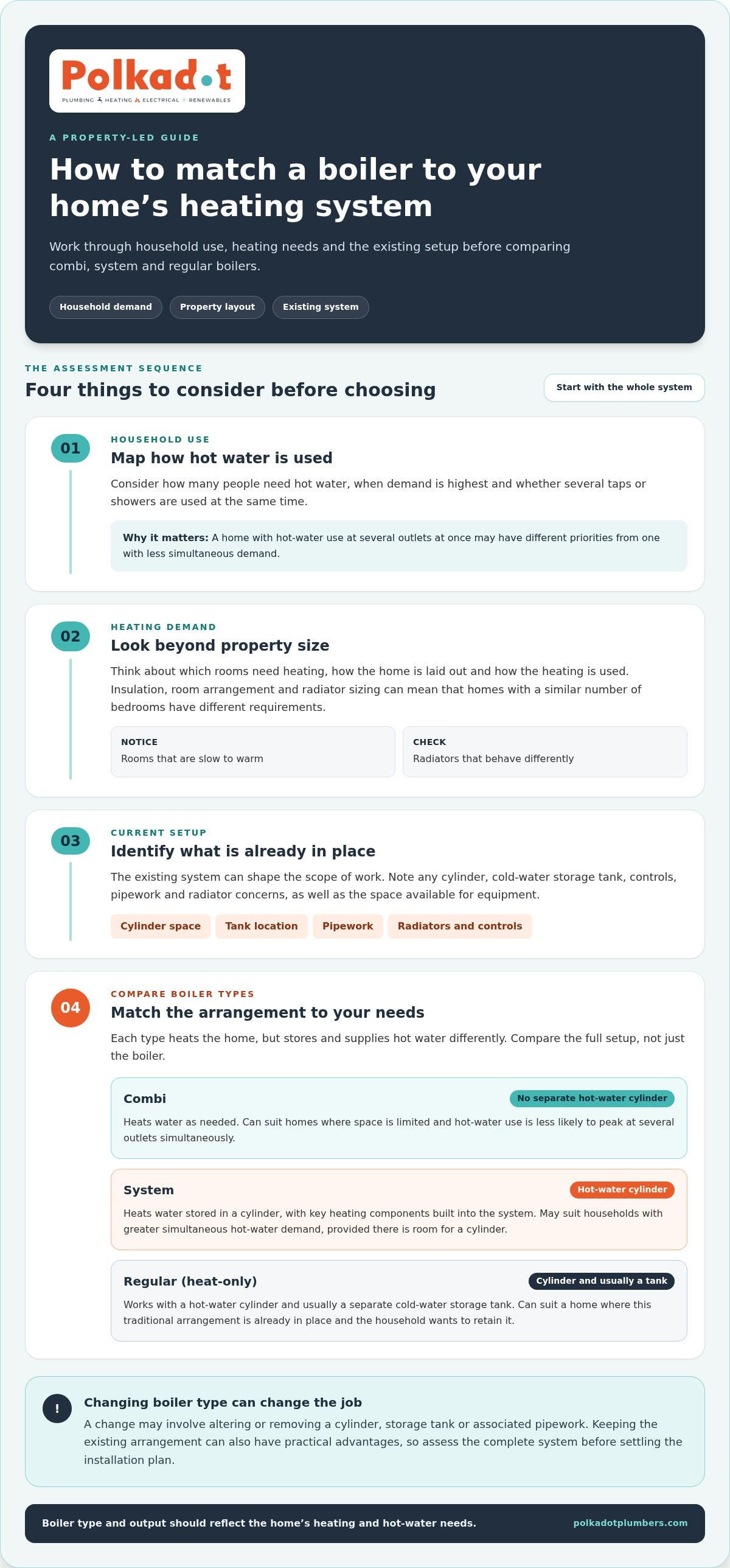
The right choice depends on how your home uses heating and hot water, as well as what’s already fitted. A flat with one bathroom and limited cupboard space may have different priorities from a busy household that often uses several hot-water outlets at once. Property size matters, but it isn’t enough on its own to determine the boiler type or output.
Combi, system or regular boiler: what is the difference?
Each type heats your home, but stores and supplies hot water differently. Use this comparison as a starting point, then consider how each option fits your household routine and current system.
Changing from one type to another may mean altering or removing parts such as a cylinder, storage tank or associated pipework. Keeping the existing arrangement can also have practical advantages, so compare the whole setup rather than treating a boiler as a standalone appliance.
What should be assessed before choosing a replacement?
Start with household use: how many people need hot water, whether outlets are used at the same time, and which rooms need heating. Then consider the property’s heat demand and layout. Two homes with a similar number of bedrooms can have different requirements because of insulation, room arrangement, radiator sizing and how the heating is used.
The existing system matters too. A cylinder takes up space; a storage tank needs a suitable location; and pipework, radiator condition and controls can influence the scope of work. If radiators aren’t heating evenly or controls don’t suit your routine, those details may need consideration alongside the boiler choice. A thorough assessment brings these factors together before the installation plan is settled.
Note when hot-water demand is highest and whether several taps or showers are used together.
Record rooms that are slow to warm or radiators that behave differently.
Identify existing cylinders, tanks and controls, and consider the space available for equipment.
This property-led approach helps match the boiler output and type to actual heating and hot-water demand, rather than choosing by floor area alone. For further context on planning work around a home’s existing setup, see the Boiler Installation London guide. The Chartered Institute of Plumbing & Heating Engineering (CIPHE) is a professional body for the UK plumbing and heating industry.
Polkadot provides heating-system installation for London properties, with the project shaped around the boiler, the existing system and the home. Explore Polkadot’s London heating installation service as you consider the setup that best fits your needs.
How to compare new boiler installation options without focusing on claims alone
A persuasive headline or impressive efficiency label can catch your eye, but neither tells you whether the proposed boiler and work suit your home. Compare the practical details: what’s being installed, why it fits your household, what work is included, and how the project will be explained. A clear proposal should cover the whole job, not just the appliance.
What should a clear installation proposal explain?
Look for a description of the proposed boiler type and its suitability for your household’s heating and hot-water needs. The plan should relate the choice to your current setup, including relevant pipework, cylinders, controls and radiators. If a component is expected to remain in place or needs alteration, the proposal should make that clear.
Scope matters. The written details should distinguish planned work from assumptions and exclusions, such as whether changes to pipework or controls are part of the project. This makes it easier to understand what happens if an issue is found outside the agreed scope. Don’t compare proposals by the boiler model alone; compare the work each one describes and how clearly it sets expectations.
Communication is part of the decision too. You should be able to follow why a particular setup is being suggested and what the next steps involve. Aftercare information should explain what guidance is provided once installation is complete, without relying on broad promises or unclear wording. Polkadot plans heating-system installation around the property and its existing system, so the details reflect the needs of the project.
How do efficiency and controls fit into the decision?
An efficiency rating describes a boiler’s performance under defined test conditions. It can help you compare appliances, but it doesn’t predict exactly how much energy a particular household will use. Actual consumption is also affected by factors such as the home’s heat loss, how long heating runs, the temperature settings and household routines.
A boiler’s efficiency rating describes the appliance, not a guaranteed reduction in your household energy bills. Treat savings claims cautiously unless they explain the assumptions behind them, and don’t mistake an efficient product for a complete solution to wider system issues.
Controls are another part of the setup. A programmer, room thermostat and thermostatic radiator valves each help manage heating in different ways, but their presence and configuration should suit the home and the way it’s used. A new boiler alone may not resolve uneven warmth if, for example, a radiator or circulation issue is contributing to the problem. The proposal should make clear whether such concerns are included in the planned work or remain separate.
Scope: Identify the appliance, associated work, assumptions and exclusions.
Suitability: Check that the recommendation reflects household demand and the existing system.
Clarity: Look for plain explanations of the plan and aftercare information.
For a new boiler installation in London, Polkadot plans heating-system installation around the home and its existing setup. Consider Polkadot’s London heating installation service as a next step once you’ve identified the questions your proposal needs to answer.
What happens during a new boiler installation in a London home?
Knowing the stages in advance can make installation feel more manageable. The work should be planned around the property and agreed scope, rather than treated as a simple appliance swap. Existing pipework, flue position, heating controls and access can all affect what needs to happen, especially if the new setup differs from the one already in place.
How does the installation process usually progress?
The sequence depends on the home and the work agreed, but a typical project moves from assessment and planning through preparation, fitting and commissioning. Before work begins, make sure you understand what is included, which parts of the current system may change and how access will be arranged. If the assessment identifies a need to alter the plan, clarify the revised scope before proceeding.
Assess the home: Review the existing boiler and heating system, including pipework, flue position, controls and relevant components.
Agree the scope: Set out the proposed boiler setup and any planned changes, so you know what work is covered.
Prepare the area: Arrange access and clear the space around the boiler and connected equipment.
Carry out the work: As agreed, remove the existing boiler, fit the replacement and connect it to the relevant services and heating system.
Commission and explain: Check the completed installation, demonstrate normal operation and explain the controls you’ll use.
Commissioning is an important part of the process, not an optional extra to overlook. Before the installer leaves, make sure you know how to use the controls and what to do for normal operation. Raise any questions about settings or the heating system during handover.
How can you prepare your home for installation?
Clear safe access to the boiler, controls and relevant heating components, such as radiators or a hot-water cylinder where these form part of the setup. Move belongings from the immediate work area and keep pets and children away from it. Share useful information about recurring system issues or changes to the property, as these details help explain the existing setup.
Check practical access to the property, including entry systems, stairs or lifts in a block of flats.
Discuss parking and any building access arrangements before the installation begins.
Where shared areas are involved, arrange any permissions or access needed with the relevant building contact.
Keep household questions ready, including how to operate the controls and what parts of the system will be affected.
London homes can present different access conditions, from a narrow entrance in a terraced house to shared corridors or restricted parking near a flat. These details don’t determine the boiler choice, but they can influence how equipment and materials reach the work area. Agree practical arrangements and the full work scope beforehand to reduce avoidable confusion on the day.
Polkadot provides heating-system installation for homes across London, with the work considered in relation to the property and its existing system. Arrange your London boiler installation with the project requirements in mind.
Arrange a new boiler installation with Polkadot in London
Once you’ve considered your household’s heating and hot-water needs, the existing system and the work your property may require, the next step is to discuss the project. Polkadot provides heating-system installation and plumbing services for domestic and commercial properties across London. A new boiler installation should be planned around the home, the chosen boiler and the system it needs to work with, rather than treated as a standard swap for every property.
What can you discuss before arranging the work?
Start with what you’ve noticed. Explain any recurring boiler faults, unreliable hot water or rooms that are difficult to heat, and describe how the household uses heating and hot water day to day. If you know the current boiler type or can identify a hot-water cylinder, storage tank or unusual controls, share that information too. You don’t need to diagnose the problem before discussing it.
It also helps to mention practical details early. For example, note whether the boiler is in a cupboard with limited access, whether the property is a flat with shared entrances, and whether parking or building access needs arranging. These points can affect how the work is planned. Clear information helps shape relevant next steps and makes it easier to discuss the likely scope for your home.
Describe the symptoms and when they tend to occur.
Share what you know about the existing boiler and heating system.
Explain household hot-water needs and any changes to how the property is used.
Raise access, parking or shared-building arrangements before work is planned.
How does Polkadot support London heating projects?
Polkadot’s heating-system installation and plumbing services support property projects across London. The approach takes account of the proposed boiler, existing pipework and system components, and the practical layout of the home. This keeps the discussion focused on the installation as a whole, including relevant preparation or changes to the current setup, rather than the appliance in isolation.
The precise scope depends on the property and the work agreed. A straightforward replacement involves different considerations from a change in boiler type or location, so the details and timing are shaped by the project. Before work begins, make sure you understand what is planned, which parts of the existing system are affected and what arrangements are needed at home.
Polkadot also works across plumbing, electrical installations and renewable energy solutions, bringing a broad property-services perspective to domestic and commercial projects. For your heating installation, the focus is on clear, practical guidance and a plan that reflects the home and its existing system. You can outline your needs and discuss the appropriate next steps directly with the team.
If you’re ready to talk through a new boiler installation in London, Discuss your heating installation with Polkadot.
Take the next step towards a heating plan that fits
A new boiler installation is a chance to make a considered decision about your home’s heating, rather than simply replace one appliance with another. Before moving ahead, think about what you want the system to do better for your household and which details still need clarifying. A clear conversation can turn those priorities into a practical direction for the project.
You don’t need to have every technical answer ready. Start with what matters most to you, such as dependable hot water, easier control of heating or making better use of the available space. Polkadot provides heating installation for domestic and commercial properties across London, with the project shaped around the property and its requirements.
Ready to take the next step? Plan your boiler installation with Polkadot and move towards a setup that fits your home.
Frequently Asked Questions
How long does a new boiler installation take?
The time needed depends on the work involved, so there isn’t one duration that applies to every new boiler installation. Replacing a boiler in the same position may be more straightforward than changing its type, moving it or altering connected parts. The installation plan should set out the expected schedule based on your property and agreed scope. If you live in a flat, building access or shared-area arrangements may also affect planning.
Do I need to replace my radiators when installing a new boiler?
No, replacing the boiler doesn’t automatically mean replacing every radiator. The decision depends on the radiators’ condition and whether they work appropriately with the heating system. For example, a radiator that stays cold or leaks may need attention, whilst one that heats normally may be suitable to retain. Mention known radiator problems during planning so they can be considered alongside the boiler work, rather than discovered as a separate concern later.
Can a new boiler be installed in a flat in London?
Yes, a new boiler can be installed in a London flat if the proposed setup is suitable for the property and its existing services. Flats can have particular considerations, such as limited cupboard space, shared building access or restrictions affecting equipment routes. Leasehold arrangements or building rules may also matter. Gather relevant property information before planning the work, including any requirements from a managing agent or freeholder.
Does a new boiler installation include removing the old boiler?
Removal may form part of the agreed installation work, but don’t assume it is included without seeing the scope. The written proposal should say whether the existing appliance will be disconnected and removed, and how related components that are no longer needed will be handled. If the boiler is in a tight cupboard or difficult-to-reach location, mention this early, as access can affect the practical arrangements for removal.
Will I need new pipework for a new boiler?
Not necessarily. Existing pipework may be suitable to retain, or sections may need altering to connect the new boiler or accommodate a different setup. The decision depends on the pipework’s condition, layout and compatibility with the planned installation. If you’ve noticed leaks, visible corrosion or previous pipework changes, point these out during the assessment. Any proposed pipe alterations should be explained as part of the work scope.
Does a new gas boiler have to be installed by a Gas Safe registered engineer?
Yes. In the UK, gas boiler installation work must be carried out by an engineer who is on the Gas Safe Register and qualified for the relevant gas work. This requirement is separate from choosing a boiler type or agreeing the project scope. Before work begins, you can check an engineer’s registration through the Gas Safe Register and confirm that their qualifications cover the specific work being undertaken.
What should I do before the boiler installer arrives?
Clear belongings from around the boiler and any nearby controls or system components, then make sure the route into the property is accessible. In a London flat, arrange entry instructions, lift access or shared-area permissions where needed, and communicate parking arrangements in advance. Keep any boiler paperwork and notes about faults to hand. Write down questions about controls, hot water or the household’s heating routine so they’re easy to discuss.


Comments